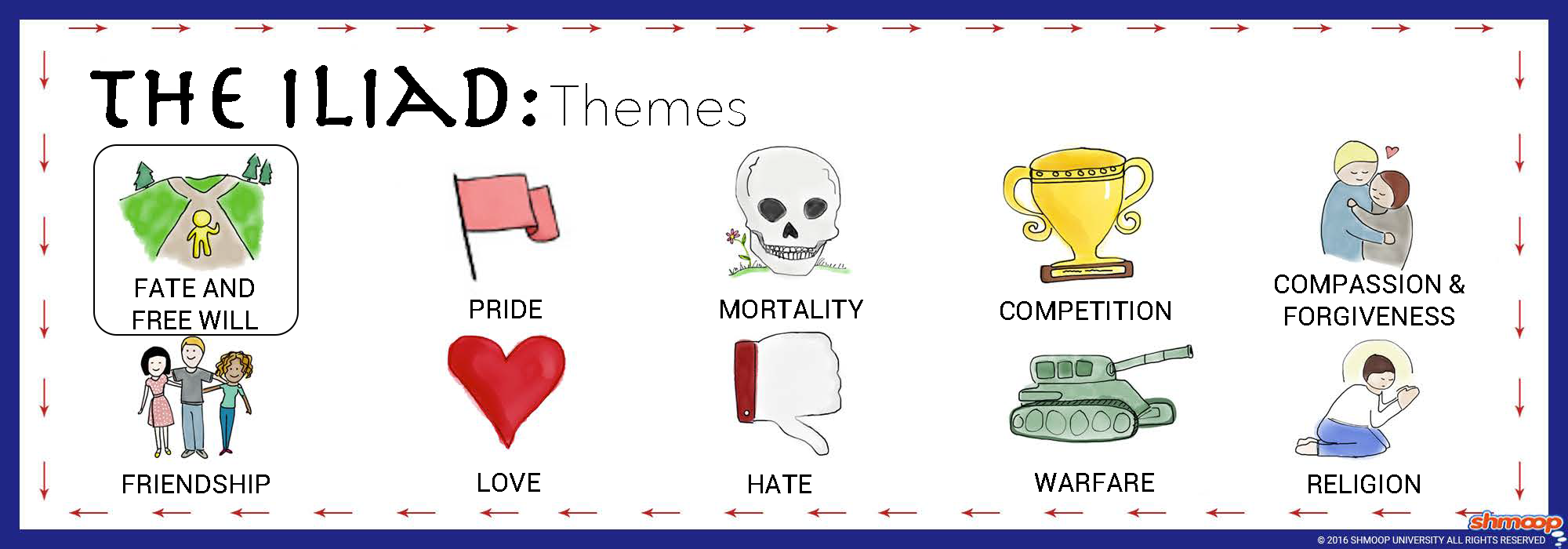
 (Click the themes infographic to download.)
From the very beginning of the Iliad, when the poet asks the Muse to reveal how "the will of Zeus was accomplished," we know that the events we are witnessing have Fate's fingerprints all over them.
Time and again, we are reminded how it is impossible to escape one's fate; to some characters, this thought is comforting. That said, just because everything is fated doesn't mean there isn't any freedom. Achilleus, for example, has a double fate: if he goes home, he will live long without glory. If he stays at Troy, he will have lots of glory, but a short life. So he has a choice.
Also, it is important to recognize that the gods don't control fate; there are times when they consider acting against it. Usually, though, they think it's best to do what fate says... just to make sure things don't get out of hand.

Questions About Fate and Free Will
- Some characters, like Achilleus, know their own fate, while others, like Hektor, do not. Do you think that the Iliad portrays knowing your fate as an advantage?
- Often, characters in the Iliad make decisions because a god gives them the idea (for example, when Achilleus decides not to kill Agamemnon, or when he agrees to give Hektor's body back to Priam). Do you think this means they should get less credit for their decisions?
- The gods are portrayed as acting in accordance with fate even when they don't necessarily have to. Why do you think it is important for the gods to follow fate?
Chew on This
Even though Achilleus is able to choose his life's path, he still does not have complete freedom of will.
Gods and mortals are equally free to disobey fate. The difference is that gods know what it is they're disobeying.