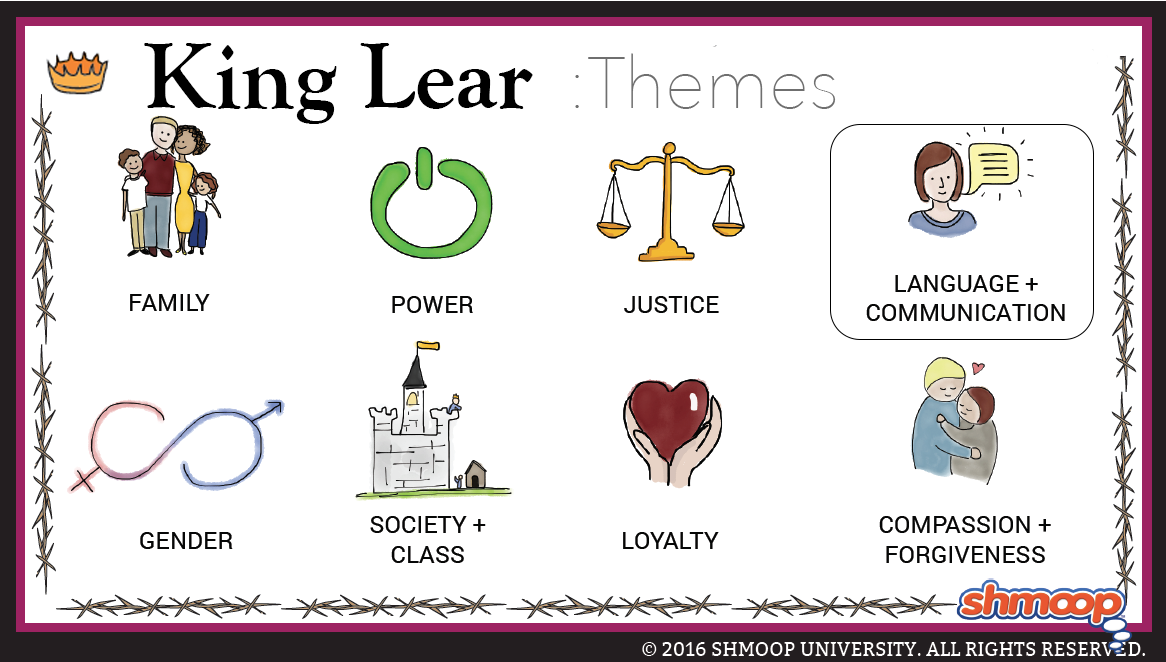
 (Click the themes infographic to download.)
King Lear, being bleakity-bleak-bleak about most things we think are awesome (like love and family), also makes language look pretty depressing. Basically, it's a super-blunt tool that means... nothing.
In King Lear honest speech is cool and all, but language often falls short of being able to accurately express human emotion. King Lear opens with a "love test" staged by the aging monarch to determine which of his three daughters can say she loves him "most." This turns out to be a huge mistake—the daughters who say they love their father more than anything in life end up mistreating him, while the daughter who says her love cannot be expressed with mere words, turns out to be Lear's only loving and loyal daughter.
King Lear, who has spent a lifetime being sweet talked by courtiers and subjects can't tell the difference between the truth and empty flattery. At other times, he simply does not want to hear the truth, as when he banishes the loyal Kent for speaking up about Lear's wicked daughters.
Questions About Language and Communication
- How does Lear determine which daughter loves him "most"?
- What does Cordelia mean when she says she cannot "heave [her] heart into [her] mouth"?
- What are the consequences of Lear's "love test"?
- Do any of Lear's subjects ever speak the truth to the monarch? If so, which ones?
Chew on This
King Lear demonstrates that words are meaningless as proof of love: only actions matter.
After Lear banishes Cordelia and Kent for speaking their minds, Lear's Fool is the only character that tells the king the truth.