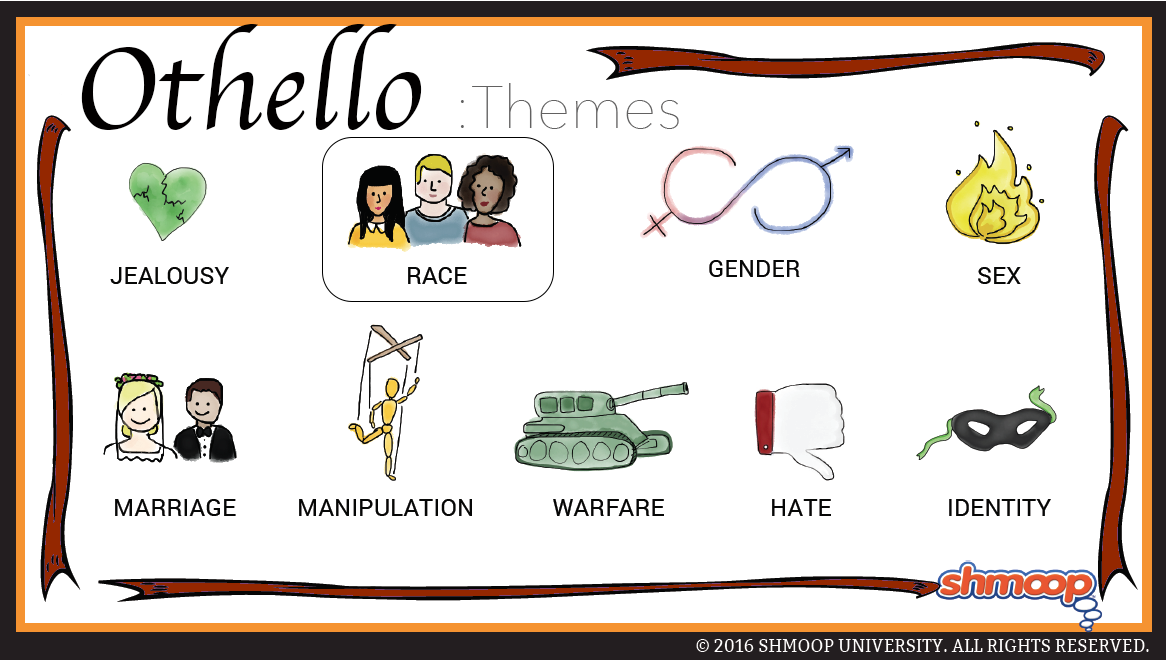
 (Click the themes infographic to download.)
Othello is one of the first black heroes in English literature. A military general, he has risen to a position of power and influence. At the same time, his status as a black-skinned foreigner in Venice marks him as an outsider and exposes him to some pretty overt racism, especially by his wife's father, who believes his daughter's interracial marriage can only be the result of Othello's trickery.
Because the play portrays the uber-racist fear of miscegenation (the mixing of races via marriage and/or sex), it's nearly impossible to talk about race in Othello without also discussing gender and sexuality.
Questions About Race
- Which characters in the play make an issue of Othello's race? What kinds of stereotypes are at work in this play?
- How does Othello's race affect his relationships with his wife and other characters?
- How does Othello's race play a role in the hero's self-identity?
Chew on This
In Othello, Shakespeare creates a hero who is not a racist stereotype. Despite this, Shakespeare ultimately allows Othello to succumb to the subtle racism that surrounds him.
Othello views his own racial identity as undesirable, and it is this lack of confidence in himself that allows Iago to persuade him that Desdemona is cheating on him.