Tools of Characterization
Character Analysis
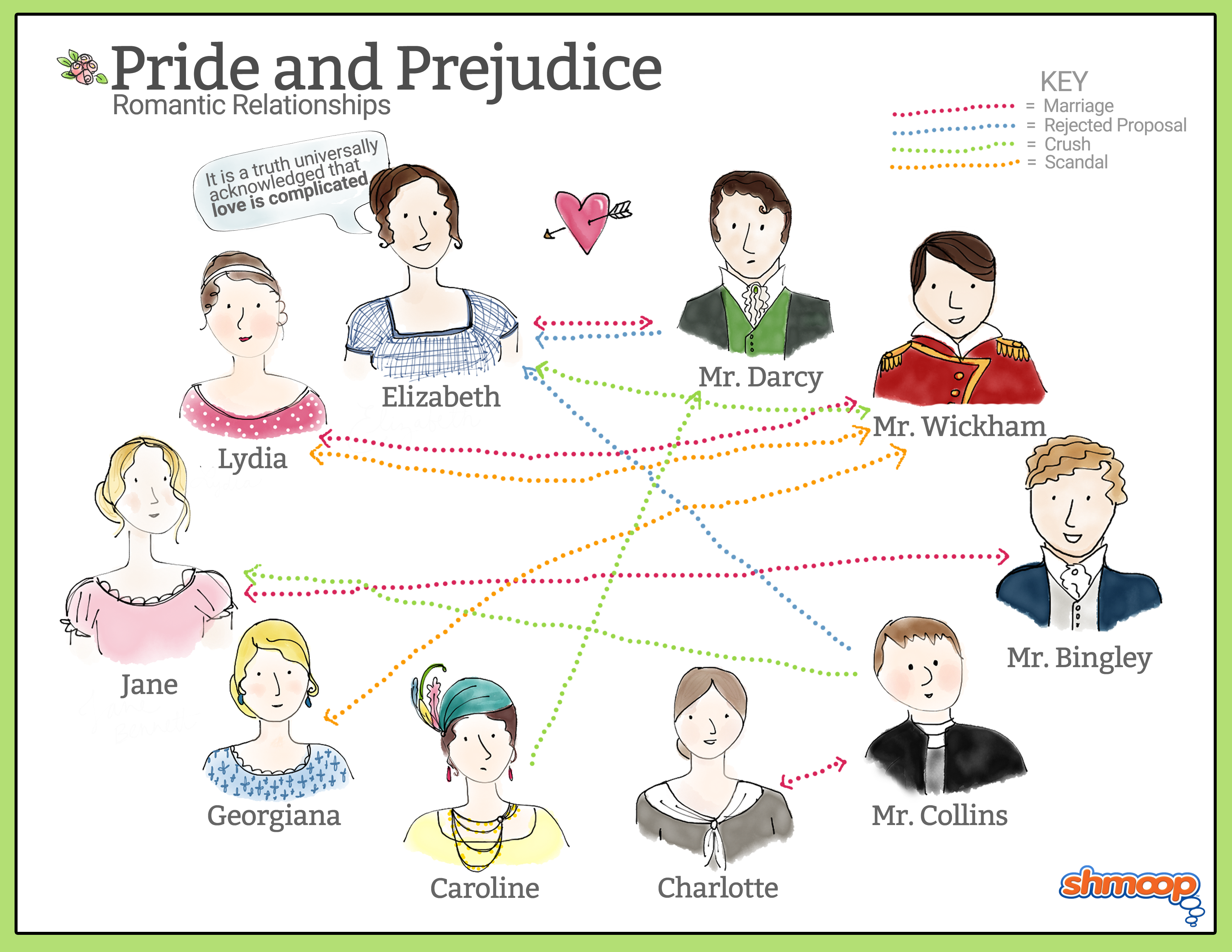 (Click the relationships infographic to download.)
Actions
In a world in which you can't always say what you mean, actions become super important for determining people's character—and characterization. Take Darcy: he stops Bingley from proposing to Jane because he believes it to be a disadvantageous match, but remedies the situation as soon as he learns of Jane's true affection for Bingley. Even better, Darcy hunts down the runaway lovers, forces Wickham to marry Lydia, pays off their debts, and then gives credit for the whole affair to Mr. Gardiner. His actions reveal him to be an honorable, caring man.
Similarly, Wickham's actions show a lot about him. Seducing Lydia with no intention of marrying her? This guy is bad news.
Direct Characterization
We have seventy-five words for you:
Mr. Bennet was so odd a mixture of quick parts, sarcastic humour, reserve, and caprice, that the experience of three-and-twenty years had been insufficient to make his wife understand his character. Her mind was less difficult to develop. She was a woman of mean understanding, little information, and uncertain temper. When she was discontented, she fancied herself nervous. The business of her life was to get her daughters married; its solace was visiting and news. (1.34).
Well, then, there you have it. Austen practically wrote our character analysis for us.
Speech and Dialogue
Okay, it's true that we just totally said that characters are defined through direct description, but plenty of the characterization is done through dialogue. Almost every character in the novel gets to talk first and be summed up by the narrator later. Even the passage we quoted about the Bennets comes at the tail end of a long conversation:
"Oh! Single, my dear, to be sure! A single man of large fortune; four or five thousand a year. What a fine thing for our girls!"
"How so? How can it affect them?"
"My dear Mr. Bennet," replied his wife, "how can you be so tiresome! You must know that I am thinking of his marrying one of them."
"Is that his design in settling here?"
"Design! Nonsense, how can you talk so! But it is very likely that he may fall in love with one of them, and therefore you must visit him as soon as he comes."
"I see no occasion for that. You and the girls may go, or you may send them by themselves, which perhaps will be still better, for as you are as handsome as any of them, Mr. Bingley may like you the best of the party."
"My dear, you flatter me. I certainly have had my share of beauty, but I do not pretend to be anything extraordinary now. When a woman has five grown-up daughters, she ought to give over thinking of her own beauty." (14-20)
From just these few lines of dialogue, we learn that (1) Mrs. Bennet is vain and stupid, and (2) Mr. Bennet likes making fun of her without letting her in on the joke—which pretty much sums up their personalities and their relationship.