Character Analysis
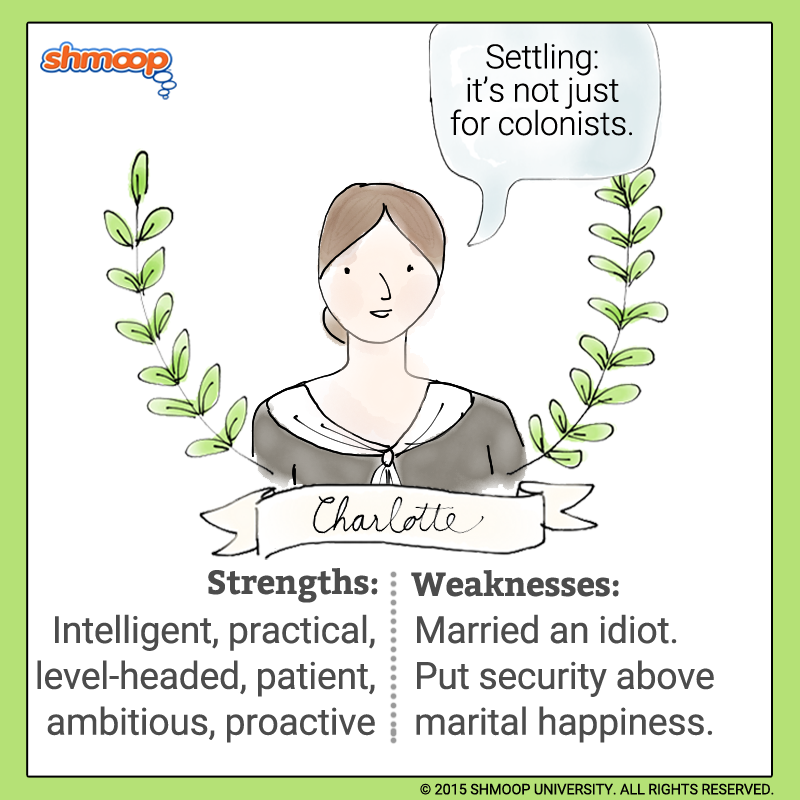
(Click the character infographic to download.)
Charlotte is Elizabeth Bennet's best friend. She's introduced as a "sensible, intelligent young woman, about twenty-seven" (5.2). And right away, we feel sorry for her, because a single woman past 25 who is neither particularly pretty nor particularly rich is on the fast track to spinsterhood.
Mrs. Roboto
On the surface, Charlotte's story looks like a disaster. Her super-practical, almost robotically logical approach to marriage leads her into a match that would make most of us feel pretty happy about being 27 and single. But not Charlotte. She wants to get out of her parents' house, and she's not getting any younger, so she hooks up with the gross Mr. Collins, knowing that he is probably her last chance to be the mistress of her own house: she "accepted him solely from the pure and disinterested desire of an establishment" (22.2).
So, our question is: does this decision make her somewhat more empowered, showing that she takes control of her own life? Or is this just spelling out how limited women's choices were back in the day?
Take My Advice
Charlotte also gives us a counterpoint to Jane's approach to marriage. Where Jane is quiet and shy, Charlotte, on the other hand, has no problem making it clear immediately to Mr. Collins that she's up for it if he is: she sets out specifically to "secure [Lizzy] from any return of Mr. Collins' addresses, by engaging them towards herself" (22.1).
Charlotte gives telling advice on the subject of marriage early on. When gossiping with Elizabeth about just how much of a crush Jane has on Bingley, Charlotte says: "If a woman conceals her affection with the same skill from the object of it, she may lose the opportunity of fixing him; and it will then be but poor consolation to believe the world equally in the dark […] In nine cases out of ten, a woman had better show more affection than she feels" (6.2). Lizzy makes fun of her, but, of course, Charlotte's right.
Shortly after, Charlotte also gets in that famous line, "happiness in marriage is entirely a matter of chance…It is better to know as little as possible of the defects of the person with whom you are to pass your life" (6.8). Elizabeth laughs at her, and says, "You would never act in this way yourself."
As we know, though, that's exactly what Charlotte does. After Elizabeth rejects Mr. Collins, Charlotte accepts him, even knowing that she's only his second choice (third, actually, since Mr. Collins initially had his eye on Jane). How did Charlotte manage to get a marriage proposal out of Mr. Collins the day after he'd been rejected by Elizabeth? We don't really know, because Austen doesn't narrate the proposal scene. Does Charlotte recognize that his business in town is wife-hunting, and deliberately flirting in the way that she suggested that Jane should do with Bingley? Maybe.
Lessons
That's not all! We have even a third idea about what Charlotte's point in the novel is—she is another lesson in empathy for Elizabeth. Check out how horrified Elizabeth first is when Charlotte tells her she's going to marry Mr. Collins. Seriously, she almost throws up a little in her mouth. But Charlotte lays it out for her:
When you have had time to think it over, I hope you will be satisfied with what I have done. I am not romantic, you know; I never was. I ask only a comfortable home; and considering Mr. Collins' character, connection, and situation in life, I am convinced that my chance of happiness with him is as fair as most people can boast on entering the marriage state. (22.17)
And you know what? It seems to be true. She sets things up at her new house so she sees her husband as little as possible, choosing to make her sitting room in the back of the house, "for Mr. Collins would undoubtedly have been much less in his own apartment, had they sat in one equally lively" (50.1)—translation, she deliberately hangs out in room that doesn't face the road, so Mr. Collins will stay in his own room. Whenever Mr. Collins says something embarrassing, Lizzy notices that Charlotte "wisely did not hear" (28.4). It might not be an arrangement that's for Lizzy, but that's the point: Charlotte helps her realize that not everyone has to live the same sort of life.
Charlotte Lucas' Timeline