ShmoopTube
Where Monty Python meets your 10th grade teacher.
Search Thousands of Shmoop Videos
Usage and Mechanics Videos 116 videos


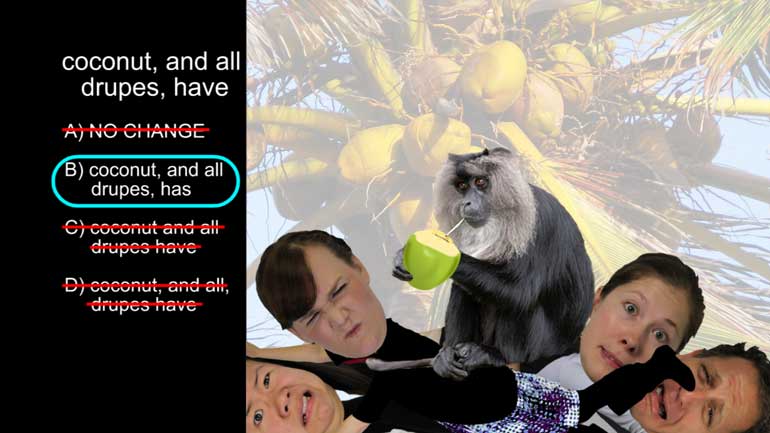














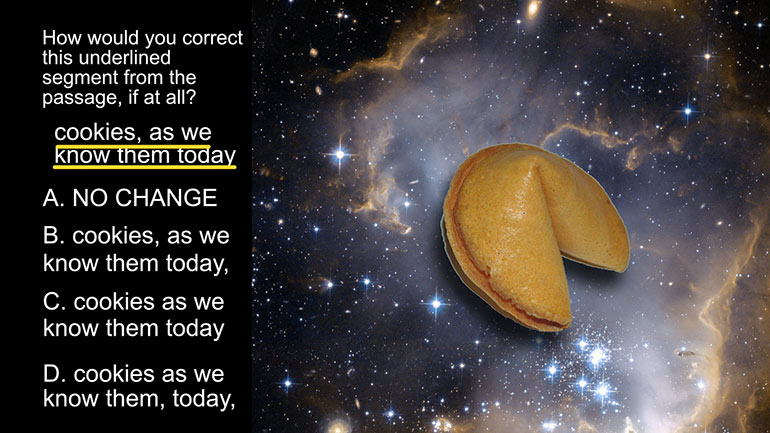

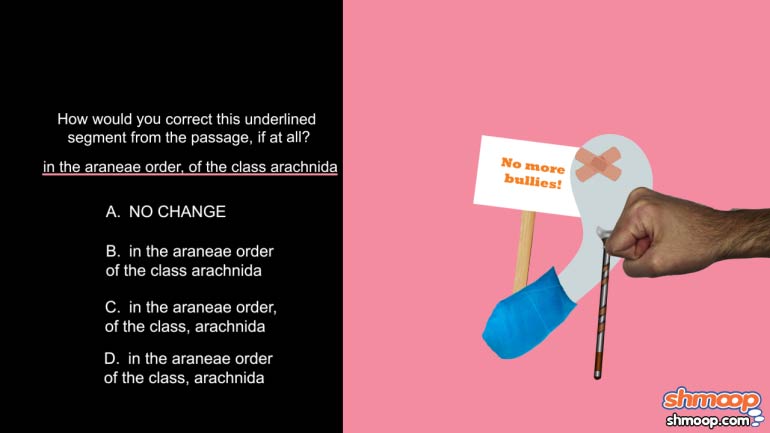
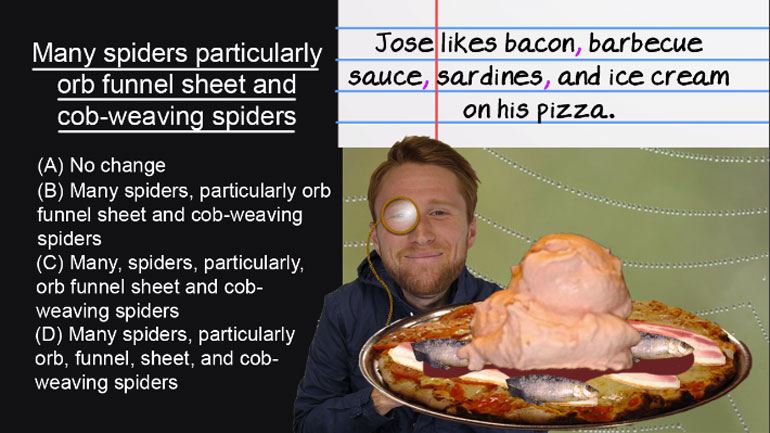

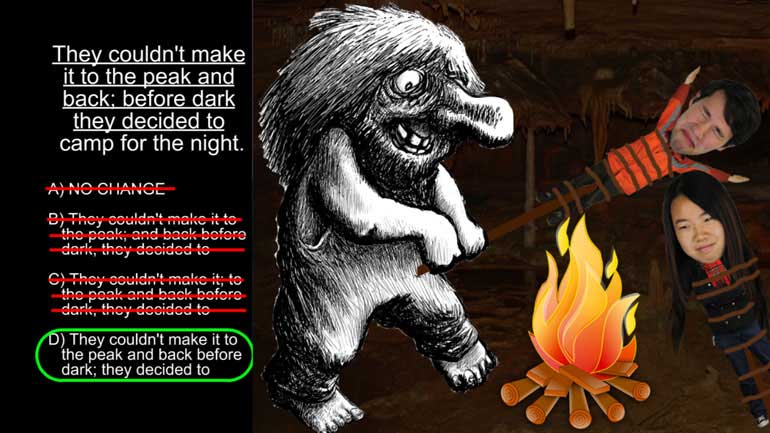






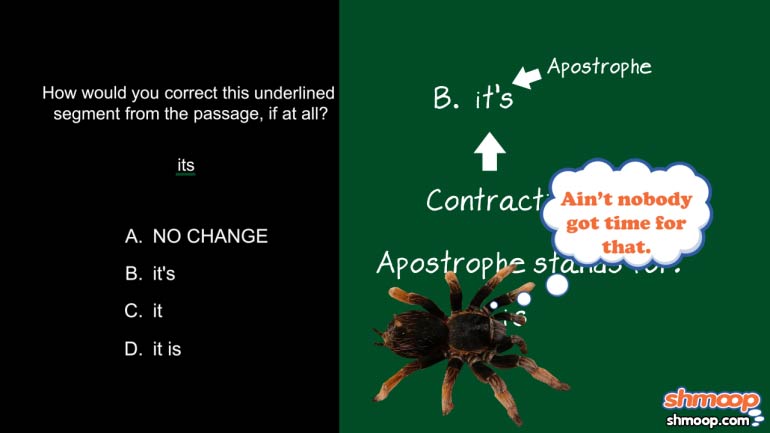





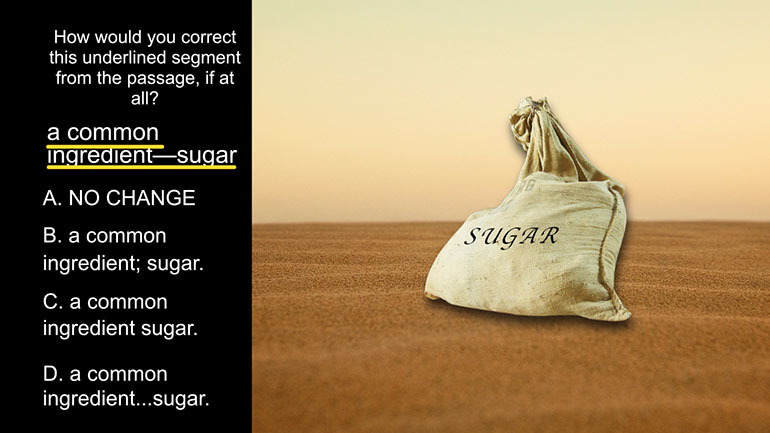
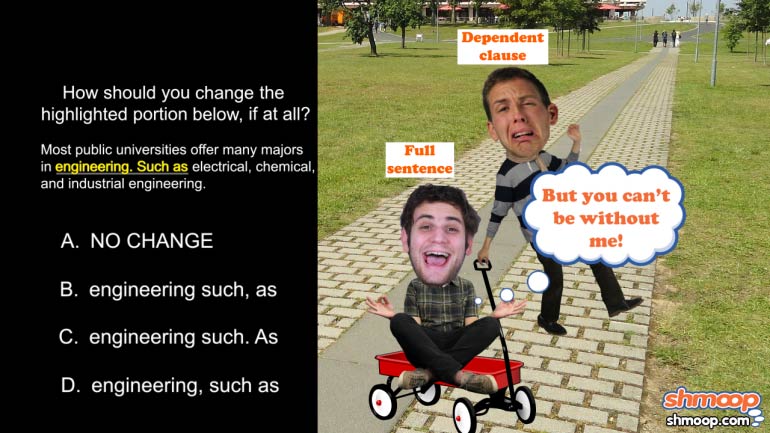
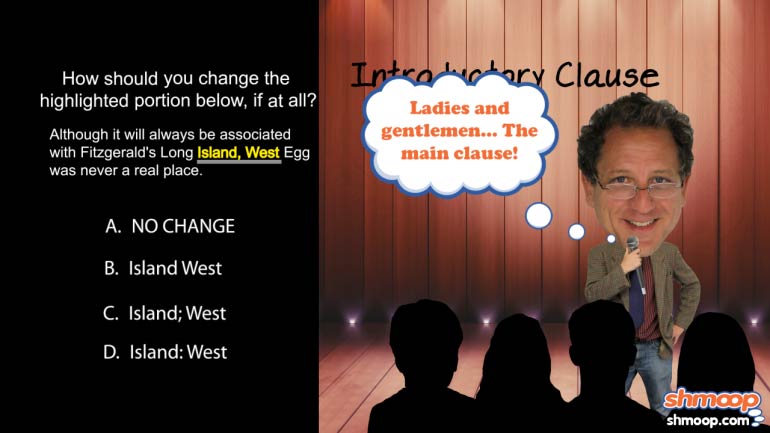
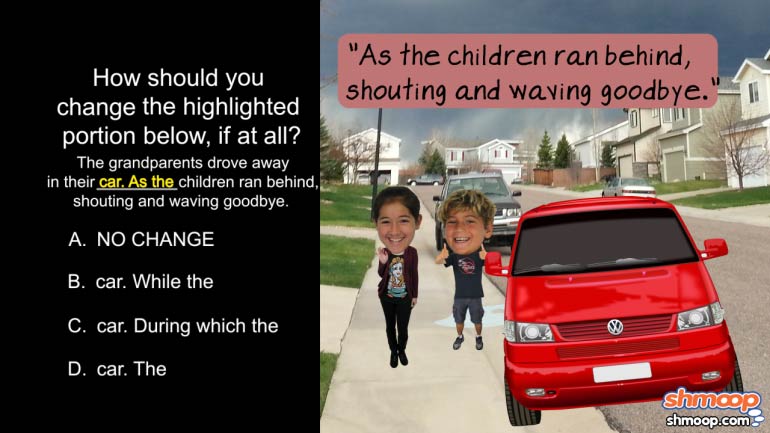

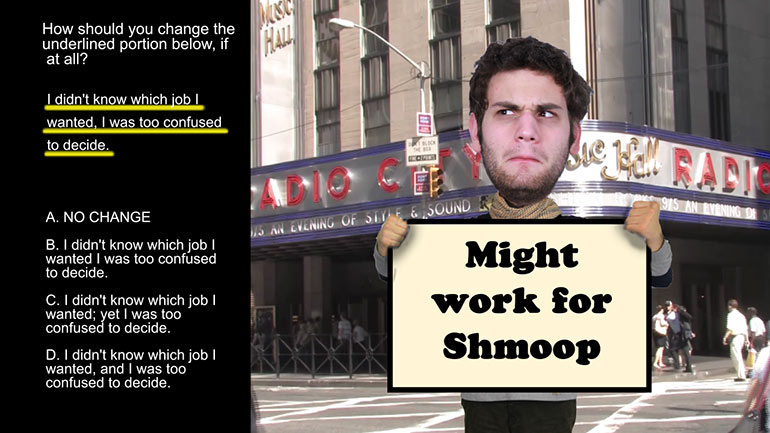
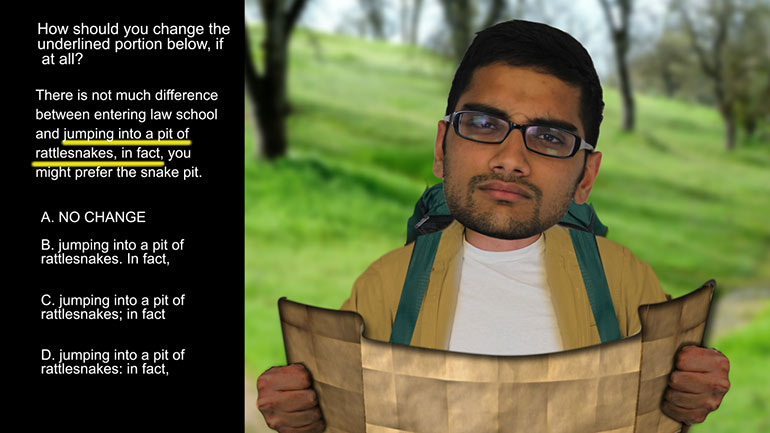

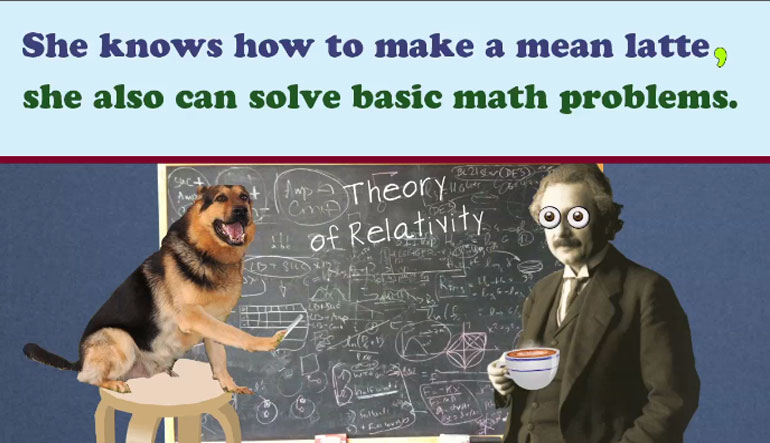
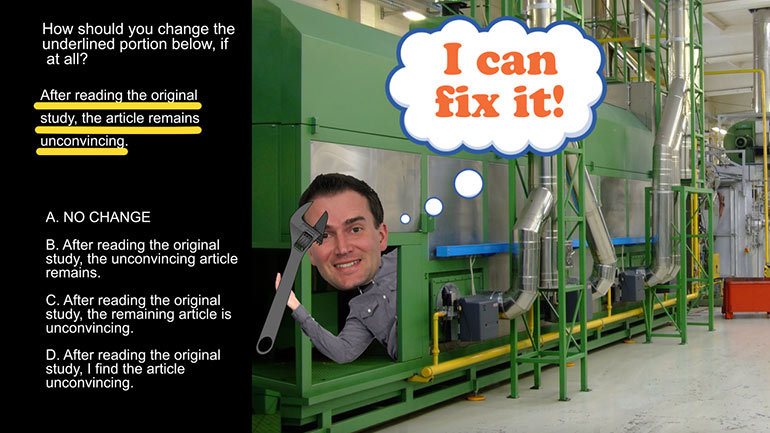





ACT English: Punctuation Drill 2, Problem 1. Which choice of punctuation best completes the sentence?
ACT English: Punctuation Drill 2, Problem 2. Where should the semi-colon be placed?

ACT English: Punctuation Drill 3, Problem 1. How should this sentence be changed so that it is grammatically correct?
ACT English 2.10 Passage Drill 224 Views
Share It!
Description:
ACT English: Passage Drill 2, Problem 10
Transcript
- 00:03
Heres your Shmoop du jour, brought to you by lukewarm water. Two questions: who the
- 00:08
heck is Luke, and why does he love room temperature water?
- 00:32
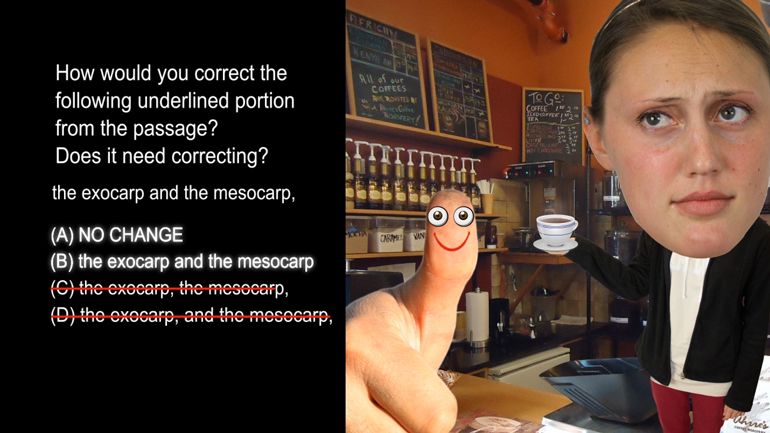
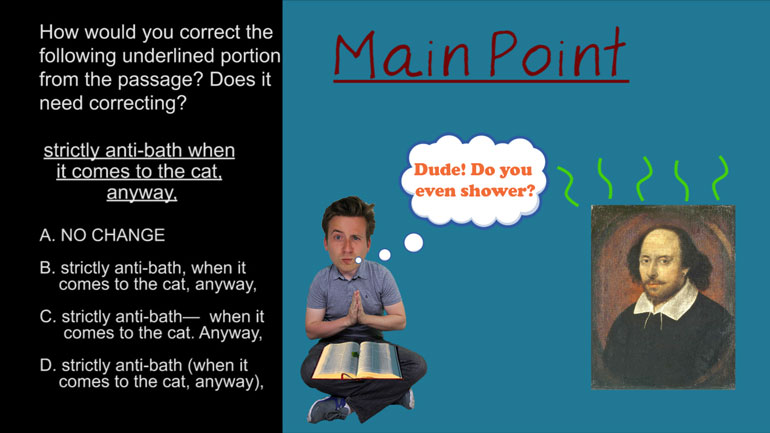
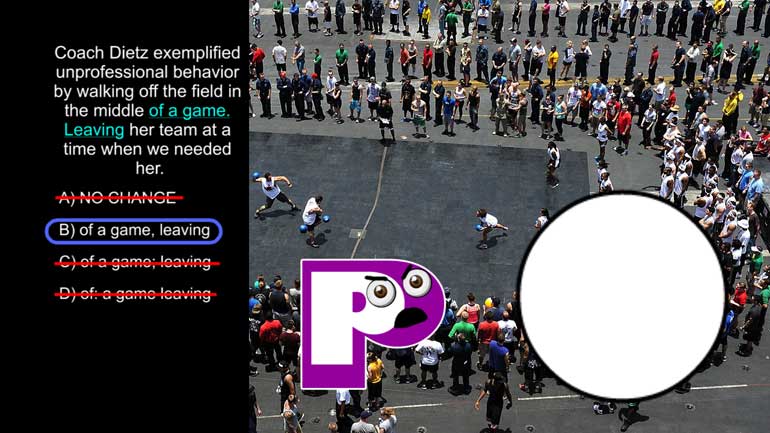
How would you correct the following underlined portion from the passage? Does it need correcting?
- 00:44
Here, we need to know the protocol for using a little word named "then." Though it
- 00:50
may seem like an innocent little fella, it can put us on the fast track to Comma Splice
Full Transcript
- 00:54
City if we're not careful.
- 00:56
See, "then" is what's known as a conjunctive adverb, a part of speech used to join words,
- 01:01
phrases, or clauses and to help the author clarify what he or she is saying. Some of
- 01:06
"then's" conjunctive adverb friends include "however," "also," and "nonetheless."
- 01:12
Knowing that "then" is a conjunctive adverb allows us to knock out (A) and (B) simultaneously.
- 01:18
An important rule to remember is that a conjunctive adverb can't link two independent clauses
- 01:22
without the help of a semicolon. Both (A) and (B) attempt this feat with nothing but
- 01:26
a comma, which turns our sentence into a dreaded comma splice.
- 01:31
Choice (D) makes a noble attempt by placing a period between the two independent clauses.
- 01:37
If we don't want to put a semicolon before our conjunctive adverb, the alternative is
- 01:41
to place a period before the adverb. Thus, we sever the two independent clauses, allowing
- 01:46
each one to be its own sentence.
- 01:50
However, choice (D) bungles the job by placing the period after the word "then," instead of before it.
- 01:55
Leaving "then" attached to the first clause actually turns the first clause into a fragment,
- 02:00
or a sentence that can't stand on its own as a complete sentence.
- 02:05
Though a sentence fragment would correspond well with the author's fragmented psyche during
- 02:08
the cat-washing attempt, that doesn't make (D) the correct answer.
- 02:12
(C) is the right choice because it correctly places the period before the word "then."
- 02:16
It also remembers to place a comma after "then," which is always necessary when a conjunctive
- 02:21
adverb kicks off a sentence. With this punctuational nip/tuck we now have a clearer understanding
- 02:26
of the soothing relationship of coconut shampoo, lukewarm water, and rubber mats.
- 02:31
Personally, we can't imagine a situation in which we'd by comforted by a rubber mat.
Related Videos
ACT English: Punctuation Drill 2, Problem 2. Where should the semi-colon be placed?
ACT English: Punctuation Drill 3, Problem 1. How should this sentence be changed so that it is grammatically correct?

ACT English: Punctuation Drill 3, Problem 2. How should we properly hyphenate the words in this sentence?

ACT English: Punctuation Drill 3, Problem 4. Which choice best formats this list of items?
ACT English: Punctuation Drill 2, Problem 1. Which choice of punctuation best completes the sentence?