ShmoopTube
Where Monty Python meets your 10th grade teacher.
Search Thousands of Shmoop Videos
Usage and Mechanics Videos 116 videos

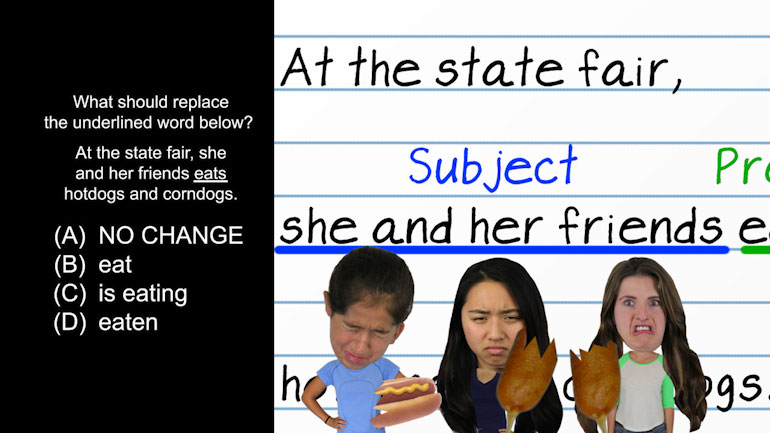
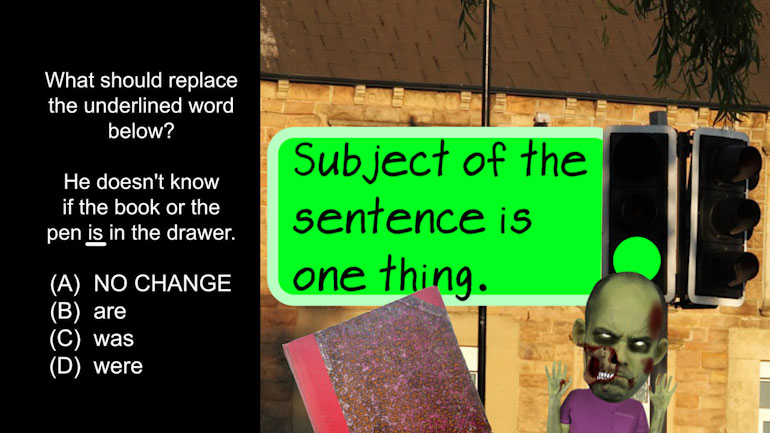





















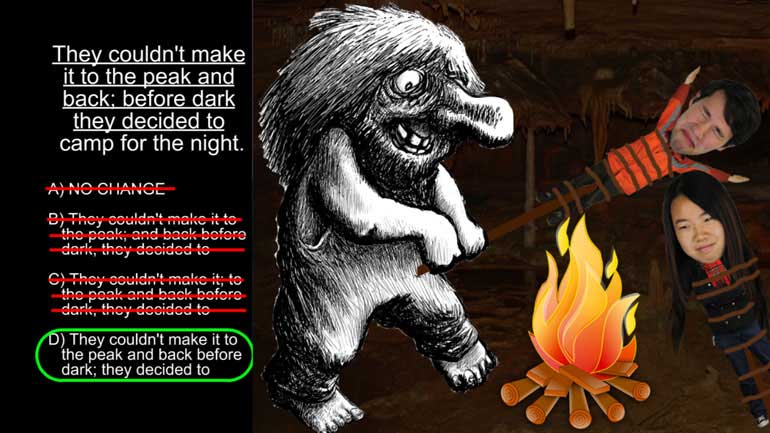












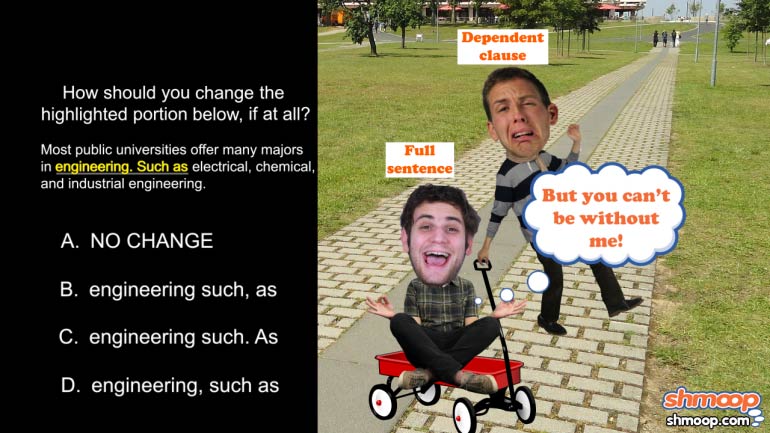









ACT English: Punctuation Drill 2, Problem 1. Which choice of punctuation best completes the sentence?
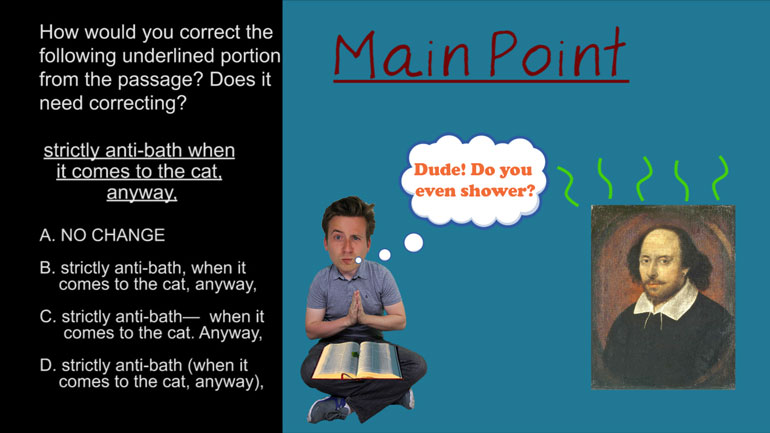
ACT English: Punctuation Drill 2, Problem 2. Where should the semi-colon be placed?

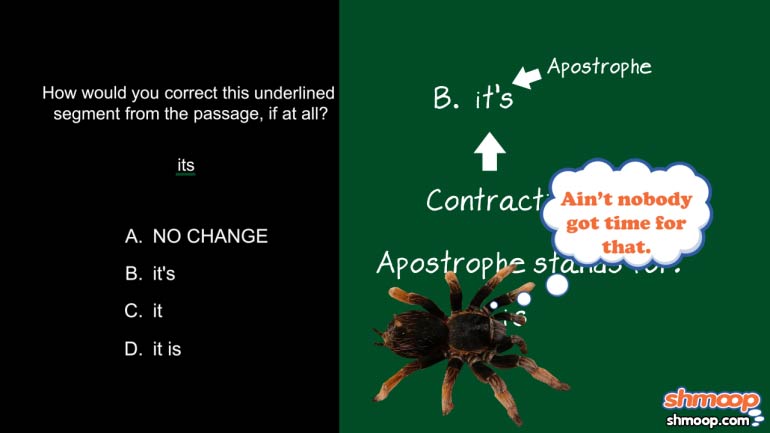
ACT English: Punctuation Drill 3, Problem 1. How should this sentence be changed so that it is grammatically correct?
ACT English 3.1 Sentence Structure 399 Views
Share It!
Description:
ACT English: Sentence Structure Drill 3, Problem 1. How would you change the underlined portion?
Transcript
- 00:03
Here's your Shmoop du jour, brought to you by modifying phrases. Poor things. They're
- 00:09
in a constant state of identity crisis.
- 00:12
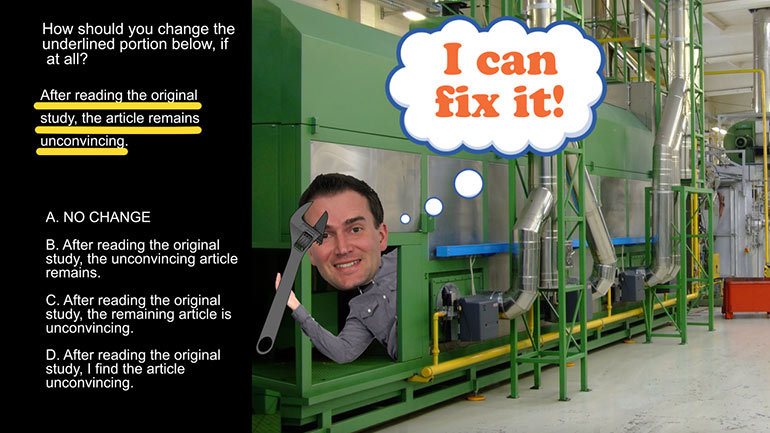
How should you change the underlined portion below, if at all?
- 00:16
After reading the original study, the article remains unconvincing.
- 00:27
Knowing one simple rule makes this one a cinch to fix.
Full Transcript
- 00:30
If we don't know this simple rule, though, we may be headed for complete chaos.
- 00:35
"After reading the original study" is what's known as a modifying phrase. Like adjectives,
- 00:40
it's the job of modifying phrases to describe nouns and pronouns.
- 00:45
The one simple rule we need to keep in mind here is that it's important to place the noun
- 00:49
or pronoun that the modifying phrase is describing directly after or before the phrase itself.
- 00:57
This way the reader is never confused about what exactly the modifying phrase is describing.
- 01:02
Confusing modifiers can cause lots of trouble.
- 01:04
For example, we might write an email to our boss where he mistakenly thinks we're describing
- 01:09
the way his wife kissed us at the holiday party rather than the cute dog she was holding.
- 01:14
The original sentence in question definitely breaks our rule. Here, the noun following
- 01:18
our modifying phrase is "article."
- 01:21
We're guessing that the article wasn't the thing reading the original study, unless it
- 01:25
was some kind of sentient article with artificial intelligence.
- 01:29
Chances are, this is not the author's intention, and so we can eliminate choice (A). We're
- 01:33
convinced that this sentence is in need of a little TLC.
- 01:38
Choices (B) and (C) basically make the same mistake. As with the original sentence, both
- 01:42
options place the noun, "article," after the modifying phrase.
- 01:46
So we can eliminate both of these options for the same reason as choice (A). Chaos will
- 01:50
always ensue if we don't place the noun or pronoun we're describing directly after the
- 01:55
modifying phrase.
- 01:57
Choice (D) is the correct answer because it does just this by placing the pronoun "I"
- 02:02
after the modifying phrase.
- 02:03
In this version, it's totally clear that it's the speaker who's done the background research
- 02:07
that has apparently exposed this poorly researched article.
- 02:10
What kind of sicko is this speaker? Exposing articles? They need to keep their pants on
- 02:14
like everyone else.
Related Videos
ACT English: Punctuation Drill 2, Problem 2. Where should the semi-colon be placed?
ACT English: Punctuation Drill 3, Problem 1. How should this sentence be changed so that it is grammatically correct?

ACT English: Punctuation Drill 3, Problem 2. How should we properly hyphenate the words in this sentence?

ACT English: Punctuation Drill 3, Problem 4. Which choice best formats this list of items?
ACT English: Punctuation Drill 2, Problem 1. Which choice of punctuation best completes the sentence?