The surface area of a solid is the area of each surface added together.
There are few formulas to memorize (w00t!). The keys to success: make sure that you don't forget a surface and that you have the correct measurements.
Surface area is often used in construction. If you need to paint any 3‐D object you need to know how much paint to buy.

If we "unfold" the box, we get something that is called – in the geometry world – a "net".

Using the net we can see that there are six rectangular surfaces.
| Side 1 | 4 x 8 | 32 cm2 |
| Side 2 | 8 x 6 | 48 cm2 |
| Side 3 | 4 x 8 | 32 cm2 |
| Side 4 | 8 x 6 | 48 cm2 |
| Side 5 | 4 x 6 | 24 cm2 |
| Side 6 | 4 x 6 | 24 cm2 |
| TOTAL | 208 cm2 |
If we study the table we will see that there are two of each surface. That's because the top and bottom of a rectangular prism are congruent, as are the two sides, and the front and back.

If we break down our triangular prism into a net, it looks like this:

In a triangular prism there are five sides, two triangles and three rectangles.
| Side 1 | ½(9 × 4) | 18 cm2 |
| Side 2 | ½(9 × 4) | 18 cm2 |
| Side 3 | 4.5 x 8.1 | 36.45 cm2 |
| Side 4 | 9 x 8.1 | 72.9 cm2 |
| Side 5 | 7.2 x 8.1 | 58.32 cm2 |
| TOTAL | 203.67 cm2 |
Imagine a can of soup.

If we use a can opener and cut off the top and bottom, and unroll the middle section, we would get:

Now you can see that we have two congruent circles, each with a radius of 4.4 cm and a rectangle with a width of 7.2 cm. The only measurement we are missing is the length. Remember when we unrolled the center section. Well, its length was wrapped around the circles, so it's the perimeter of the circle, i.e., the circumference. Therefore, we must find the circumference of a circle with radius 4.4 cm.
Circumference of a circle = dπ = (4.4 × 2)π = 8.8π ≈ 27.63 cm

Now, we can solve for surface area:
| Circle 1 | 4.42 × π | ≈ 60.79 cm2 |
| Circle 2 | 4.42 × π | ≈ 60.79 cm2 |
| Center | 27.63 x 7.2 | ≈ 198.94 cm2 |
| TOTAL | ≈ 320.52 cm2 |
That great mathematician Archimedes, the one who gave us the formula for the volume of a sphere, spent many hours plugging away by candlelight to bring you this: the surface area of a sphere is 4 times the area of the center circle.
To find the surface area of a cone we need to find the area of the circular base and the area of the curved section. This one involves a new measurement, s, which is the length of the slanted part.
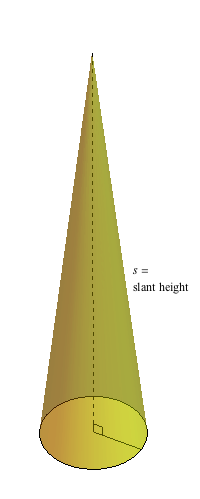
If you take apart the cone, you get two surfaces, the circular base and the curved sides. The area of the base is just πr2, and the area of the curved section is πrs.
Look Out: surface area is only two-dimensional and is expressed as units squared, not units cubed. This is because we are only dealing with the flat surfaces, not the inside space.