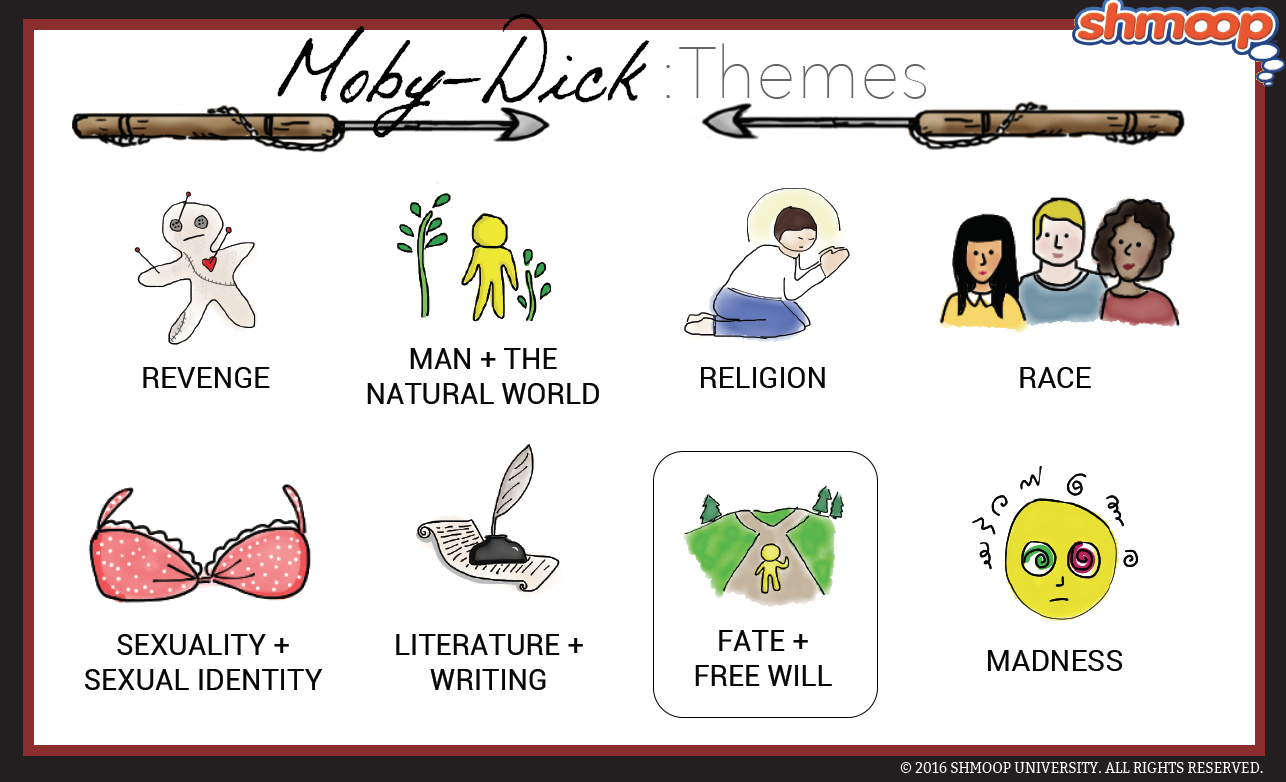
 (Click the themes infographic to download.)
Some novels might be subtle about issues of fate vs. chance, but subtlety isn't really Moby-Dick's thing.
This book thrusts questions of free will vs. determinism right into the reader’s face, starting in the very first chapter. At one point (Chapter 47, to be precise), the novel even develops a complicated metaphor that brings together fate, chance, and free will in one elaborate system. The question for the reader is whether this metaphor can take all the strain of an insane quest, a revenge tragedy, a series of strange coincidences, and heavily allegorical symbolism. When we can no longer bear the power and strangeness of fate, the novel explicitly encourages us to consider laughter our only recourse.
Questions About Fate and Free Will
- Do the characters in Moby-Dick have unavoidable destinies? Consider especially Ahab, Ishmael, and Starbuck.
- Read the first two paragraphs at the beginning of Chapter 47, "The Mat-Maker," in which Queequeg and Ishmael work together to weave a sword-mat for their boat. As Melville lays out his metaphorical interpretation of this activity, why is it so important to include all three elements: fate, free will, and chance?
- How does the invocation of Fate increase the tragedy of the story in Moby-Dick?
- Why does Ishmael alone escape the wreck of the Pequod? Is there something that marks him out as different from the rest of the crew, or is it simply blind chance?
Chew on This
The only choice Ishmael makes in Moby-Dick is to sign the ship’s articles of the Pequod; from that point forward, his entire adventure is the result of Ahab’s tragic destiny, and there’s nothing he can do to alter it.
Even though the narrator continually describes the voyage of the Pequod as a journey cursed by fate, the novel also goes to great lengths to emphasize many different points at which small decisions, if made differently, could have saved the ship.