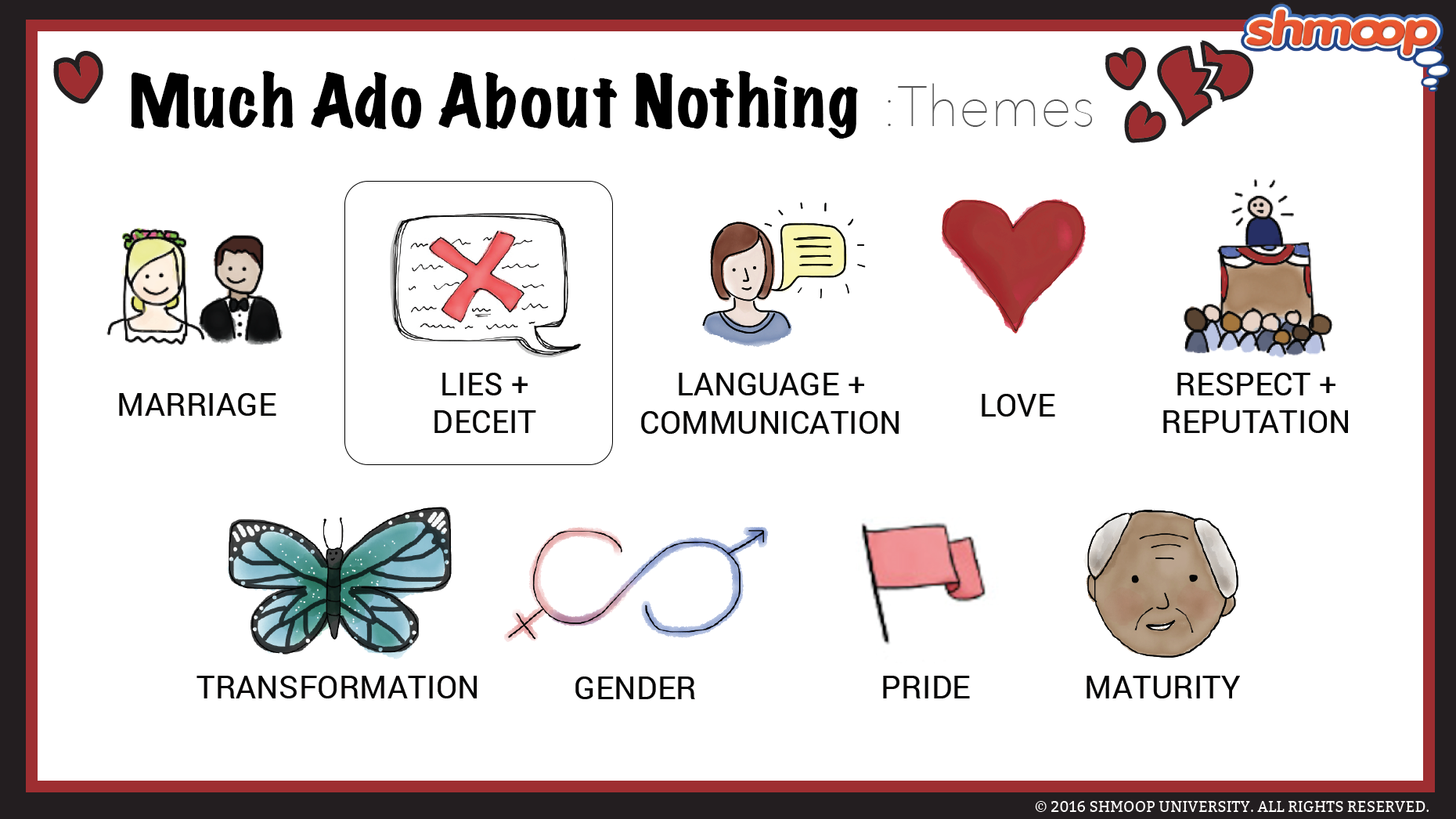
 (Click the themes infographic to download.)
Lies and cheating is ever-present in Much Ado About Nothing... but the characters never expect it. This is one gullible crew.
Deception appears as the tool of villains to spread chaos and unhappiness. However, it’s also a device used by friends to improve each other’s lives. Everyone from scoundrels to nice daddy’s girls to clergymen use deviousness—so deception doesn’t come with a value judgment, it’s neither absolutely good or absolutely bad. Whether deception is okay or not depends on the intentions of the deceivers—if the intention is to promote happiness, then the deceiver is a good friend, but if the deceiver intends harm, then he’s a nasty jerk.
Questions About Lies and Deceit
- Is deception presented as morally wrong in the play? Does anyone worry about morality, or is deception accepted as a natural, neutral fact of life?
- Why does Don John love deceiving others so much? Are you satisfied with Shakespeare’s answer that Don John is just naturally bad? How does Don John compare to Shakespeare’s other famous deceiving illegitimate son, Edmund from King Lear?
- The play seems to suggest that there can be good deceptions, but this raises the question of whether deceiving Benedick and Beatrice was necessary to get them to fall in love? Is it OK that their courtship is built on a lie?
- Why does Friar Francis insist that they all keep up the lie about Hero’s death after the first wedding? Why also does Leonato let Claudio think Hero is dead until the moment she unmasks herself at the second wedding?
- Does the play deal too lightly with deception and its potentially harmful consequences? Does the play ever address what these consequences might be, or apologize for them?
- Much of the manipulation in the play seems unnecessary (especially in the masquerade scene – with Don Pedro’s wooing of Hero and Don John pretending to think Claudio is Benedick). What’s the point of all this? Is Shakespeare just trying to thicken the plot, or is this unnecessary manipulation a reflection of real life?
- Manipulation in this play is not unlike the manipulation that occurs in Shakespeare’s tragic romance Romeo and Juliet, like when Juliet makes everyone think she’s dead, but she isn’t really, and it costs her lover’s life. What distinguishes comedies and tragedies in Shakespeare? Is it only the outcome of the manipulations?
Chew on This
Deception is not to blame for the mishaps in the play. All of the major plots are actually set in motion by the characters’ susceptibility to suggestion. They only see what they want to, and they are no more misled than they allow themselves to be.
Deception is inherently bad. It is used in this play to sometimes bring out positive results, but those outcomes are actually artificial, and easily undone.