The Scarlet Letter Introduction
Passion, wild emotion, and forbidden love: is it the newest 50 Shades of Whatever? Or is it Nathaniel Hawthorne's The Scarlet Letter, published in 1850 and set over a century earlier, amid those stuffy old Puritans with their funny hats and buckles?
Yep. It's the second one. Nathaniel Hawthorne set the story of poor, persecuted Hester Prynne and her lover in the early Massachusetts Bay Colony, where his ancestors played a role in the persecution of Quaker women, as well as in the prosecution of women in the Salem Witch Trials. (Hey, you can't choose your family.) In The Scarlet Letter's preface, Hawthorne actually alludes to this history, taking blame for the actions of these ancestors and hoping that any curse brought about by their cruelty will be removed.
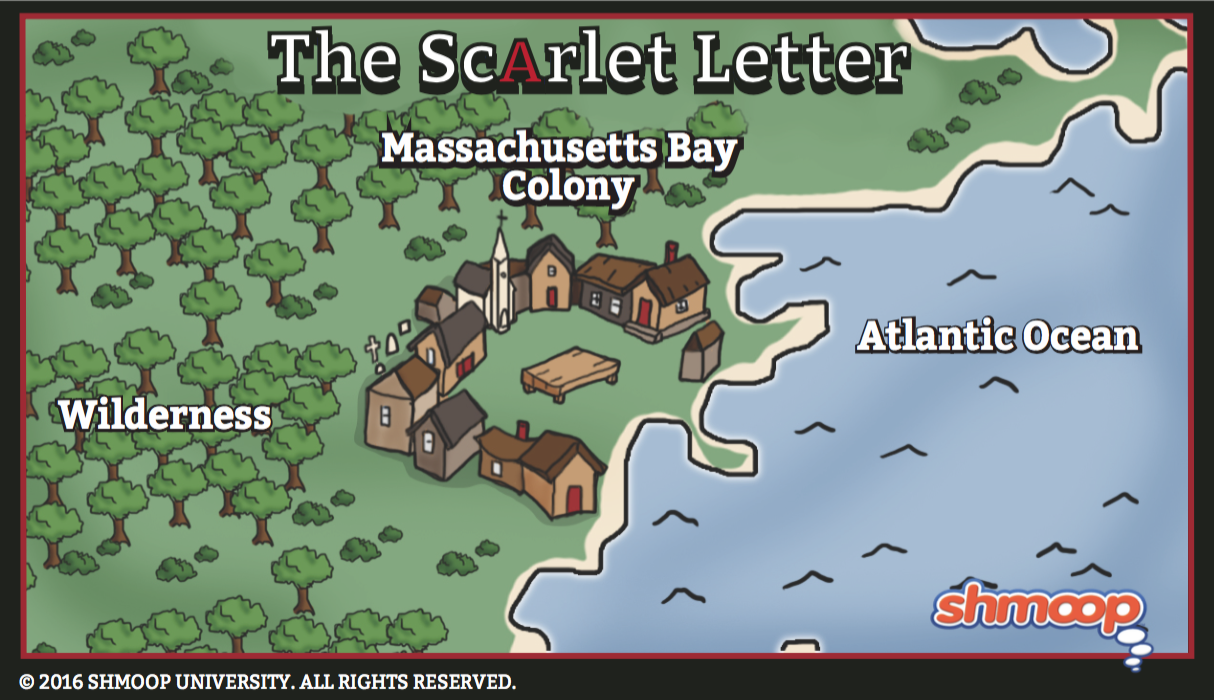 (Click the map infographic to download.)
Before we set you loose upon the thrilling world of mid-17th century Boston, let's do a quick recap: this was a society governed by Puritans, religious men and women who settled at Plymouth Rock, founded Boston, and began the experiment that grew into the US of A. The Puritans left the Church of England (the Christian church of, well, England) because they thought it was getting a little bit too relaxed about things, and they wanted the freedom to practice their own strict form of religion. Set in a deeply religious time and place, the novel is centered around the concept of man's relationship to himself (or herself) and to a Christian God.
The novel itself came out of a difficult time in Hawthorne's life. After graduating from Bowdoin College, where he hung around with the likes of poet Henry Wadsworth Longfellow and future United States President Franklin Pierce, Hawthorne found a government job at the Custom House in Salem. He lost the job in 1849, just before his beloved mother died. Instead of lying on the couch eating Flamin' Hot Cheetos and playing Halo during his unemployment (ahem), Hawthorne decided to write a book. When he read the final words of the final chapter to his wife, he ran to bed crying.
At that point, Hawthorne knew he had a hit on his hands, and what a hit it was. Oh, sure, it was one of the first mass-produced books sold in America, and it received praise from no less than Henry James himself—but can that compare to being on almost every American literature reading list in the history of everywhere?

What is The Scarlet Letter About and Why Should I Care?
It's Monday morning, and you slink into your American Studies class with a conscience so guilty, you begin to think the words "I didn't read the book" are tattooed on your forehead. Your classmates are gleefully exchanging anecdotes about their weekends as they pull out their glossy copies of The Scarlet Letter.
This is just going to have to be one of those classes where you do a lot of nodding.
"Did you read the book?" one of your classmates asks the kid sitting across the table. "Dude, of course not," he replies. "Neither did I," replies your classmate. Oops. It looks like no one has read the book. How are you all going to survive Mr. Chillingbone's class? Noticing the increasing frenzy, the class clown tries to calm everyone down: "Relax. All we have to know is that the book is about a lady who has an affair with a priest, like, thousands of years ago. It's juicier than a soap opera. We can make it up as we go."
Mr. Chillingbone, a wise, scarily perceptive Dumbledore look-alike of a man, walks into class somberly. He places his book and mug of tea on the table, looks around the room suspiciously, sniffs the air, and then fixes you in his gaze.
"Good morning, class. I hope you're all prepared for a lively discussion about the role Mistress Hibbins plays in developing our understanding of Hester Prynne. You there, Mr. Shmoop. Why don't you start us off?"
Uh-oh. You can either 1) run out of class immediately, 2) pretend to have read the book say something about two characters you've never even heard of, or 3) tell the truth.
"I'm sorry, Mr. Chillingbone, but I wasn't able to read the book." You are so noble.
"What!" Mr. Chillingbone roars. "You've had a whole week to read this classic tale, and you HAVEN'T READ THE BOOK?!" He stares around the room in scholarly horror. "Who else has neglected to read this work of sheer genius? Who?!"
No one says a thing. Your classmates thumb through their glossy copies, unwilling to fess up.
"Good," Mr. Chillingbone says. "I am glad there are still some scholars left in the world. As for you, Mr. Shmoop: please write a 20-page paper by Friday about Mistress Hibbins' role in the novel, taking into account the historical personage on which the character is based. You may go now."
Blushing and mortified, you leave class. Your classmates stare at you as you go, smirking. How does it feel to be Hester Prynne? How does it feel to tell the truth and to feel the pang of injustice? Whether it has to do with class, friendships, parents, or the law, we bet that, on some level, you and Hester have a lot in common.