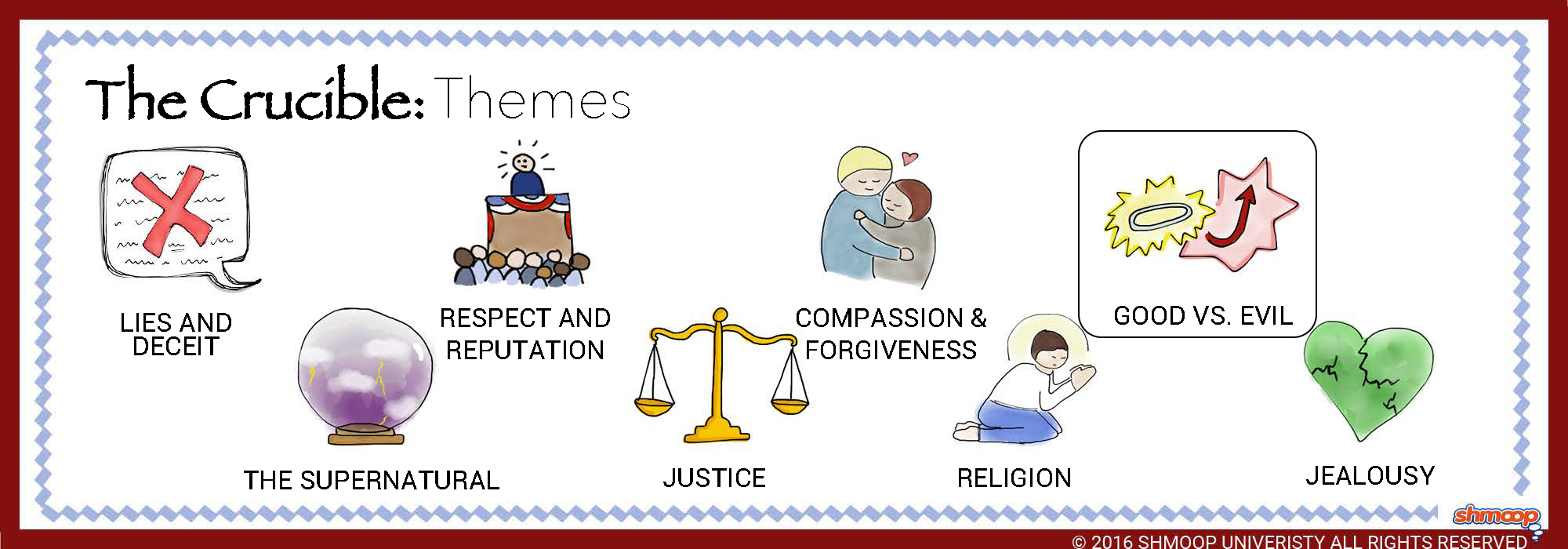
 (Click the themes infographic to download.)
The entire village bases its belief system on the conflict between good vs. evil, or Satan vs. God. Over and over, as people are accused of witchcraft, this paradigm gets dragged out. When Tituba confesses, she claims she wants to be a good Christian now and stop hurting people. She must renounce the Devil. When Mary Warren can’t handle the girls’ accusations, she accuses Proctor of making her sign the Devil’s book and claims she is now with God.
The world in The Crucible is clearly divided into these two camps. Unfortunately, everybody’s confused about which side is actually good and which side is actually evil, though it’s abundantly clear to the reader. It may seem like evil is winning, as one innocent person after another is put to death, but we also see that there is power in martyrdom.
Questions About Good vs. Evil
- Are any of the characters in The Crucible beyond redemption? Abigail’s flight at the end furthers the impression that she is simply a bad apple, but even Elizabeth is able to see how Abigail could have interpreted her affair with Proctor as something more than lust.
- The characters in the play are obsessed with evil and the Devil. If the Devil is so powerful, what kind of role, if any, is left to God to perform?
Chew on This
God has no positive presence for the people of Salem; only Satan is an active force in the world.