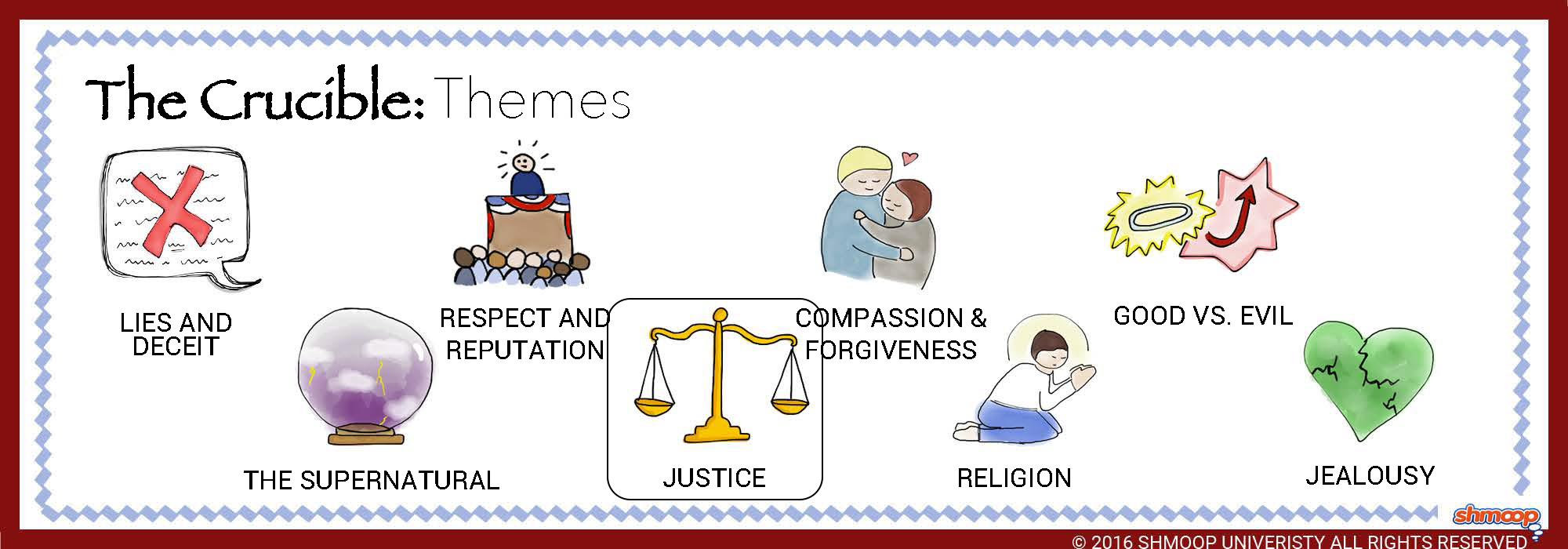
 (Click the themes infographic to download.)
The Salem of The Crucible is a theocracy, which means that God is supposed to be the ultimate leader, arbiter, and judge.
In practice, however, the town’s religious authorities do the governing. God needs men on earth to do his work of justice, and Hathorne, Danforth, Hale, and Parris are all part of that system. They believe that God is speaking through the children to help them prosecute invisible, hidden crimes. The whole system gets turned upside-down, and these men of experience and education are completely dependent on the assumption that children are telling the truth.
Questions About Justice
- What is the concept of justice, according to Parris, Hathorne, and Danforth?
- What is Proctor’s concept of justice? How does it differ from that of other characters, such as Elizabeth?
- Does the play take a stand on the question of whether people have an innate sense of justice? For example, do young people and the uneducated fare any better with questions of justice than educated people do?
Chew on This
Only those characters who have fallen and admit to committing grave errors possess anything close to a sense of justice.
In a play that seems hostile to religion, the ending is especially pointed. John Proctor receives no justice on earth, so the only way that we assume he receives justice would be in some other realm.