Character Analysis
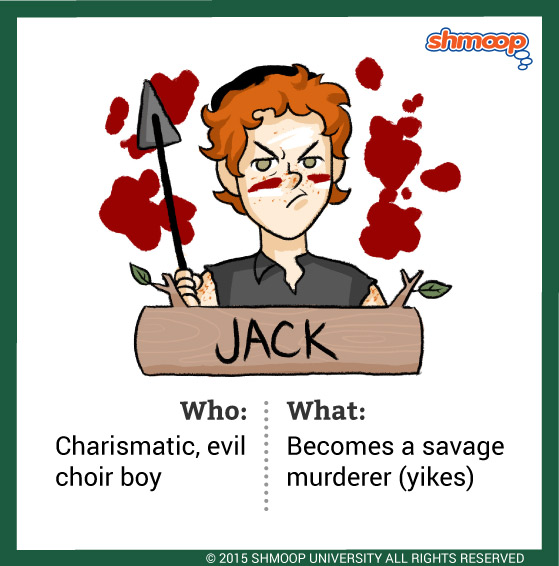
(Click the character infographic to download.)
For Jack, the island is like the best summer vacation ever. He gets to swear, play war games, hunt things, and paint his face—all without any grownups around to send him to his room for accidentally killing the neighbors.
Like Ralph, Jack is charismatic and inclined to leadership. Unlike Ralph, he gets off on power and abuses his position above others—so, he's basically an '80s teen villain, without good hair and daddy's credit card. Let's see how he transforms from arrogant choir boy into painted savage.
Not-So-Golden Boy
Jack is ugly. Well, according the narrator he is: he's "tall, thin, and bony: and his hair was red beneath the black cap. His face was crumpled and freckled, and ugly without silliness. Out of this face stared two light blue eyes, frustrated now, and turning, or ready to turn, to anger" (1).
We've just met him, and we're already getting a bad feeling. Where Ralph is described as "fair" and "attractive," Jack is freckled and redheaded. (Duh, everyone knows redheads are evil.) And check out those angry eyes. It's no surprise that Jack can't wait to pick up a spear.
Ralph is elected leader because he's cute and seems pretty mature, and he's our protagonist for pretty much the same reasons (check out "Character Roles" for more on this). But Jack doesn't get it. He thinks that he deserves to be chief because he's "chapter chorister and head boy. [He] can sing C sharp" (1.228-30)—in other words, for no good reason at all. He should be leader because he's always been leader in the past, even though that leadership was based on something completely unrelated to his ability to govern: a nice singing voice.
The problem with this kind of social structure is that it's not based on anything real. At first, Jack seems ready to help Ralph establish order: "We've got to have rules and obey them. After all, we're not savages. We're English, and the English are best at everything" (2.192). That doesn't exactly sound like a kid who's five seconds away from slaughtering a wild pig and painting himself with its blood, right?
But saying "we have to have rules because we're English and awesome" is, when you think about it, identical to saying "I should be leader because I can sing C sharp." It's meaningless. It's jingoistic. And it disguises the fact that Jack is actually a pretty scary dude. As soon as there's no civilization to keep him in line, he—unlike Ralph—falls out of line. Majorly.
Power Corrupts
Jack's litany of evil is pretty impressive. He leads the brutal slaughter of a pig—and then Simon. He fosters rebellion. He has his minions beat a kid named Wilfred for some unspecified misdeed. He throws a spear at Ralph with "full intention" (11), trying to kill him, and then sends the minions after him to finish the job.
But he couldn't do any of this without power. And somehow, he gets it. When he leaves Ralph's group, he convinces the others to come with him by promising a hunt. The pre-teen boys aren't interested in Ralph's boy-scout team-building and fire-watching. They want blood. And once Jack gets control, he turns from a choir boy into a, well, this:
A great log had been dragged into the center of the lawn and Jack, painted and garlanded, sat there like an idol…
Power lay in the brown swell of his forearms: authority sat on his shoulder and chattered in his ear like an ape.
"All sit down."
The boys ranged themselves in rows on the grass before him but Ralph and Piggy stayed a foot lower, standing on the soft sand. Jack ignored them for the moment, turned his mask down to the seated boys and pointed at them with his spear. (9.37, 52-56)
Jack is an "idol" with an "ape" sitting on his shoulder; he's no longer a little boy. He's a "chief," and not only the boys but the narrator actually calls him "the chief": "the chief was sitting there, naked to the waist, his face blocked out in white and red" (10). Jack? There is no Jack by this point. "Jack" is a just a name covering up the ugly, primitive core beneath the British choir boy exterior. When Jack picks up a spear and then walks out on Ralph's pitiful attempt to impose order, he's not a boy anymore: he's a savage.
(And if you're thinking that this all sounds a little racist—we think you're right. Check out our "Primitivity" theme for some thoughts on that.)
Kid Stuff
By the end of the book, Jack has become a subhuman terror, inspiring panic in Ralph and awe in the rest of the boys. Or has he?
Throughout the whole story, we get little hints that this might be nothing more than a game gone wrong. When Jack leaves Ralph's group, check how he does it:
His voice trailed off. The hands that held the conch shook. He cleared his throat, and spoke loudly.
"All right then."
He laid the conch with great care in the grass at his feet. The humiliating tears were running from the corner of each eye.
"I'm not going to play any longer. Not with you." (8.67-75)
Does this sound like a savage psychopath in the making, or does it sound like a little boy who's mad that things aren't fair? What's cool about this moment is that Golding mostly keeps us in the boys' viewpoint, and particularly Ralph's. When they're scared, we're scared; when they're having a fun pig-killing orgy, we're having a fun pig-killing orgy. But occasionally he drop in moments like this, where we see the boys in a new way—as kids playing a game gone horribly wrong.
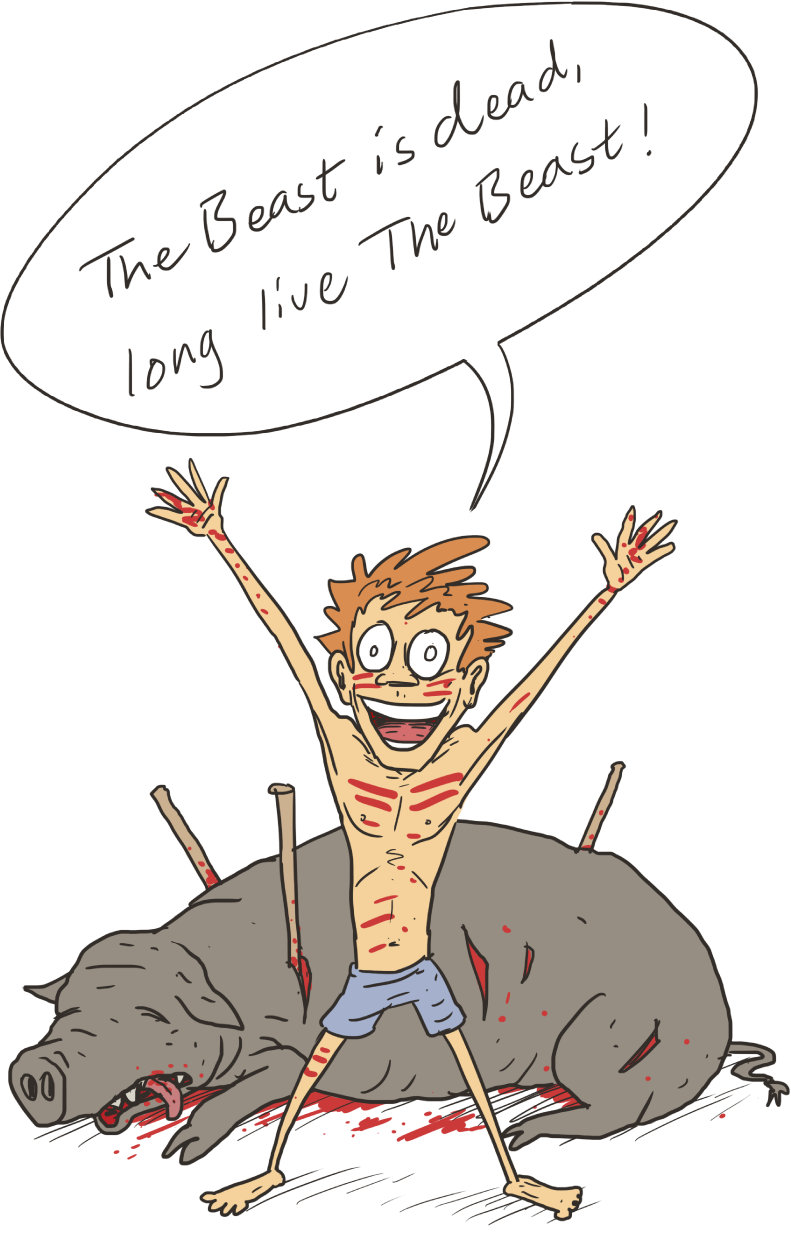
At the end, we see things from the naval officer's perspective. He asks who's in charge (assuming very Britishly that someone is), and Ralph steps up. Keep in mind that being in charge also means taking some sort of responsibility for, oh, the two gruesome murders. Maybe that's why Jack ends up hanging back:
A little boy who wore the remains of an extraordinary black cap on his red hair and who carried the remains of a pair of spectacles at his waist, started forward, then changed his mind and stood still. (12)
To the boys, Jack is a powerful, savage chief. To the officer (and to us), he's just a "little boy" wearing goofy clothes. Golding leaves us with a question: what is Jack, really? Is he a heartless savage, or is he just a little British boy playing a game?
Jack Timeline