Character Analysis
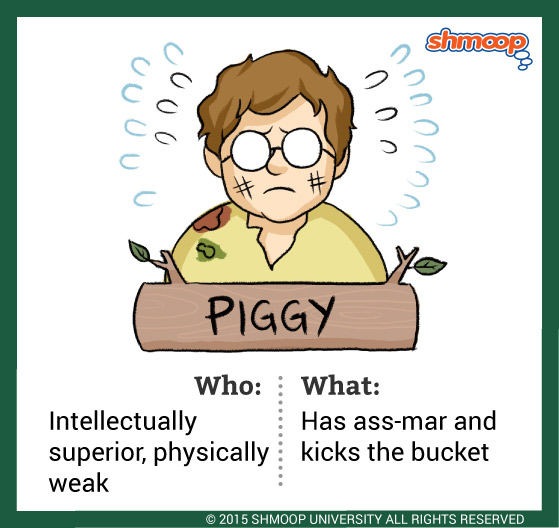
(Click the character infographic to download.)
In the Lord of the Flies, Piggy starts off as the group's outcast and ends up smashed to an untimely death by a large rock. But what happens along the way of this tragic character arc?
Ass-Mar
Piggy is one of the first characters we meet (as "the fat boy"), so we're predisposed to like him, even if nobody else does. Ralph may find the conch, but Piggy is the one who identifies it and tells Ralph how to use it—but doesn't use it himself. He may know what to do (blow into the shell), but he's too weak physically (because of his asthma) to do it. And that's Piggy: intellectual superiority, physical inferiority.
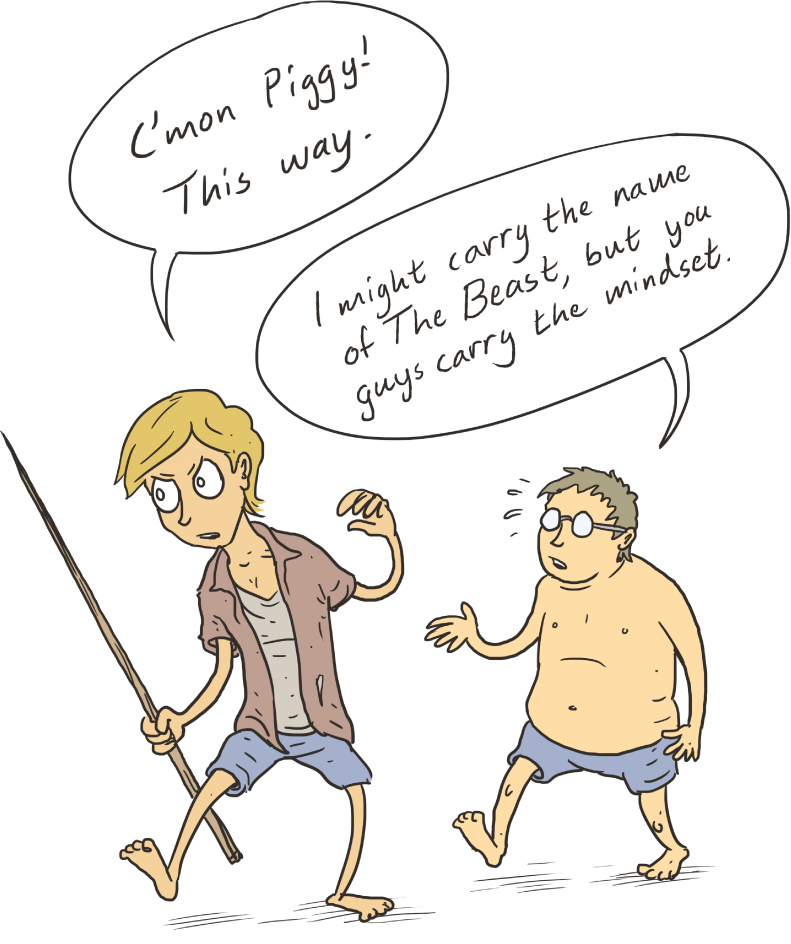
He's also the closest thing we have to an adult on the island, defending the conch and insisting on rules and order. He makes a big deal about learning names, "frowning to remember them" (1.179): he sees each boy as a fellow human being, and wants to give him the right and privilege of being called by his proper name. Having names matters to Piggy, because, just like the conch, it represents a system of rules and order.
It's not that Piggy benefits from his interest in names. No one calls Piggy by his rightful name (we never even learn it). But the conch does benefit him. Without rules and order, people like Piggy get squashed—literally. With the conch, everyone gets a fair chance. If he's holding the conch, it doesn't matter if he's fat and unathletic. His voice matters just as much as anyone else's. That's probably why he defends it even when he and Ralph are being attacked by Jack's gang, holding it up and demanding, "Which is better—to have rules and agree, or to hunt and kill?" (1).
Four Eyes
It's too bad for the boys that they don't listen, since Piggy has some pretty good ideas—like that the beast isn't real. He believes in science, saying "Life […] is scientific, that's what it is. In a year or two when the world is over they'll be traveling to Mars and back" (5.99).
So, naturally he wears glasses. We see more than once that "Piggy's glasses flashed" (1, 4) as if they're an essential part of him—which they are. And this integral part of a character whose focus is science and technology, is used for the purposes of…science and technology. While the boys revert to their primitive and animal ways, the glasses become a symbol of the opposite sort of transformation: advancement, discovery, innovation. After all, without his glasses, the boys never would have been able to start a fire. (Check out "Symbols" for more thoughts on Piggy's glasses.)
Thanks to Piggy, we get the sense that, while Golding doesn't think civilization is quite all it's cracked up to be, it's probably still better than running around with painted faces slaughtering pigs.
This Little Piggy Went to Market
Speaking of slaughtering pigs: toward the end of the novel, when things are getting real for our intrepid band of pre-teens, Roger sees Piggy as a "bag of fat" (11.198). Sound familiar? Only a few chapters earlier, the pigs are referred to as "bloated bags of fat" (8). Does this make you think? It sure made us think—about how Piggy's name is, well, "Piggy," and about how the boys went gradually from killing PIGS to killing PIGGY. (Then we abused the use of capital letters to get our point across.)
Piggy's death shows us just how bad things have gotten—that it's a slippery, slidey, downward slope of atrocity from taking off your choir robe to mercilessly killing two of your peers. And note that, when Piggy dies, the conch dies with him, "[exploding] into a thousand white fragments" (11.209).
Now there are really no grownups.
Piggy Timeline