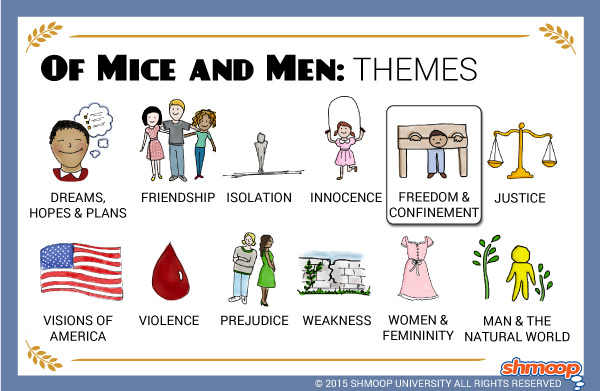
 (Click the themes infographic to download.)
Lennie and George are tied down by their need for money. Curley's wife is limited by being a woman. Crooks is stuck because of his race. Except when they're caught up in the intensity of the dream, most characters in Of Mice and Men seem more focused on bemoaning their confinement than planning for their freedom. And you know what? In a world where death seems to be the only way out, we can't blame them.
Questions About Freedom and Confinement
- Do Lennie and George see their life of traveling and working as a type of freedom? Do they ever consider the question of freedom?
- Crooks is the only ranch hand to have his own room. Is this a type of freedom, or a type of confinement?
- At the end of the story, when George is facing life without Lennie, does he feel freer, or more confined?
- What does "freedom" mean to Lennie? Is it related to the "fatta the lan"? Does he find it in death?
Chew on This
Try on an opinion or two, start a debate, or play the devil’s advocate.
For the characters in Of Mice and Men, freedom means settling down. The life of the open road is only a type of captivity.
In Of Mice and Men,all the characters are trapped, either by their circumstances or who they are. Their lives are simply processes of becoming comfortable with those traps.