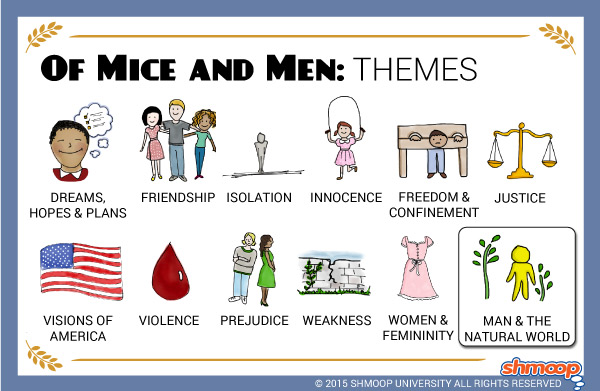
 (Click the themes infographic to download.)
Like the ranch, the natural world is a dog-eat-dog place, where animal instincts trump any sense of justice or goodness and people accept cruelty as, well, natural: Lennie loves animals, but kills them; Candy loves his dog, but can't stand up for it; and even Crooks tends to the horses that maimed him. In the natural world, love has nothing to do with safety: sometimes, things that we love die. And sometimes, they have to be killed. Of Mice and Men asks us to consider how different Lennie is from Candy's old dog—and how different Carlson is from George.
Questions About Man and the Natural World
- Why is Lennie constantly compared to an animal? Is this a fair comparison? Is the author suggesting that not all humans are animals?
- What separates the rule of civilized law from the rule of the natural world? Does Steinbeck seem to suggest one is better than the other?
- Are the natural world and man's world presented as parallels to each other or as contrasts to each other? (And what's the role of women in all this?)
Chew on This
The novel uses the natural world as a sensible contrast to the bureaucratic or prejudiced justice of the civilized world.
If we see Lennie as belonging to the natural world, and George as belonging to the world of men, then we can see the novel as about man's inextricable relationship with the natural world.