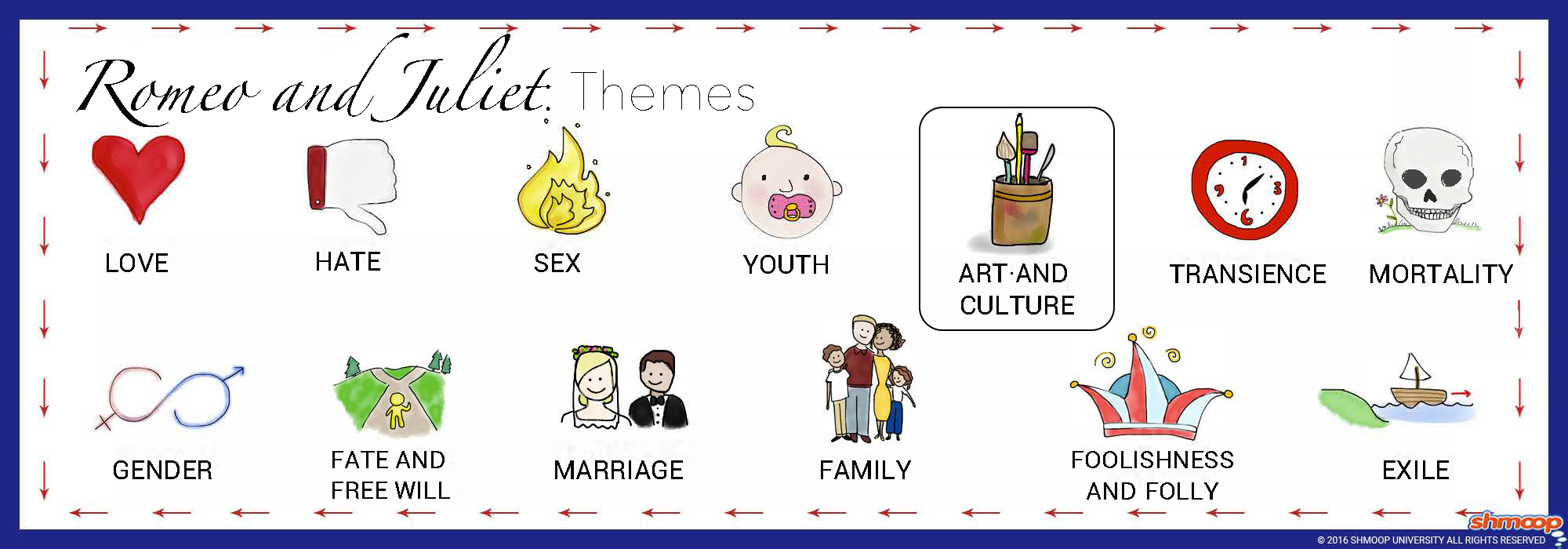
 (Click the themes infographic to download.)
When the characters in Romeo and Juliet aren't making dirty jokes, they're speaking in perfect love sonnets.The famous balcony scene? Well, it's full of great lines that have since made their way into Hallmark cards and pop music lyrics. Shakespeare's not just showing off his skills—the play takes a pretty self-conscious look at the conventions of popular sixteenth-century poetry even as it participates in the art form. Just look at how Romeo evolves from the kind of cliché lover that frequently appears in popular Petrarchan sonnets to someone speaking his own kind of sonnets—Shakespearean sonnets.
Questions About Art and Culture
- What are some examples of the sonnet form that appear in the play? Why do you think Shakespeare uses this poetic form in Romeo and Juliet?
- Does the play ever make fun of love poetry? If so, when? Why would Shakespeare, who is also a poet, make fun of his own craft?
- What does Juliet mean when she tells Romeo that he "kiss[es]" by the book" (1.5.110.2)?
- Why does Lady Capulet compare Paris's face to a book of love poetry when she instructs Juliet to "read over the volume of [his] face" at the Capulet ball (1.3.82)? What are the implications of such a comparison?
Chew on This
Although Romeo's love musings are cliché and unauthentic at the play's beginning, his poetry improves over the course of the play as he grows deeper in love with Juliet.
Shakespeare makes fun of cheesy love poetry in Romeo and Juliet, but he also suggests that sincere love poetry can be a powerful and authentic mode of human expression.