Character Analysis
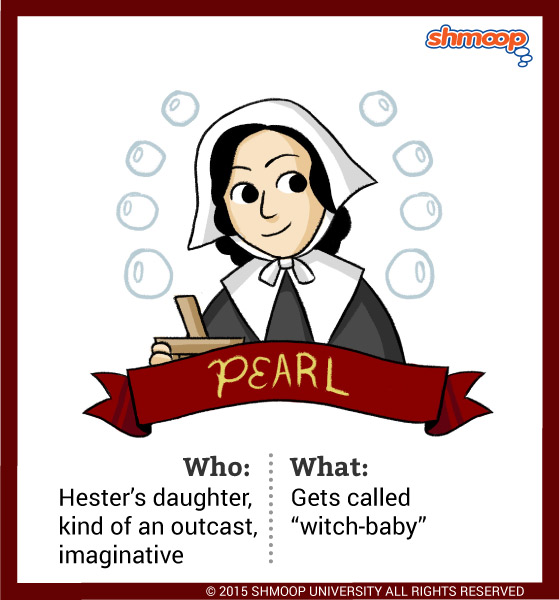
(Click the character infographic to download.)
Quick: you're the most sinful woman in probably the entire New World, not counting those heathen Indians, you've just given birth to a girl, you feel really bad about your adultery, and you want to convince the town leaders that you should be allowed to keep the child. What do you name her?
(A) Humiliation
(B) Sin-Deny
(C) Sorry-for-Sin
(D) Abstinence
(E) Pearl
Yep. Hester names her daughter "Pearl," as in pure, white, and definitely not sinful. (Oh, and A through D? Totally Puritan names.) But that's not what "pearl" means to Hester. To Hester, it means the pearl of great price, the pearl in Jesus' parable that is bought at "great price."
If you're thinking by now that Pearl is much more of a symbol than an actual character—well, you're right. But let's see what we can make of her.
Sassy Pants
Pearl is too smart for her own good. When she sees her mother meet with Dimmesdale in the woods, she knows that something's up: "Doth he love us?" she asks her mom. "Will he go back with us, hand in hand, we three together, into the town?" (19.33). Somehow, Pearl picks up on what no one else does: that Dimmesdale is her father.
Okay, she does have the advantage of knowing that he and her mom have secret meetings in the woods, but, come on, the girl is only seven years old when this happens. Most 7-year-olds we know are too busy undressing Barbies to notice what the adults are doing,
She also has quite a way of talking:
"What a strange, sad man is he!" said the child, as if speaking partly to herself. "In the dark night-time, he calls us to him, and holds thy hand and mine, as when we stood with him on the scaffold yonder! And in the deep forest, where only the old trees can hear, and the strip of sky see it, he talks with thee, sitting on a heap of moss! And he kisses my forehead, too, so that the little brook would hardly wash it off! But, here, in the sunny day, and among all the people, he knows us not; nor must we know him! A strange, sad man is he, with his hand always over his heart!" (21.10-12)
Again, this doesn't sound like any 7-year-old we know. (Except maybe this one.) Our question: is Hawthorne even interested in making Pearl seem like a real 7-year-old, even a Puritan one? Or is she just there because the story needs her?
Witch-Girl
If she's just there for the story, then Hawthorne spends a surprising amount of time talking about how awesome she is. She's full of "native grace," and so pretty that she was "worth to have been brought forth in Eden"—and then left there so the angels could play with her.
That might have been an easier life for her, since the Puritan community is pretty intent on shunning her as much as they shun her mom, since she's "an imp of evil, emblem and product of sin" (6.7). All the kids ignore her, and if they do come up to her, she throws stones at them while screaming in a way that sound like "a witch's anathemas in some unknown tongue" (6.7). Pretty freaky.
And check out the way she plays when she's alone:
The unlikeliest materials—a stick, a bunch of rags, a flower—were the puppets of Pearl's witchcraft, and, without undergoing any outward change, became spiritually adapted to whatever drama occupied the stage of her inner world. Her one baby-voice served a multitude of imaginary personages, old and young, to talk withal. The pine-trees, aged, black, and solemn, and flinging groans and other melancholy utterances on the breeze, needed little transformation to figure as Puritan elders; the ugliest weeds of the garden were their children, whom Pearl smote down and uprooted most unmercifully … In the mere exercise of the fancy, however, and the sportiveness of a growing mind, there might be a little more than was observable in other children of bright faculties; except as Pearl, in the dearth of human playmates, was thrown more upon the visionary throng which she created. The singularity lay in the hostile feelings with which the child regarded all these offsprings of her own heart and mind. (6.9)
Translated, this passage means that Pearl has a vivid imagination; she makes little playmates out of all kinds of inanimate objects, like sticks, rags, and flowers. (Note that the narrator calls this "witchcraft": come on, Hawthorne, lay off the girl a little.) Sure, most kids do this, especially if they don't have endless episodes of Wonder Pets to watch after school. The difference is that Pearl hates her toys. She doesn't make little people to play house; she makes them so she can "[smite] them down."
No wonder she gets called names like "witch-baby" (12.26).
Wild Child
It's not just her unusually aggressive imaginative play that gets Pearl in trouble. She's a wild child. Or, as Hawthorne's narrator puts it a little more sedately, she "lacked reference and adaptation to the world into which she was born. The child could not be made amenable to rules."
In other words, Pearl just doesn't fit in—and she can't fit in, at least not yet. She can't "adapt" to the Puritan world. She's "a being… all in disorder" in a community that values order and propriety above anything else; she's "wild, desperate, defiant"; and she has "cloud-shapes of gloom and despondency." This doesn't sound much like a girl who's going to grow up to have 2.5 kids (or 7.5, or however many kids those Puritan women have) and a white picket fence.
Baby, You're a Woman Now
So, why doesn't Pearl grow up to be a witch, like Mistress Hibbins; or a social outcast, like her mom?
She cries over her dad's dying body. The moment that Dimmesdale acknowledges her as his child—his "little Pearl" (23.31), she kisses him and "a spell was broken":
The great scene of grief, in which the wild infant bore a part had developed all her sympathies; and as her tears fell upon her father's cheek, they were the pledge that she would grow up amid human joy and sorrow, nor forever do battle with the world, but be a woman in it. (23-32)
The obvious way to read the The Scarlet Letter is to say that Pearl ends up redeeming both her mom and Dimmesdale. She's the "pearl of great price" who ends up restoring their souls. But what if Dimmesdale is the one who redeems Pearl? By acknowledging her, he gives her a human father and a place in the world. Sure, she can't exactly hang around the Puritan community; they'd never accept her. But his confession and death directly leads to Chillingworth leaving her his fortune, which lets her get out of town and settle somewhere she can marry and have children—where she can be "married, and happy, and mindful of her mother" (24.9).
Aw, our little Pearl is all grown up.
Pearl's Timeline