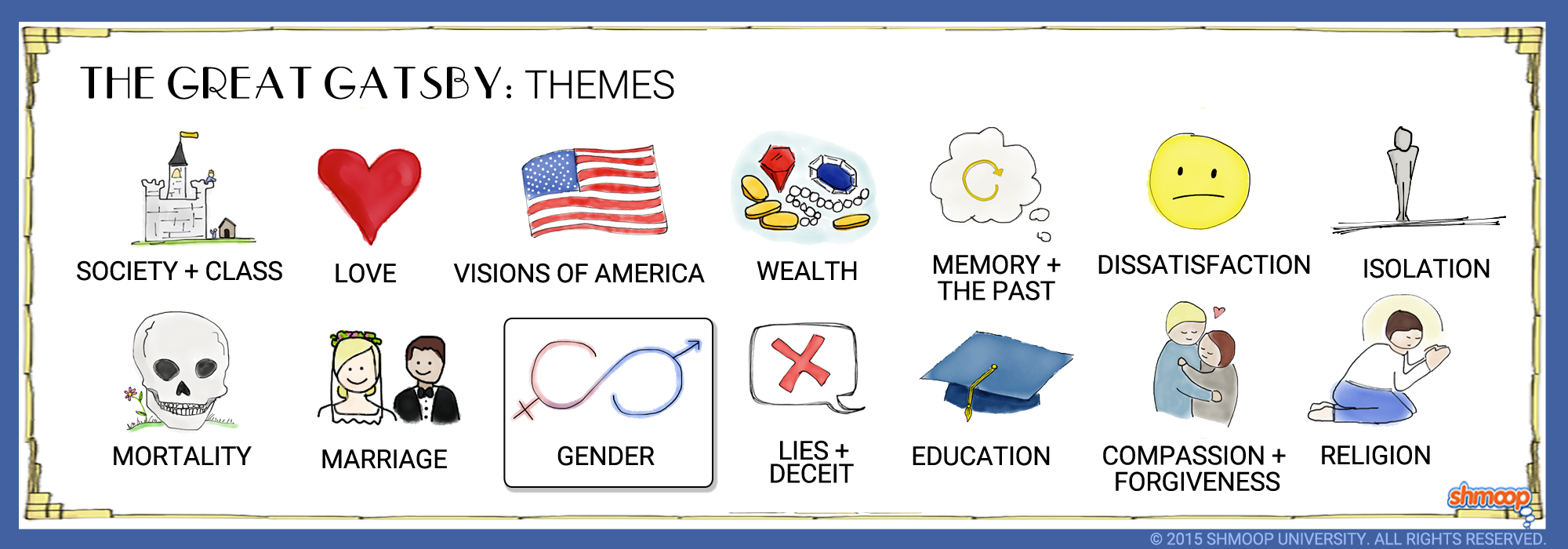
 (Click the themes infographic to download.)
Here's a fun scavenger hunt for you: see where and how often the word "woman" shows up in The Great Gatsby. (Helpful hint: this online text is searchable.) We'll give you a hint: it's mostly in reference to lower class women, like Myrtle or some of the servants. Upper class women are "girls," like the "men and girls" who wander around Gatsby's garden (3.1). That doesn't quite tell you all you need to know about gender in The Great Gatsby, but it tells you a lot: Fitzgerald is no feminist, and neither, apparently, is Nick.
Questions About Gender
- How does class affect the expectations for male and female behavior?
- What is "work life" like for men of Tom's class, Nick's class, and George Wilson's class?
- How do men treat women in The Great Gatsby? How does Tom treat his wife, Daisy, and his mistress, Myrtle? How does Nick treat Jordan? How does Gatsby treat Daisy? How does George Wilson treat his wife, Myrtle? And how does the way that a man treats a woman comment on his character in this text?
- How do women behave at Gatsby's parties? Is this behavior "normal" or induced by alcohol?
- Does Daisy represent the "ideal woman" of the upper class? Why or why not?
- What do women want from men in The Great Gatsby? Is it different for different women? What do men want from women?
Chew on This
In The Great Gatsby, men and women don't make each other better; they just make each other worse. So much for chivalry.
Women in The Great Gatsby are mostly there to entice and subvert men. Without women messing things up, their lives would be a lot better.