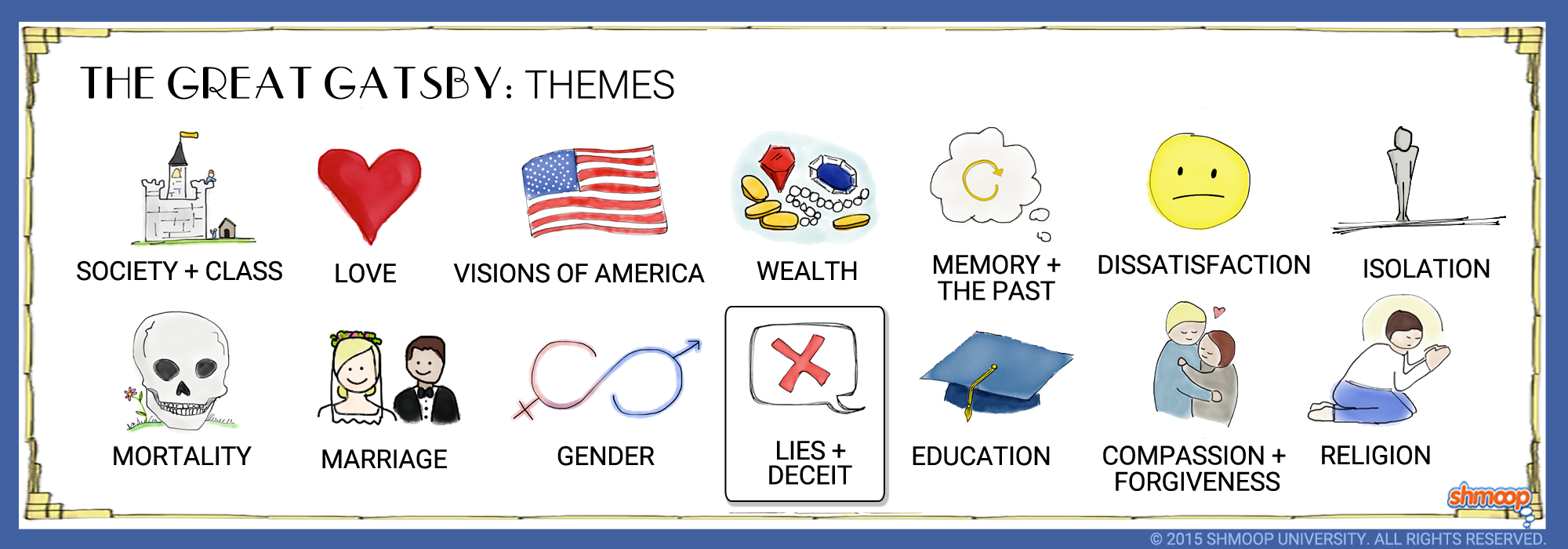
 (Click the themes infographic to download.)
Nick may say that he's one of the few honest people he knows, but we're not so sure about that. The Great Gatsby is built around lies, and why should this be any different? Human beings are inherently dishonest, whether they're male or female, born or made, poor or rich—and they're selfish, hypocritical, and destructive as well. And you may be able to fool your friends, but the eyes of God—or T. J. Eckleburg—are always watching.
Questions About Lies and Deceit
- At one point, Jordan claims that Nick deceived her. Is this true? Or was Jordan deceiving Nick? What kind of dishonesty is she talking about, anyway?
- Nick briefly mentions that Tom discovered Daisy's deception very close to the time that Wilson discovered that of his own wife. How do these men each deal with the discovery? Does it make them seem more similar, or highlight their differences? Check out what Nick says about it.
- Nick assures us he is "one of the few honest people" he knows. How does this affect the way we read his story? Do we trust his narration?
- Are Nick and Gatsby more similar than Nick would like to admit? Is it possible to see Nick and Gatsby as possessing the same fundamental characteristic of deception?
- In the showdown scene at the Plaza, Daisy Buchanan is ultimately honest with her husband and Gatsby despite what she might lose. Why does she choose honesty?
Chew on This
In The Great Gatsby, Nick Carraway presents himself as the voice of reason and reliability, yet ultimately he proves to be an unreliable narrator.
Nick Carraway and Jay Gatsby are two sides of the same coin: each has built a successful façade to fool others, yet they can now no longer distinguish their true selves from the one they have created for the world.