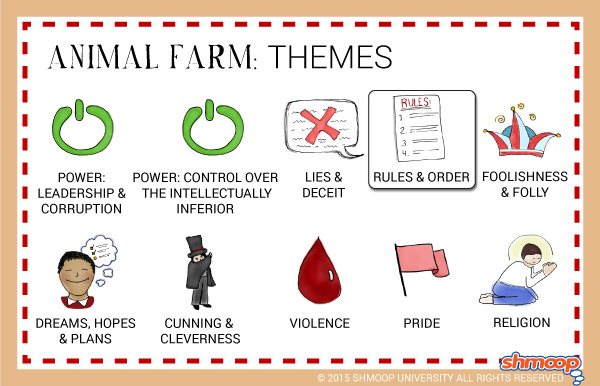
 (Click the themes infographic to download.)
Out with the old, in with the new: in Animal Farm, the animals get rid of an old set of rules just to find themselves oppressed by a new one. At first, new commandments and traditions are supposed to energize and unite the animals. But these rules turn out to be not so much rules as easily changed suggestions—especially because most of the animals don't read so good (and don't remember so good, either). Instead of preserving order, rules are used to deceive and abuse. Gee, it's a good thing that never happens in our world.
Questions About Rules and Order
- The animals establish tons of traditions on the farm, and certain routines become cyclic and expected. Is the action of the plot itself — that is, the cycle of oppression-rebellion-corruption, a routine tradition? Could it be? Maybe Benjamin hints at this when he says, "Donkeys live a long time. None of you has ever seen a dead donkey."
- What rules change? Why do they get altered in this order? Which changes are the most significant?
- Do the Seven Commandments seem like solid rules? Could a society that truly lived by those rules succeed?
Chew on This
The shifting rules, customs, and traditions of Animal Farm parallel the decay of Animalism and the ideals of Old Major.
Although the pigs have many ways of oppressing the other animals, their use of rules and order is the most powerful.