Symbolism, Imagery, Allegory
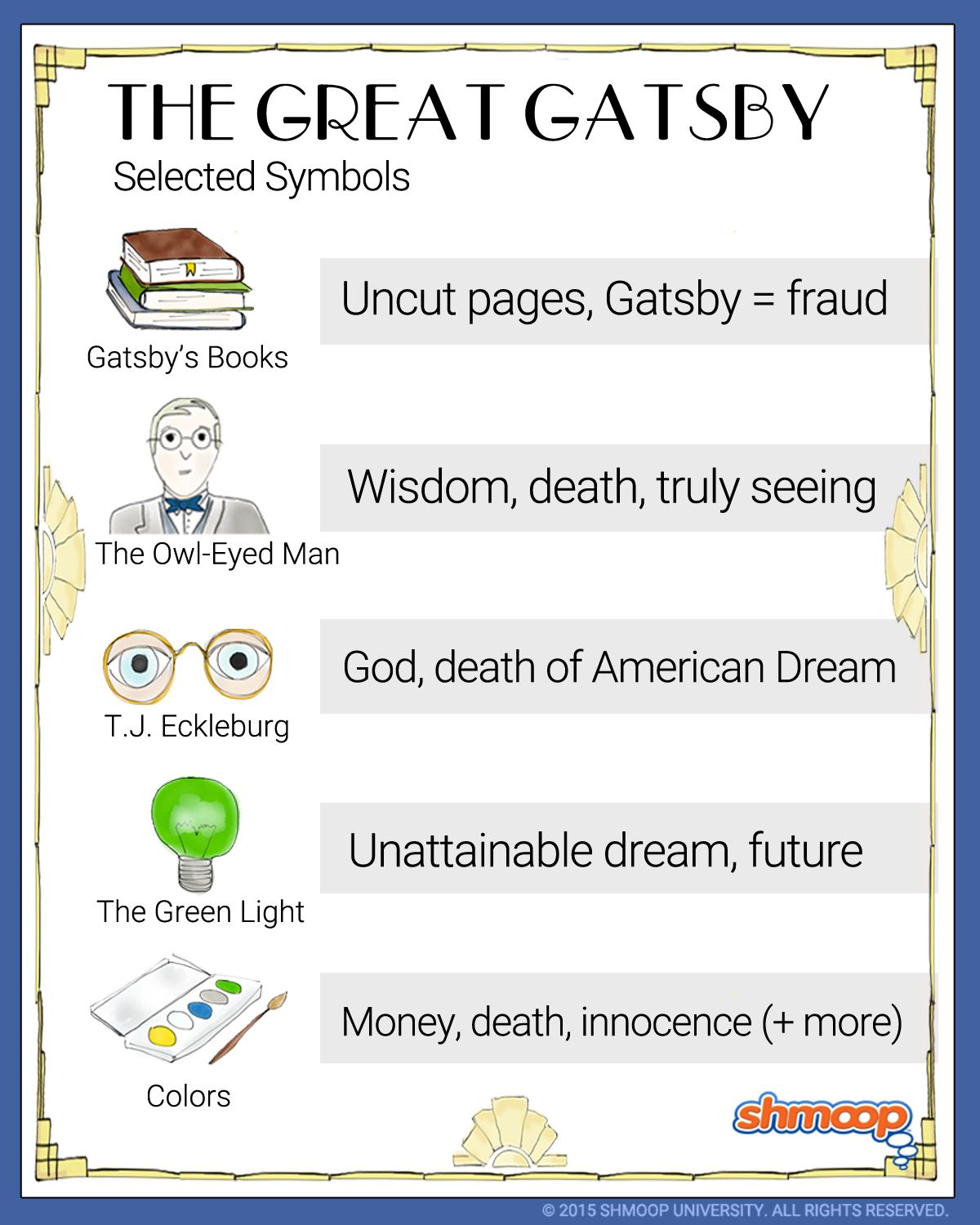
(Click the symbolism infographic to download.)
Somewhere Over the Rainbow
The green light isn't the only symbolic color in Great Gatsby. Fitzgerald uses color like a preschooler let loose with tempera paints—only a little more meaningfully. Let's break it down:
Yellow and Gold: Money, Money, Money. Oh, and Death.
First off, we've got yellows and golds, which we're thinking has something to do with…gold (in the cash money sense). Why gold and not green? Because we're talking about the real stuff, the authentic, traditional, "old money"—not these new-fangled dollar bills. So you have Gatsby's party, where the turkeys are "bewitched to dark gold," and Jordan's "slender golden arm[s]" (3.19), and Daisy the "golden girl" (7.99), and Gatsby wearing a gold tie to see Daisy at Nick's house.
But yellow is different. Yellow is fake gold; it's veneer and show rather than substance. We see that with the "yellow cocktail music" at Gatsby's party (1) and the "two girls in twin yellow dresses" who aren't as alluring as the golden Jordan (3.15). Also yellow? Gatsby's car, symbol of his desire—and failure—to enter New York's high society. And if that weren't enough, T. J. Eckleburg's glasses, looking over the wasteland of America, are yellow.
White: Innocence and Femininity. Maybe.
While we're looking at cars, notice that Daisy's car (back before she was married) was white. So are her clothes, the rooms of her house, and about half the adjectives used to describe her (her "white neck," "white girlhood," the king's daughter "high in a white palace").
Everyone likes to say that white in "The Great Gatsby" means innocence, probably because (1) that's easy to say and (2) everyone else is saying it. But come on—Daisy is hardly the picture of girlish innocence. At the end of the novel, she's described as selfish, careless, and destructive. Does this make the point that even the purest characters in Gatsby have been corrupted? Did Daisy start off all innocent and fall along the way, or was there no such purity to begin with? Or, in some way, does Daisy's decision to remain with Tom allow her to keep her innocence? We'll keep thinking about that one.
Blue: This One's Up For Grabs
Then there's the color blue, which we think represents Gatsby's illusions -- his deeply romantic dreams of unreality. We did notice that the color blue is present around Gatsby more than any other character. His gardens are blue, his chauffeur wears blue, the water separating him from Daisy is his "blue lawn" (9.150), mingled with the "blue smoke of brittle leaves" in his yard.
His transformation into Jay Gatsby is sparked by Cody, who buys him, among other things, a "blue coat"—and he sends a woman who comes to his house a "gas blue" dress (3.25). Before you tie this up under one simple label, keep in mind that the eyes of T.J. Eckleburg are also blue, and so is Tom's car. If blue represents illusions and alternatives to reality, maybe that makes the eyes of God into a non-existent dream. As for Tom's car…well, you can field that one.
Grey and a General Lack of Color: Lifelessness (no surprise there)
If the ash heaps are associated with lifelessness and barrenness, and grey is associated with the ash heaps, anyone described as grey is going to be connected to barren lifelessness. Our main contender is George Wilson: "When anyone spoke to him he invariably laughed in an agreeable colorless way" (2.17). George's face is "ashen," and a "white ashen dust" covers his suit (2.17), and his eyes are described as "pale" and "glazed." We're not too surprised when he shows up with a gun at the end of the novel.
Green: Life, Vitality, The Future, Exploration
Last one. We're thinking green = plants and trees and stuff, so it must represent life and springtime and other happy events. Right?
Well, the most noticeable image is that green light we seem to see over and over. You know, the green light of the "orgastic future" that we stretch our hands towards, etc. etc. (9.149). Right before these famous last lines, Nick also describes the "fresh, green breast of the new world," the new world being this land as Nick imagines it existed hundreds of years before. Green also shows up—we think significantly—as the "long green tickets" that the rich kids of Chicago use as entry to their fabulous parties, the kind of parties where Daisy and Tom meet, and where Gatsby falls in love. So green does represent a kind of hope, but not always a good one.
When Nick imagines Gatsby's future without Daisy, he sees "a new world, material without being real, where poor ghosts, breathing dreams like air, drifted fortuitously about...like that ashen fantastic figure gliding toward him through the amorphous trees." Nick struggles to define what the future really means, especially as he faces the new decade before him (the dreaded thirties). Is he driving on toward grey, ashen death through the twilight, or reaching out for a bright, fresh green future across the water?