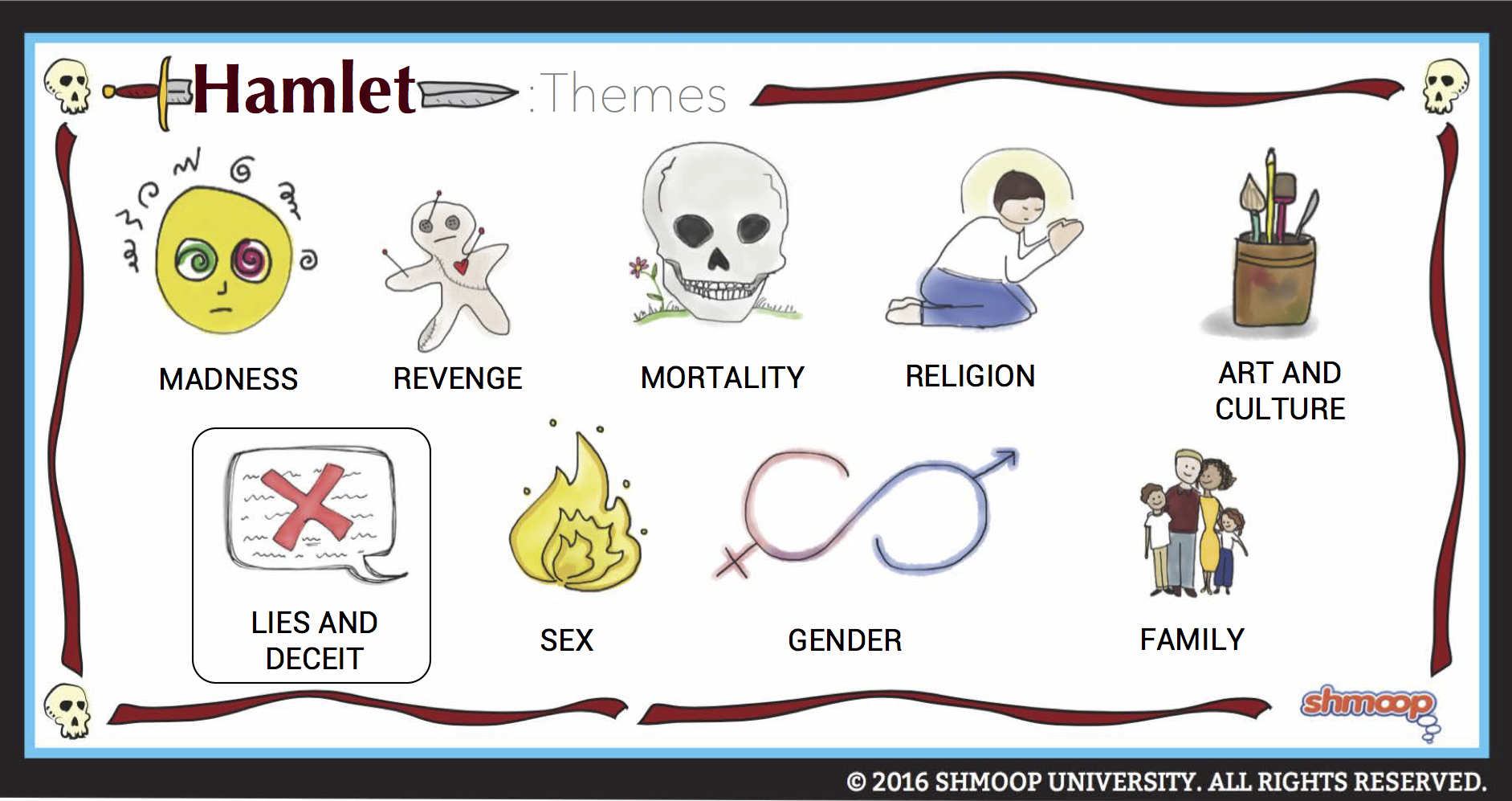
 (Click the themes infographic to download.)
For someone who hates deception, Hamlet sure finds himself coming up with a lot of lies. Hamlet depicts a seamy political world, where deception is a necessary part of life and political "spin" rules the day. In other words, it's a lot like our world—and like pretty much every political court or congress in history. No wonder directors seem to think it's infinitely adaptable: lies and deceit aren't limited to one time or place.
Questions About Lies and Deceit
- What is Hamlet's stance towards deception or "seeming?" Does he provide any explanation as to why he is so disgusted by these things? Are we supposed to share his opinion?
- How do characters other than Hamlet discuss deception? Who in the play engages in some kind of deception or deceit? Which characters avoid deception completely?
- Does Hamlet himself avoid deception? Is he a hypocrite?
- Polonius says, "To thine own self be true / and it must follow, as the night the day / Thou canst not then be false to any man." Is this evaluation of truth and deception backed up by the play? Does Polonius follow his own advice? Does anyone follow it?
Chew on This
Hamlet is miserable not just because of his father's death, but because he craves honesty while everyone else around him is engaged in deception and manipulation.
Hamlet's form of justice involves punishing every character that practices deception, often by his own form of treachery.