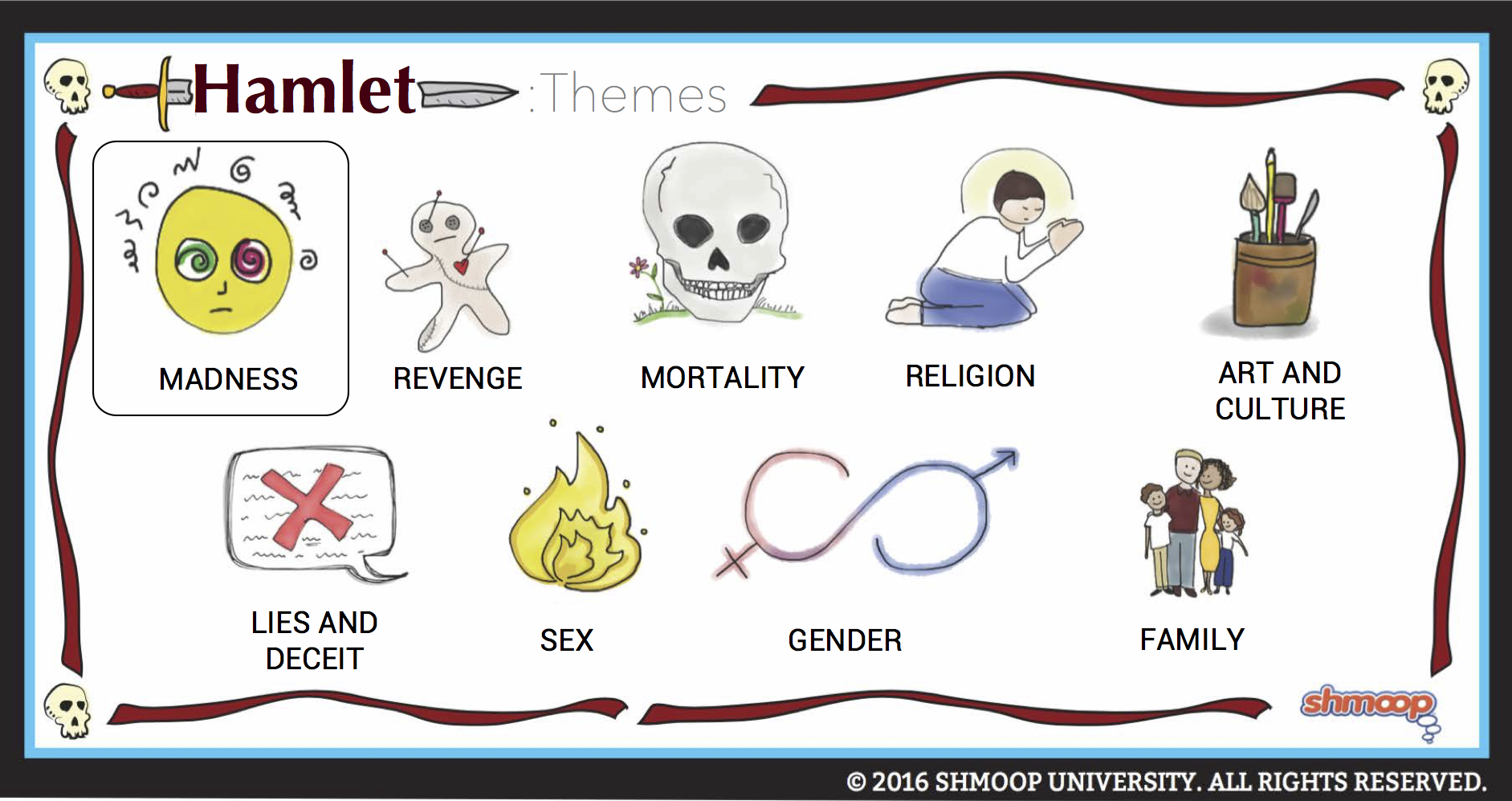
 (Click the themes infographic to download.)
Obfuscating insanity —uh, faking madness to throw people off—is one of the oldest tricks in the book. In Hamlet, Shakespeare takes it up a notch: does Hamlet truly go "mad," or is the cuckoo-talk, like the play itself, all an act? And if madness is a form of theatricality (maybe with some "method" in it, as Polonius says) —does that mean that all actors are crazy?
Questions About Madness
- What does Hamlet mean when he says he's going to put on an "antic disposition" (1.5.175)? Why does Hamlet play the role of an "antic"? What's purpose does it serve?
- We know that Hamlet says he's going to pretend to be insane. Is there textual evidence in the play that Hamlet actually does descend into madness?
- What is the difference between Hamlet's madness and Ophelia's? Is there a marked difference in their behavior and speech?
- What causes Ophelia to go mad? What purpose does her madness serve in the play? What textual evidence would you use to support your claim?
Chew on This
While Hamlet's "mad" behavior starts out as an "antic disposition," his mental state deteriorates over the course of the play so that he ends up legitimately insane.
It's impossible to know whether or not Hamlet is actually "mad," because our uncertainty about Hamlet's mental state is supposed to mirror the play's general ambiguity and doubt.