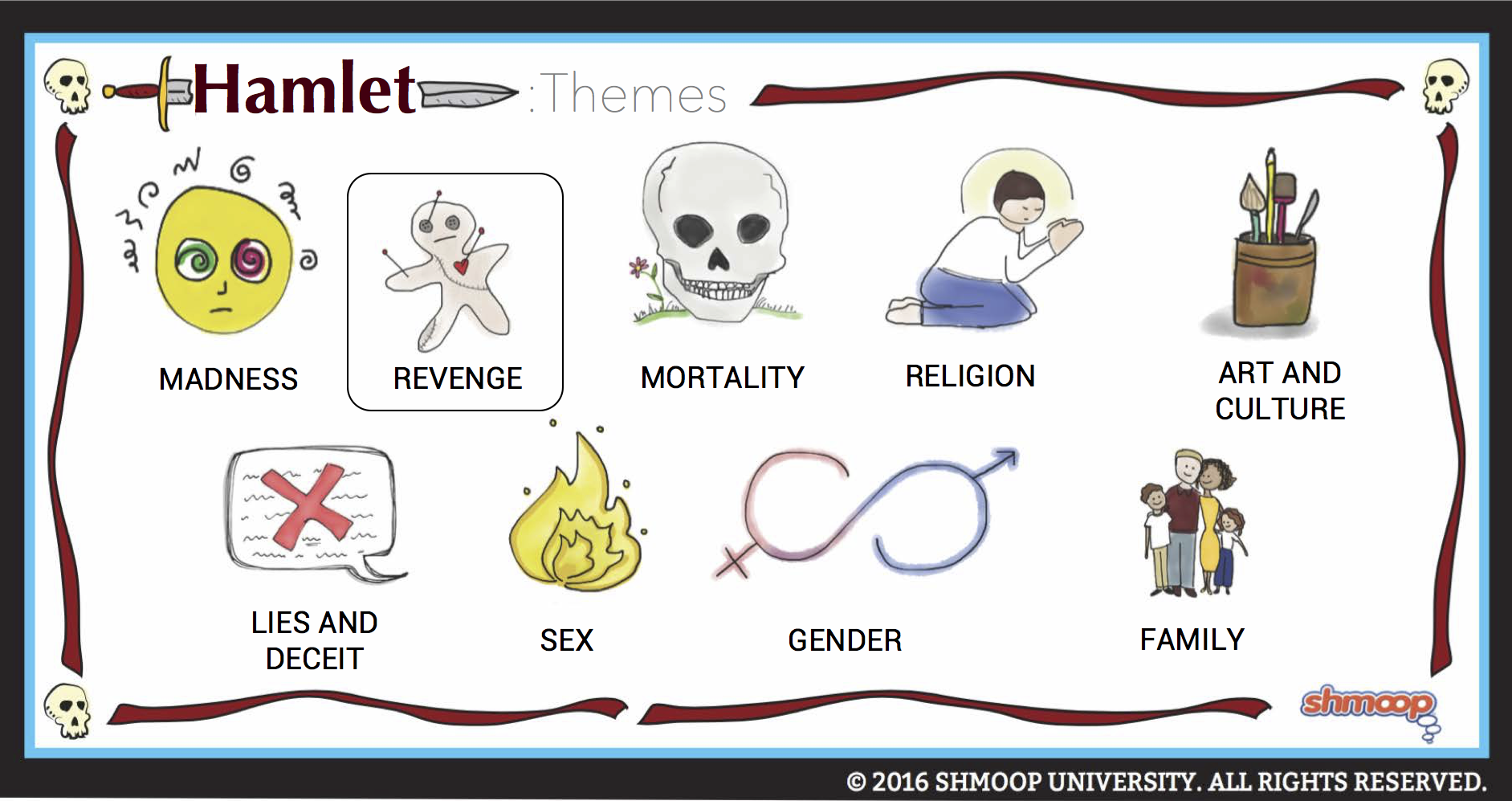
 (Click the themes infographic to download.)
Ghosts, perverse family drama, and a vow of revenge: Hamlet is all geared up to be a traditional bloody revenge play… and then it grinds abruptly to a halt. The play isn't about Hamlet's ultimately successful vengeance for his father's murder at all—that's taken care of in about two seconds during Act 5. Instead, most of the play is concerned with Hamlet's inner struggle to take action. Our point? The play is a lot more interested in calling into question the validity and usefulness of revenge than in satisfying the audience's bloodlust—although, sure, it does that too. Shakespeare had a theater to fill, after all.
Questions About Revenge
- How does Hamlet's attitude toward revenge change throughout the play? When does he talk about revenge? How does what he says about revenge match what he actually does?
- How does Hamlet's attitude toward revenge contrast with Fortinbras's or Laertes's approach?
- Why does Hamlet delay so much in avenging his father's murder? Is there a part of him that doesn't really want to take revenge?
Chew on This
Hamlet deals with three revenge plots, all of which involve a son seeking vengeance for the death of a father. In the end, though, the resolution of each revenge plot highlights the inadequacy of revenge.
Hamlet's delay is what separates the play from other revenge tragedies; it's also what marks the play as modern.