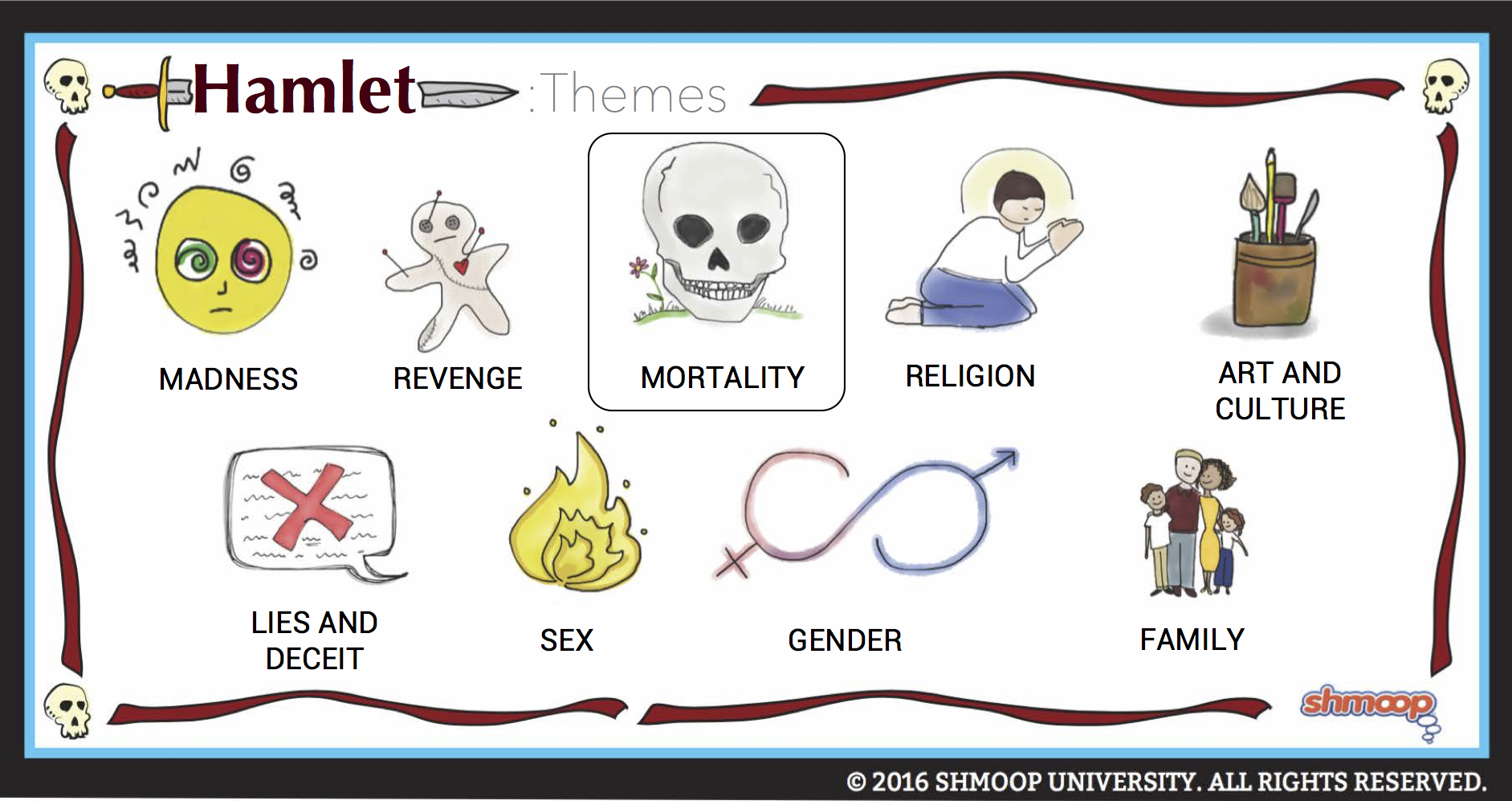
 (Click the themes infographic to download.)
Hamlet may talk—and talk, and talk—about suicide, but what he's really concerned with is mortality, and the fact that the living world is made of death and decay. (Yeah, we know that life looks pretty grim when you put it that way. Sorry.). From Hamlet's initial confrontation with a dead man's ghost to the final bloodbath, the play is trying to come to grips with just this problem: if we all die eventually, then does it really matter who kills us?
Questions About Mortality
- Why does Hamlet wish his "too, too solid flesh would melt"? What's the cause of his suicidal tendencies? Under what circumstances, and at which moments of the play, does Hamlet dwell on the possibility of ending his own life?
- What counterarguments for suicide does Hamlet provide throughout the play? Do the arguments change or evolve in any way?
- How does Ophelia's suicide parallel or contrast with Hamlet's discussions of suicide? In what forms does Hamlet encounter death in the play?
- In what ways do people in Hamlet die? Would it be fair to call Hamlet a catalogue of murders?
- What fascinates Hamlet about death? In what ways does he explain or evaluate death? What kinds of language does he use? Do other characters put forth perspectives on death?
Chew on This
The fact that Hamlet is still talking about suicide even after he has sworn to avenge his father shows that the Prince's problems lie much deeper than simple grief over his father's murder.
Hamlet's anger against his mother is rooted in the fear that if someone's life can be so easily forgotten after death, life itself has no meaning. His crisis is therefore an existential one, not one of morality.