Character Analysis
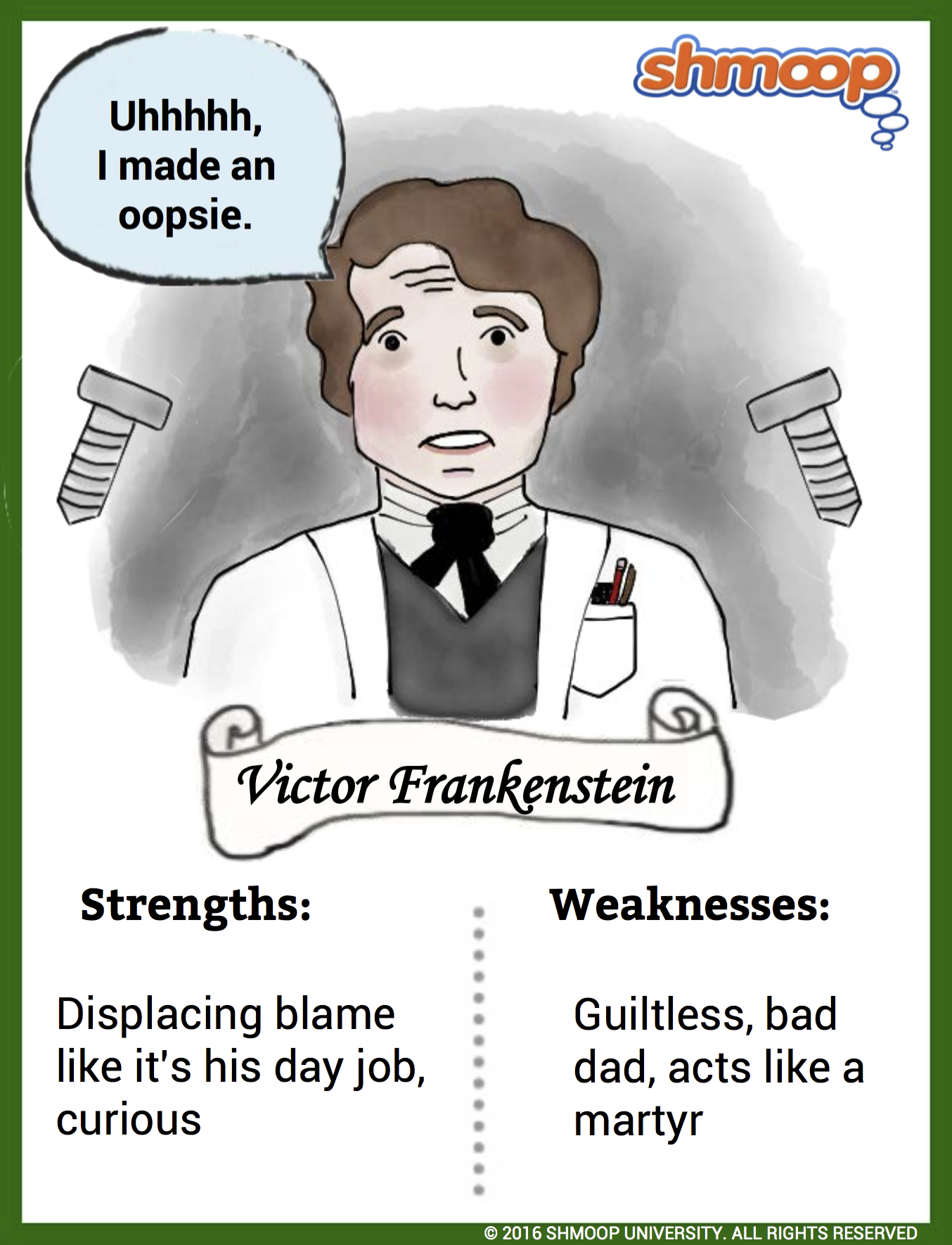
(Click the character infographic to download.)
If you ask us, it's no coincidence that people get Mr. Frankenstein and his monster mixed up. He may have conquered the secrets of nature, but he's a big dunce when it comes to, oh, everything else. So, how did this kid messing around with the nineteenth-century equivalent of a chemistry set end up on a suicide mission over frozen Artic wastes?
Curiosity Killed the Cat
Luckily, Frankenstein gives us a really detailed account of his personality as a child. "The world," he says, "was to me a secret which I desired to divine" (2.1); "Curiosity, earnest research to learn the hidden laws of nature … are among the earliest sensations I can remember"; and "It was the secrets of heaven and earth that I desired to learn" (2.4).
Anyone else getting a little mad scientist vibe, here? The point is, Victor tells us (1) that he's curious, and more importantly, (2) he's always been this way. By insisting that he's been curious since he was a little kid, he almost makes it so we can't blame him for his actions. He was just born this way.
Victor even gives us a little more evidence that he's just victim of his genes by pointing out that he had a happy childhood:
My parents were possessed by the very spirit of kindness and indulgence. We felt that they were not the tyrants to rule our lot according to their caprice, but the agents and creators of all the many delights which we enjoyed. When I mingled with other families I distinctly discerned how peculiarly fortunate my lot was, and gratitude assisted the development of filial love. (2.3)
But is that convincing? Is Victor really trying to absolve himself of any responsibility by insisting that he just couldn't help himself?
Not entirely … because he also seems to blame his father and his teachers. When he starts obsessing over the alchemist Cornelius Agrippa, he blames his father for not "tak[ing] the pains to explain to me that the principles of Agrippa had been entirely exploded" (2.7) and then leaving him to "struggle with a child's blindness" (2.9). And then, when he finally goes off to university, his teacher of natural philosophy M. Krempe is a "little squat man with a gruff voice and repulsive countenance" (3.12)—which sends him straight off to study chemistry with the sexy M. Waldman:
This professor was very unlike his colleague. He appeared about fifty years of age, but with an aspect expressive of the greatest benevolence; a few grey hairs covered his temples, but those at the back of his head were nearly black. His person was short but remarkably erect and his voice the sweetest I had ever heard. (3.14)
Again, Victor makes excuses. He couldn't help being interested in chemistry because M. Krempe was ugly and M. Waldman was essentially George Clooney. He couldn't help wanting to know the secrets of nature. He couldn't help that his father didn't tell him not to waste time with alchemists. It's destiny's fault: "Destiny was too potent, and her immutable laws had decreed my utter and terrible destruction" (2.12). Does this sound like a man who's repentant that he created (in more ways than one) a terrible monster?
Take Responsibility
To us, not so much—although, toward the end of his story, he does seem to consider that he just might have some responsibility for his actions. The key moment here is when he decides to destroy Mrs. Monster:
Had I right, for my own benefit, to inflict this curse upon everlasting generations? I had before been moved by the sophisms of the being I had created; I had been struck senseless by his fiendish threats; but now, for the first time, the wickedness of my promise burst upon me; I shuddered to think that future ages might curse me as their pest, whose selfishness had not hesitated to buy its own peace at the price, perhaps, of the existence of the whole human race. (20.1)
Is this sound logic? Maybe. But look at the way he phrases it: he's worried that people will be mad at him. He doesn't say anything about whether he's actually wrong—he's just worried about being perceived as wrong. Don't know about you, but this doesn't sound like real maturity to us.
And then look at one of his very last speeches, when he says, "Never will I give up my search until he or I perish; and then with what ecstasy shall I join my Elizabeth and my departed friends, who even now prepare for me the reward of my tedious toil and horrible pilgrimage!" (24.11). On the one hand, fine: we accept that he's ready to hunt down this merciless killer. On the other hand, "tedious toil" and "horrible pilgrimage" sound a lot like he's making himself out to be some sort of martyr, when, um, the whole situation is totally his fault.
Sorry, Frankenstein. We're just not buying it.
Mommie Dearest
The monster refers to Frankenstein as his creator, so we're tempted to think of him as a father figure and talk about the ways he's a deadbeat dad. But we don't think that's entirely accurate. We think it's a lot more likely that Shelley saw him as a mean mommy.
Now, we don't necessarily want to get all psychoanalytic on our authors. But, when it comes to Frankenstein, a lot of scholars actually think there's a good reason to. See, Mary Shelley's mom was Mary Wollstonecraft, a radical chick who suggested that women could do a lot more than curl their hair and have babies. She even shocked, well, everybody by having several public and unconventional love affairs, before marrying atheist philosopher William Godwin and dying from childbirth complications after giving birth to Mary.
And Mary Shelley herself was pregnant three times during and around the period in which she wrote Frankenstein (one son, one daughter, and one miscarriage), so it would make sense that she had some anxiety around childbirth. Let's take a look at the passage in which Frankenstein describes creating the monster:
My cheek had grown pale with study, and my person had become emaciated with confinement … the moon gazed on my midnight labours, while, with unrelaxed and breathless eagerness, I pursued nature to her hiding-places… My limbs now tremble, and my eyes swim with the remembrance; but then a resistless and almost frantic impulse urged me forward; I seemed to have lost all soul or sensation but for this one pursuit. (4.9)
During the nineteenth century (and in many other centuries), women—at least, wealthy women—went into "confinement" during the later stages of pregnancy, where they holed up in their rooms either with the idea that confinement would protect the baby or because good manners forbade nice ladies from showing evidence that they'd actually had sex. Paleness and emaciation would have been common side-effects of difficult pregnancies, and, well, we don't need to explain "midnight labours."
Not convinced? Trembling limbs, frantic impulses, losing soul and sensation—these are suspiciously similar to the experiences of women in labor. And then, what does Frankenstein do when he finally sees that his creation "breathed hard, and a convulsive motion agitated its limbs" (5.1)? He falls asleep: "At length lassitude succeeded to the tumult I had before endured" (5.3).
To us, this act of scientific creation sounds suspiciously similar to pregnancy, confinement, labor, and birth. The question is, what does it mean? Is she saying that Frankenstein is even more messed up than we thought, because he's trying to create life without a women? Is Shelley saying that this kind of scientific pursuit is somehow feminine? Or is she just using Frankenstein to work out her own issues around maternity and motherhood?
Isn't It Romantic
There's some backstory here: Shelley's husband Percy Bysshe was one of the Big Six, a group of English poets who would later be hailed as the be-all and end-all of the Romantic movement in literature. (They may not have thought of themselves as the Big Six back then, but they still thought pretty highly of themselves.) What did you need to be a Romantic poet? (1) A lot of feelings; (2) A healthy sense of self importance; (3) A sense of yourself as a lone individual trekking out to bring knowledge and enlightenment to the rest of the world; (4) An ability to sense the Sublime in nature.
Sound familiar? Victor Frankenstein just might be the perfect Romantic. (We'll talk about how the monster might be a Romantic figure in his own "Character Analysis.") We already know that he's a dreamer with a big ego; let's look at how he feels about nature:
During this short voyage I saw the lightning playing on the summit of Mont Blanc in the most beautiful figures. The storm appeared to approach rapidly, and, on landing, I ascended a low hill, that I might observe its progress. It advanced; the heavens were clouded, and I soon felt the rain coming slowly in large drops, but its violence quickly increased. While I watched the tempest, so beautiful yet terrific, I wandered on with a hasty step … This noble war in the sky elevated my spirits; I clasped my hands, and exclaimed aloud, "William, dear angel! this is thy funeral, this thy dirge!" (7.22-24)
Victor appears to see nature as being beyond his control. It's massive, overpowering, frightening, and yet somehow "beautiful": in other words, it's sublime.
But even here, we think Victor isn't entirely honest with himself. When he first gets to the valley, he communes with nature: "Dear mountains! my own beautiful lake! how do you welcome your wanderer? Your summits are clear; the sky and lake are blue and placid. Is this to prognosticate peace, or to mock at my unhappiness?" (7.20).
Notice how he can't help talking about "his" mountains and lake, as though nature exists just to make him feel better? Okay, we could forgive him that—but then we remembered that he describes himself as always wanting to "penetrate the secrets of nature" (2.7).
Hm. We're no Freudians, but we can't help thinking that Dr. Frankenstein might still have some issues to work out—and, given what happens to this perfect Romantic and everyone he loves, that Mary Shelley might have some issues to bring up with her husband.