Character Analysis
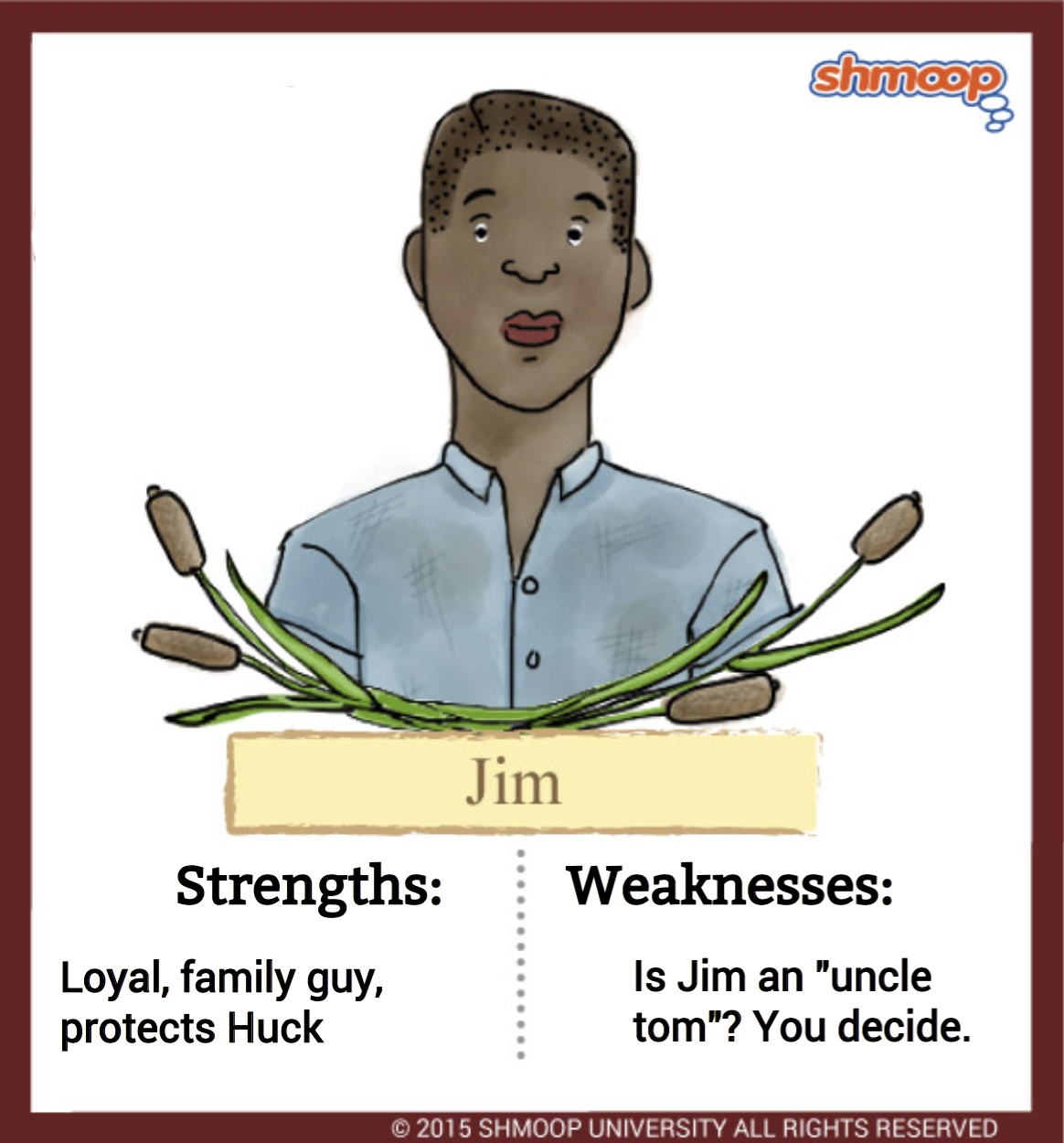
(Click the character infographic to download.)
Jim is a slave. For most people living in the pre-Civil War South, that's about all there is to know. Who cares about a slave's motivations, or character, or background, or feelings? It would be like trying to psychoanalyze your family pet—or not even, since that's apparently a thing that exists.
But Twain is smarter than that—and so is Huck, eventually. Jim is every bit as complex a character as Huck is, and maybe even more. So what makes him tick?
Friends Forever
Well, for one, loyalty. Jim sees Huck as the only "white genlman dat ever kep' his promise to ole Jim" (16.16), and Jim repays him: he shelters Huck from seeing his dead father; he lets Huck sleep through his watch, staying up all night to keep lookout ("he often done that" (23), says Huck); and practically dancing a jig when he realizes that Huck actually is alive. "It's too good for true, honey, it's too good for true," he says: "Lemme look at you chile, lemme feel o' you" (15.19).
Just for contrast, check out the way Huck's own father greets him after not having seen him for a year: "You think you're a good deal of a big-bug, don't you" [5.4]. Warms your heart, doesn't it? Jim may not exactly be a father figure to Huck, but he's doing a much better job looking out for him than Pap is.
Jim's loyalty extends to Huck's friends, too. When the doctor is operating on Tom Sawyer after the boy's been shot, Jim pops out of his hiding place to help save the kid, risking his own life and (he thinks) giving up his hard-earned freedom.
The Magic Hairball
For all his practical street smarts—or, uh, river smarts, Jim has a superstition for every occasion. Cooking dinner? Don't count your food. See a snakeskin? Don't touch it. Bit by a rattlesnake? Kill it, roast it, and eat the meat. (Tastes like chicken.) Oh, and tie the rattles around your wrist. Got a big hairball? Use it to tell fortunes.
This may all sound a little silly, but is it any sillier than Miss Watson's religion, which will send you straight to hell if you slouch? Or Aunt Sally, who thinks that spirits must have stolen Jim away? Or Huck himself, who wants to throw salt over his left shoulder when he pills it?
We think not. Jim is a product of his time. Sure, maybe he's a little goofier and more committed to these superstitions than Huck or Tom. But can he help it? He's a slave. He was never sent to school or coerced into going to church. In fact, Jim might actually smarter than Huck, or at least has more natural smarts. Huck may think he's silly not to know that some people speak languages other than English, but, come on, he has a point: why do people speak so many different languages?
Family Man
So, we know that Jim is loyal, and we know that he's superstitious. But what does he want? What makes Jim run away, when we really get the impression that he's basically okay with being enslaved?
Family.
He finds out that Miss Watson is planning to sell him down to New Orleans, where he'd be separated from his family. And Jim loves his family. Huck is a little surprised by this, actually, saying, "I do believe he cared just as much for his people as white folks does for their'n. It don't seem natural, but I reckon it's so" (23).
Uh, okay, Huck.
But the point is, Jim loves his family. We never see him interact with them—although we do see a sort of disturbing incident where he smacks around his deaf daughter, although, to be fair, he didn't know she was deaf—but, based on the way he treats Huck, we're going to guess that he's a pretty good dad.
In the end, Jim gets what he wants: freedom. He also gets the respect of the white folks, who say, like Huck, that he's a "good" black man.
Uncle Tom
And that brings us to our final point. Is Jim an "Uncle Tom" character? Uncle Tom is a character in Harriet Beecher Stowe's Uncle Tom's Cabin (shock!). He's a gentle, childlike slave who's totally loyal to his white masters. So, to call someone an "uncle tom" is an insult. Basically, it's like calling someone a brownnoser or a suck up, except, well, worse.
So, Jim. Is Jim unrealistically helpful to Huck? Is his gentleness and nature-smarts a way of making him seem primitive and simpler than the white guys? Or is Twain actually just trying to show that a black man can be a complex character?
You decide.
 Jim's Timeline