Character Analysis
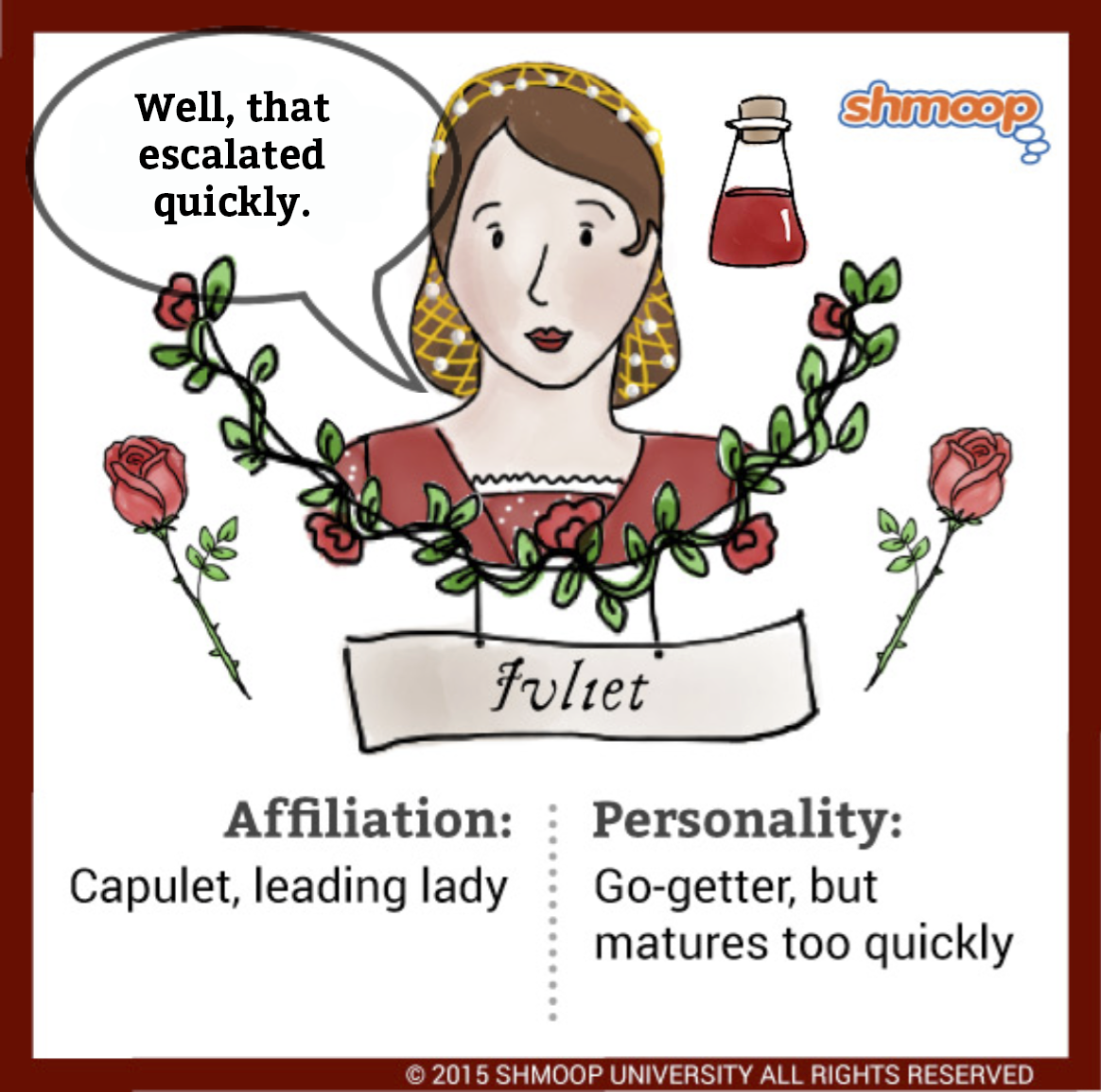
(Click the character infographic to download.)
Poor Juliet. Not only does she end up dead, she doesn't get nearly the love that Romeo does. (Have you ever heard some girl described as "such a Juliet"? And would you even want to be that girl?)
But we think she deserves a lot more credit. As the beautiful and only daughter of the Capulets, Juliet is slated to marry Verona's hottest non-Montague bachelor until she takes her fate into her own hands. This is a girl who knows what she wants, and gets it—even if it means death.
More Than Just a Pretty Face
Juliet may be beautiful, but she's also much more than just a pretty face. She's smart, witty, and determined; it's Juliet, after all, who proposes to Romeo, not the other way around: "If that thy bent of love be honorable, / Thy purpose marriage, send me word tomorrow," she says (2.2.150-151), basically telling Romeo to put a ring on it, only much more beautifully. (Sorry, Beyoncé. Love ya.)
In fact, she might even be the play's real protagonist: she speaks to the audience most frequently (often a good indicator of who is important in a Shakespeare play), and her character undergoes the greatest evolution during the course of the play. She also gets to speak some of Shakespeare's most poetically beautiful lines.
Growing Up Is Hard to Do
Juliet starts out as a naïve girl who's dependent on her family and ends up a woman willing to desert that family to be with the man she loves—over the course of five days. (What have you done this week?) Let's walk you through it:
When we first meet Juliet, she's insisting that marriage is "an honor that I dream not of" (1.3.71), i.e. she's not even thinking about it. But the minute she meets Romeo, she's sending her nurse to find out if he's married. That's a pretty quick change from "boys drool" to writing Mrs. Romeo Montague on her Lisa Frank Trapper-Keeper.
We see this change again when she goes from essentially insisting that she could never love a Montague even if he is super dreamy, to "My bounty is as boundless as the sea / My love as deep. The more I give to thee / the more I have, for both are infinite" (2.2.140-142). The next step? S-E-X. By the end of Act 3, Scene 2, Juliet has basically completed her entire adolescence in a matter of a few minutes: from "boys are icky" stage to "boy band crush" stage to "make me a woman" stage:
Gallop apace, you fiery-footed steeds,
Towards Phoebus' lodging. Such a wagoner
As Phaethon would whip you to the west,
And bring in cloudy night immediately.
Spread thy close curtain, love-performing night,
That runaways' eyes may wink and Romeo
Leap to these arms, untalked of and unseen.
Lovers can see to do their amorous rites
By their own beauties; (3.2.1-9)
To translate this kind of obscure passage: Juliet cannot wait for the night to come so Romeo can have sex with her. And she's not ashamed. She might be nervous and a little scared, but she doesn't apologize for wanting to go to bed with her husband: this is serious business to her.
Our clearest example of this change is when the Nurse breaks the hopeful mood of the scene with the news that Romeo has killed Tybalt. Juliet's first reaction is to grieve over her cousin and reject Romeo as just another heartless Montague. But then she changes her mind: in a single monologue, Juliet decides to choose loyalty to her new husband over love of her family:
My husband lives, that Tybalt would have slain,
And Tybalt's dead, that would have slain my
husband.
All this is comfort. Wherefore weep I then? (3.2.115-118).
What's cool about this is that Shakespeare uses the very words she's speaking to show the switch: in the first two lines, "husband" and "Tybalt" actually switch places. For a woman in Shakespeare's time, this is exactly what marriage meant: your priority was now your husband and your husband's family. Married to Romeo, Juliet is literally no longer a Capulet.
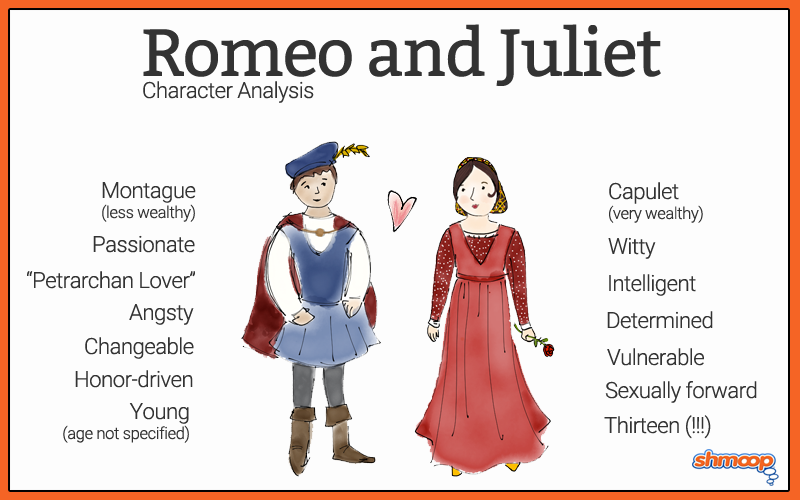 (Click the comparison infographic to download.)
Juliet's Vulnerability
It's also important to realize that Juliet's path to suicide is different than Romeo's. Romeo has been banished from his home city, but he still has contact with his family and friends. Juliet, on the other hand, has been systematically stripped of the support of everyone around her. She has to undergo a brutal series of scenes that take her from saying good-bye to Romeo after their wedding night, to the news that she is supposed to marry Paris, to her father's rage when she refuses, to a meeting with Paris himself.
So, does she have a choice? Her father threatens to throw her out of the house onto the streets if she doesn't marry Paris. Her mother nearly disowns her. Even the Nurse turns against her. Juliet, for all the emotional maturity she gained throughout the play, is still a woman. As far as we can tell, she hasn't really been anywhere besides her home and Friar Laurence's. She has no idea how to survive in the outside world, especially in the Elizabethan world where women couldn't really function without husbands and fathers, unless they were prostitutes. AND, in case you forgot, she's thirteen years old.
Oh Yeah, About That
So, why is Juliet so young? Before you start saying that girls always married young before the 20th century, stop: it's not true. In fact, most women in Elizabethan England married in their twenties, just like most women throughout European history (source). (Aristocratic women did tend to marry a little earlier, but certainly not at an average of age 13.)
And it's not like Shakespeare didn't know what he was doing: before we even meet Juliet, the Nurse gives us a long speech about how old she is (she's going to turn fourteen in two weeks, on Lammas-Eve—so, the night before August 1st.)
The way we see it, we have two options:
(1) Shakespeare made Juliet so young as a dig at those crazy Catholics off in Italy, who married their kids off when they were still, well, kids. Possible, but not too interesting.
(2) Way more interesting: Lammas is a traditional harvest festival, but Juliet is born right before the harvest festival. So, it's almost as though Shakespeare is saying her long summer of growing is over—and it ends before she gets the "bounty" of the harvest. By making her so young, Shakespeare emphasizes both Juliet's rapid maturity and the tragic waste of youth caused by the family feud. What do you think?
Juliet's Timeline