Character Analysis
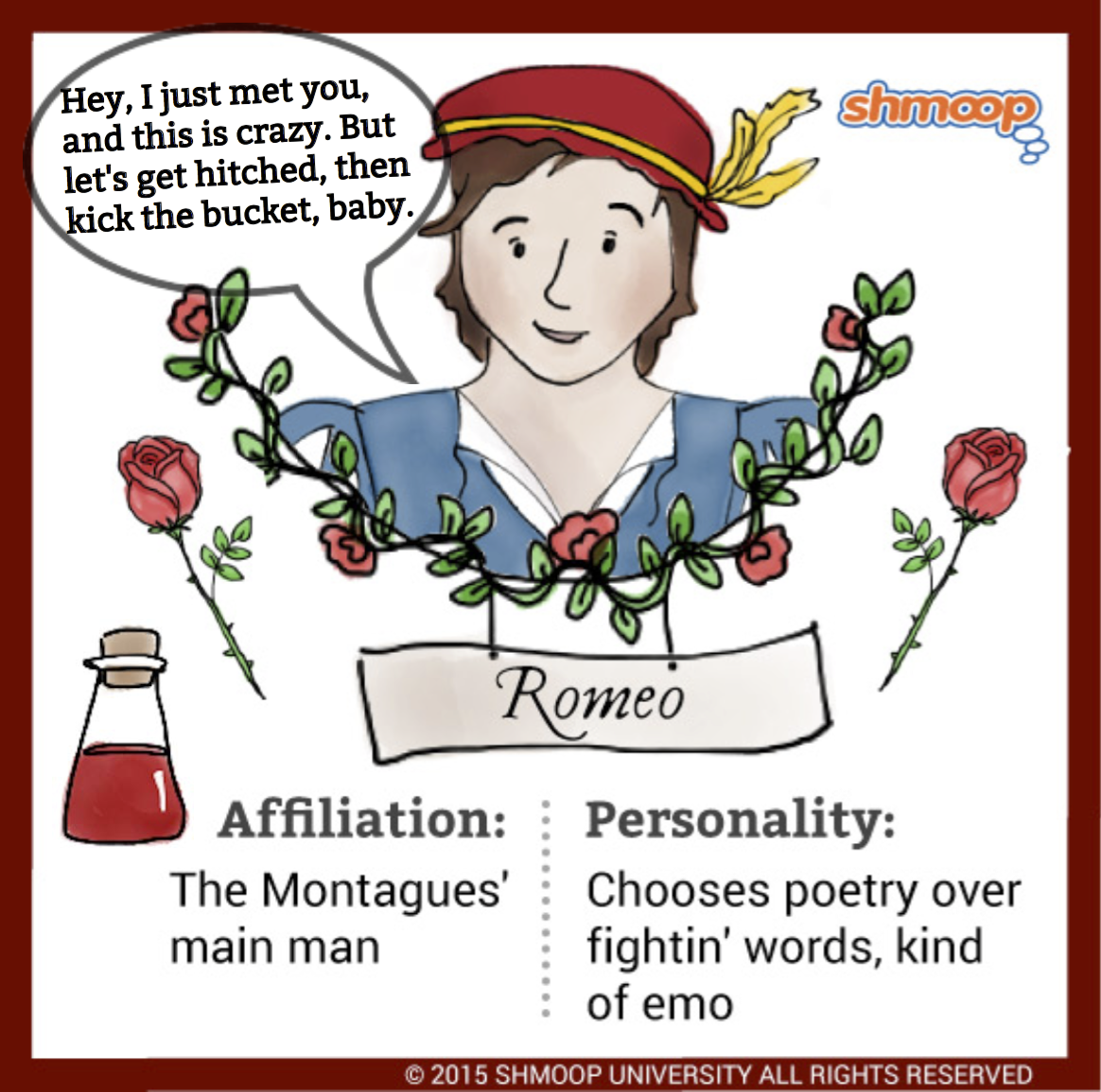
(Click the character infographic to download.)
Romeo: literature's greatest lover… or literature's greatest player? Sure, his name has practically become synonymous with true love 4EVA, but let's look at the facts: he's the young son of the affluent Montague family who lusts after the unavailable, but oh-so gorgeous Rosaline—right up until he sets eyes on Juliet Capulet, only daughter of his family's arch enemies, and falls in love at first sight.
Hm. We have to say, we're not entirely convinced. Let's take a closer look at this guy.
You Can't Spell "Romeo" Without "Emo"
If you find yourself occasionally annoyed by Romeo, you're in good company. He's emotional and angsty (plus he always has his hair in his eyes), and it drives some people crazy. His over-the-top infatuation with Rosaline at the beginning of the play, immediately followed by, um, completely forgetting about Rosaline, can make Romeo seem shallow and foolish. No sooner does he meet Juliet than he starts insisting, "I have forgot that name and that name's woe." (2.3.49).
The thing to know is that Shakespeare makes lovesick Romeo (the Romeo that crushes on Rosaline anyway) shallow and foolish on purpose. In fact, at the beginning of the play, his character is made to resemble a typical "Petrarchan lover," which had become a cliché by the time Shakespeare wrote Romeo and Juliet (around 1595). Petrarch was a fourteenth-century Italian poet whose sonnets were all the rage in Renaissance England. These love poems featured "Laura," a gal who was just as unavailable and unattainable as Rosaline.
So, a "Petrarchan lover" is the kind of guy who mopes around sighing dramatically, moaning about the fact that his crush wants nothing to do with him, and reciting cheesy poetry about some angelic girl who's got eyes like stars, lips like luscious cherries, and who fills men with icy-fire (passion). In other words, the next lead singer for Dashboard Confessional.
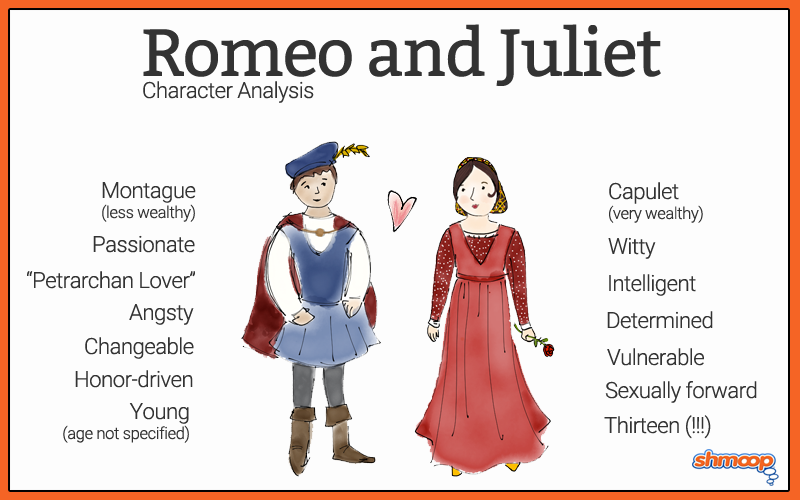 (Click the comparison infographic to download.)
Rosaline Schmazaline
Ugh, right? Well, maybe not. When was last time you switched your crush like a pair of worn-out tennis shoes? Romeo may not be shallow so much as he's just … a person. A teenaged person, to be more specific. Even though Romeo breaks out a conventional pick-up line when he first chats it up with Juliet (he basically says that hooking up with Juliet would be a religious experience), he ends up seeming genuinely in love with Juliet. After all, he does vow to "lie with thee tonight"—i.e., kill himself—as soon as he hears that she's dead (5.1.37), and then he actually follows through with it.
That said, we should note that some skeptics think the only difference between Romeo's desire for Rosaline and his passion for Juliet is the fact that Juliet, unlike Rosaline, loves Romeo back. What do you think?
Ch-Ch-Changes
But, does Romeo's seemingly more authentic love for Juliet mean that Romeo evolves and matures as a character over the course of the play?
On the "Yes" side: Sure, Romeo's puppy love for Rosaline gives way to a more grown up relationship with Juliet.
On the "No" side: Romeo never changes. He's rash and impetuous throughout the entire play, whether he's trespassing on Capulet property to see Rosaline, running off to elope with Juliet, or chugging a vial of poison when he mistakenly believes Juliet is dead.
To be fair, Romeo does show restraint when Tybalt challenges him, which is a big deal, since Romeo damages his reputation when he refuses to fight. But, Romeo winds up killing Tybalt after Mercutio is murdered. He follows up this act of murder, by the way, with a bout of hysterics on the floor of Friar Laurence's cell (room).
In fact, some scholars (ahem, Harold Bloom) think that Juliet actually deserves someone better than Romeo—he just can't keep up. What do you think? Are they a match made in heaven , or are they just two dumb kids who only want to be together because forbidden love is sexy?
A Lover, Not a Fighter?
Romeo may be acting a teensy bit rash when he kills Tybalt, but in general the boy's a lover, not a fighter. Let's recap a bit. When the Capulet and Montague servants start a big brawl in the opening scene, Shakespeare goes out of his way to let us know that Romeo is not out on the streets of Verona like all the other young men. In fact, his mom asks, "O, where is Romeo? Saw you him today? / Right glad I am he was not at this fray" (1.1.118-119). Romeo, as it turns out, has been off doing what Romeo does best…daydreaming about a girl. It seems that love has a whole lot to do with Romeo's disinterest in fighting.
Later, when Tybalt wants to rumble (because Romeo crashed the Capulet party earlier), Romeo flat out refuses to fight because he doesn't want to hurt his new wife: "But love thee better than thou canst devise … And so, good Capulet, which name I tender / As dearly as my own, be satisfied" (3.1.70; 72-73).
So why does Romeo end up killing Tybalt, anyway? Well, most obviously, Tybalt kills Romeo's BFF, Mercutio, and Romeo feels responsible. Does this mean Romeo's friendship with Mercutio is more important to him than his marriage to Juliet? What do you think? If your answer is "yes," then you should also know that Romeo wouldn't be the only Shakespeare character to prioritize bromance over marriage. Think about Antonio and Bassanio in The Merchant of Venice, for example.
Second, and perhaps more importantly, Romeo is feeling pretty ashamed that he didn't fight Tybalt earlier and he blames it all on his love for Juliet:
O sweet Juliet,
Thy beauty hath made me effeminate
And in my temper softened valor's steel! (3.1.118-120)
Translation: Romeo thinks that loving Juliet has made him into a "softened" wimp. Turns out, many Elizabethans believed that love (between a man and a woman, that is) could turn a man into a wimp. (That's right: being "effeminate" didn't mean you were acting like a woman; it meant you liked women a little too much.)
The point we're trying to make is this: the pressure to be a "man" (which involves a lot of sword fighting in this play) eventually gets to Romeo. He caves in to the idea that masculinity and violence go hand in hand. And, we all know that when Romeo kills Tybalt his actions have some major consequences—Romeo is banned from Verona, which leads to him to seek out some pretty bad advice and guidance from Friar Laurence, which basically leads to the deaths of both Romeo and Juliet.
So, what leads to Romeo's tragedy? Not so much the family feud as the social pressure to "be a man"—and to carry out destructive, tragic, revenge-style violence. Hm, Romeo and Juliet is starting to look a lot less like a love story.
Romeo's Timeline