Character Analysis
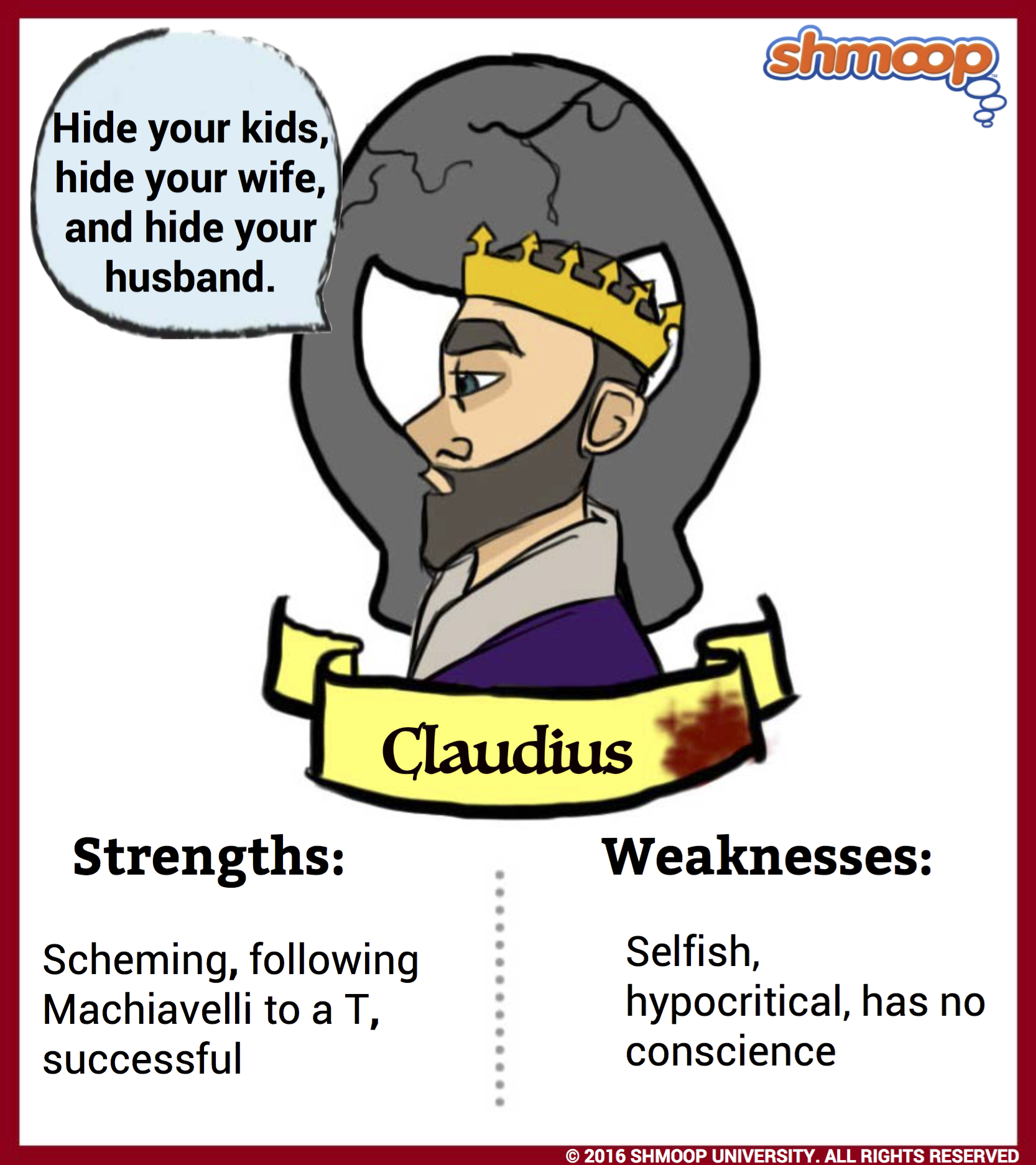
(Click the character infographic to download.)
Uneasy lies the Head that Wears the Crown…
Especially if he got it through sibling-cide and quasi-incest. That's our man Claudius, the current king of Denmark. He's married to his dead brother's wife Gertrude, which makes him Hamlet's uncle and stepfather. Make that evil stepfather: Claudius murdered the previous king, Hamlet's father. Is it just us, or did it just get really cold in here?
Claudius is so evil that he's practically a cartoon villain. And we have to ask: what sort of man would murder his brother, basically usurp the throne, and then plot to have his nephew killed?
Claudius and Biblical Allusion
Let's take a look first at how Claudius went about his dastardly deeds. Fact #1: He murdered Old King Hamlet by pouring poison in Old King Hamlet's ear while the guy was sleeping peacefully in his garden. Hm. Brothers killing brothers sounds pretty familiar. Claudius is definitely aligned with Cain, the Biblical figure whose claim to fame is committing the first murder ever, when he offed his brother, Abel. Even Claudius admits his "offence is rank [and] smells to heaven [because] / It hath the primal eldest curse upon't, / A brother's murder (3.3.36-38).
Claudius' murderous deed in the garden also recalls the Biblical story of the Fall. The Ghost (of Old Hamlet) says "[t]he serpent that did sting [Hamlet's] father's life / Now wears his crown. (1.5.46-47) The Ghost also goes on to say "that that incestuous, that adulterate beast, / With witchcraft of his wit, with traitorous gifts […] won to his shameful lust / The will of [Old Hamlet's] most seeming-virtuous queen (1.5.49-53).
In other words, the Ghost is comparing Claudius to the infamous serpent who seduced Eve in the Garden of Eden. (We talk more about gardens in "Symbols, Imagery, Allegory," so be sure to check that section out.) Our point? Claudius kind of is a cartoon villain. He's a distillation of the most basic, fundamental evil in a Christian worldview: Cain, the original murderer; and the Serpent, who got Adam and Eve kicked out of the Garden.
The King is Dead; Long Live the King!
Claudius is definitely a bad man: nice guys don't kill their brothers and steal their wives. But he might not be such a bad ruler. William Camden said in 1586 that Richard III—another of Shakespeare's tricky kings—was a "bad man, but a good king" (source). Could we say the same about Claudius?
Well, he did do a pretty spectacular job of assuming the throne. As he says himself, he had to convince the nobles of the court to accept his bizarrely timed and probably sinful marriage to Gertrude, all "discretion fought with nature" and talking about his "wisest sorrow" (1.2.5; 6). In other words, he says, he really didn't want to marry Gertrude, but the kingdom needed him. Convincing? It convinced the entire court, everyone except Hamlet.
Aside from crown-stealing and wife-stealing, Claudius goes on to diplomatically avoid war with Norway. Remember that the trouble between Denmark and Norway began when Old King Hamlet accepted Old Norway's challenge to a duel in which the winner would walk away with some of the other ruler's lands. His willingness to gamble away part of his kingdom suggests he wasn't exactly the terrific king his son remembers. In any case, Claudius cleans up the mess with Norway when his negotiations prevent Old Norway's son (Fortinbras) from attacking Denmark in order to retrieve Norway's lost territory.
Later in the play, Claudius manages to talk his way out of Laertes' rebellion, too. Even at swordpoint, Claudius manages to calm the kid down and convince him that he is innocent of Polonius' death by telling Laertes to "speak, man" and ordering Gertrude to "let him demand his fill" (4.5.143; 147). He gives Laertes a voice and treats him like an equal—well, sort of. He pretends to listen to him, while really he's just manipulating the poor kid. But the point is that Laertes invades the palace with a bunch of "rabble" (4.5.112), and still Claudius comes out on top —and wearing his crown.
Claudius as Machiavellian Ruler
There's a reason Claudius is so good at kingcraft: he seems to be a pretty diligent student of one Niccolò Machivelli, whose Prince (1532) was basically a self-help guide for rulers looking to get and maintain power. According to Machiavelli's theory, being a successful ruler has nothing to do with being a nice person or doing the right thing. Instead, it's about being inventive, charismatic, willful, and manipulative. Controversial, sure—but also super popular in Shakespeare's day.
So it seems that the same characteristics that make Claudius a bad man are those that make him a successful king. He has no qualms about manipulating people, and he is unapologetically selfish. Hypocrisy barely bothers Claudius: he pretends to be a loving stepfather to Hamlet even while sending him off to be killed. Claudius doesn't let his conscience get in the way of the job that needs to be done. He also lets Gertrude drink a goblet of wine he knows is poisoned, since he'd rather see his wife die than risk ruining his plans.
Okay, let's give him a little credit. He does manage a "Gertrude, do not drink"—but opts out of the perhaps more effective, "Gertrude, do not drink, whatever you do, as the wine is poisoned because I'm secretly trying to kill your son, and even though I really would rather have him dead, I'm not willing to let you go down as a casualty of my despicable and unlawful scheming."
Claudius' Timeline