Character Analysis
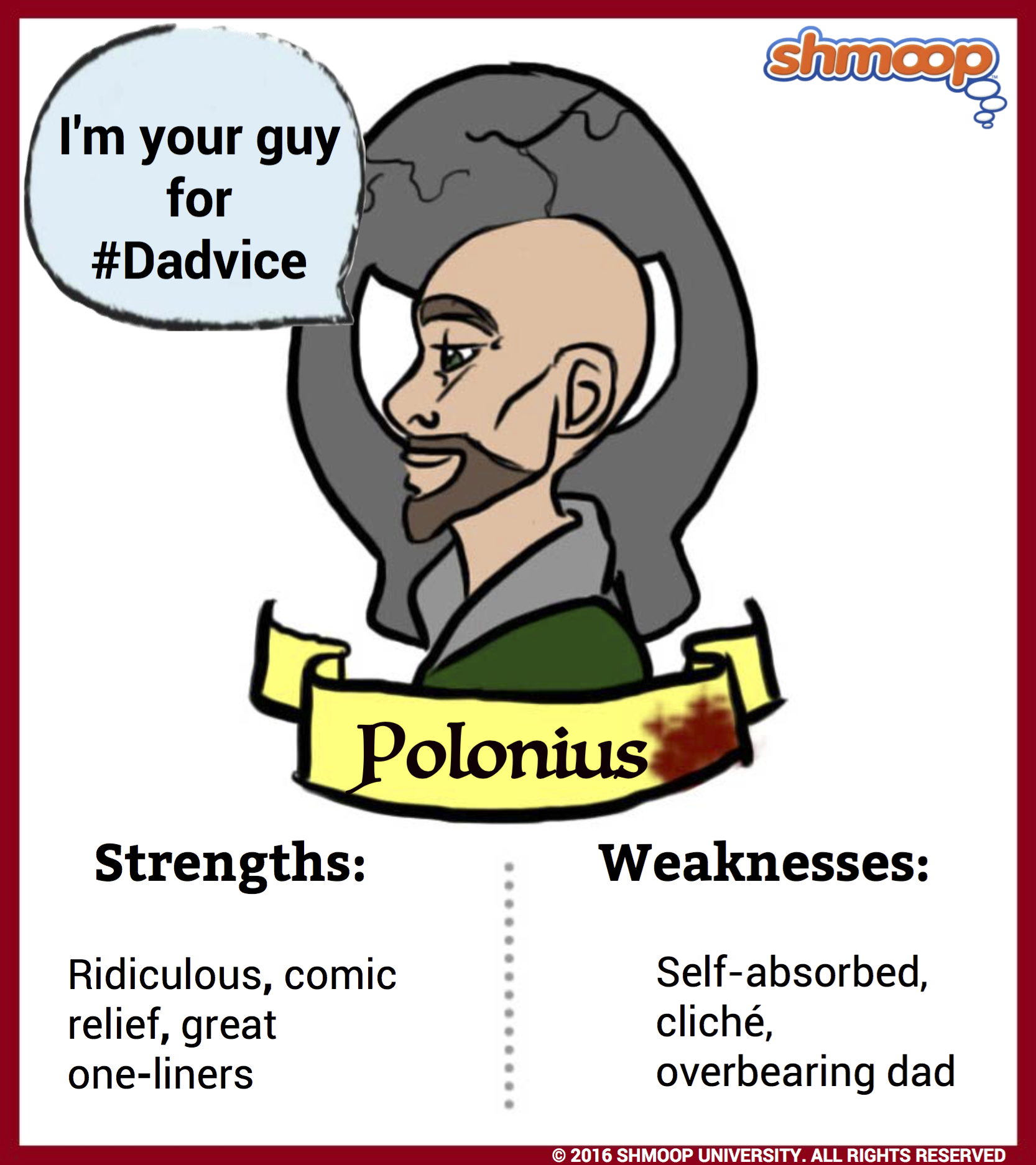
(Click the character infographic to download.)
A Danish lord, Polonius is the father of Laertes and Ophelia. And he's exactly the kind of dad who's so embarrassing that you don't even want to bring friends to meet him: he's self-absorbed, long-winded, and dull. (Not to mention that he's totally bugged your car with a GPS tracking device.) So, what's going on with this bad dad?
Comic Relief
Played by the right actor, self-absorbed, long-winded, and dull becomes completely hilarious. Check out the scene where Hamlet's directing the players (actors). Polonius is hilarious. When one of the players delivers a heart-wrenching speech about Priam's death, Polonius interrupts to say (and we are not making this up). "This is too long" (2.2.523) (Admit it: you were thinking it, too.)
He also cuts in at their use of the words "mobled queen" to say "Oh, that's good; 'mobled queen' is good." Basically, this is SNL-type humor: Shakespeare is using Polonius to mock his less sophisticated audience members, whose theatrical tastes are less developed than the ideal playgoer. (Brain Snack: you're not alone in thinking that "mobled" is a bizarre word, even for Shakespeare. Some editors substitute the word "ennobled.")
Check the Source
It's weird, then, that Polonius gets some of the play's most famous lines. Quoted out of context, they even sound like good advice. "Neither a borrower or a lender be"? Sure, we can get behind that. "To thine own self be true"? Yep, that also sounds like pretty solid advice.
But, given that Polonius is the one telling us/ Laertes these little tidbits of wisdom, are we supposed to take it seriously? Is Shakespeare actually making fun of this cheery, cliché, How to Win Friends and Influence People type of early self-help? (You just know Polonius would have written a self-help book.)
Ugh, Dad
As comical and ridiculous as Polonius is, his elaborate attempts to keep tabs on Laertes and Ophelia remind us that fathers can't always be trusted to care for their children. This is especially true when Polonius pays Reynaldo to spread rumors about Laertes so that Laertes will confide in Reynaldo, who can then report back to Polonius (2.1.). Yikes!
Polonius is also all-too willing to use his daughter to get in good with the king —with disastrous consequences. His manipulative tactics leave Ophelia open to Hamlet's abuse and are probably partly to blame for Ophelia's tragic end. Brain Snack: Polonius isn't the only Shakespearean father to use his daughter in order to manage his relationships with other men. The "Comedy" plays are full of fathers who use their daughters as bartering tools. (Check out, for example, Baptista Minola in The Taming of the Shrew.)
Just Deserts
We don't think that anyone deserves to die, particularly not by being stabbed when they're just innocently hiding behind a curtain to eavesdrop on a private convo between a mom and son. But, given Polonius' tone-deaf advice, nasty habit of spying on pretty much everyone, and his obsequious sucking-up to the king—we can't exactly say we're surprised when he meets his end in just that way.
Polonius' Timeline