Symbolism, Imagery, Allegory
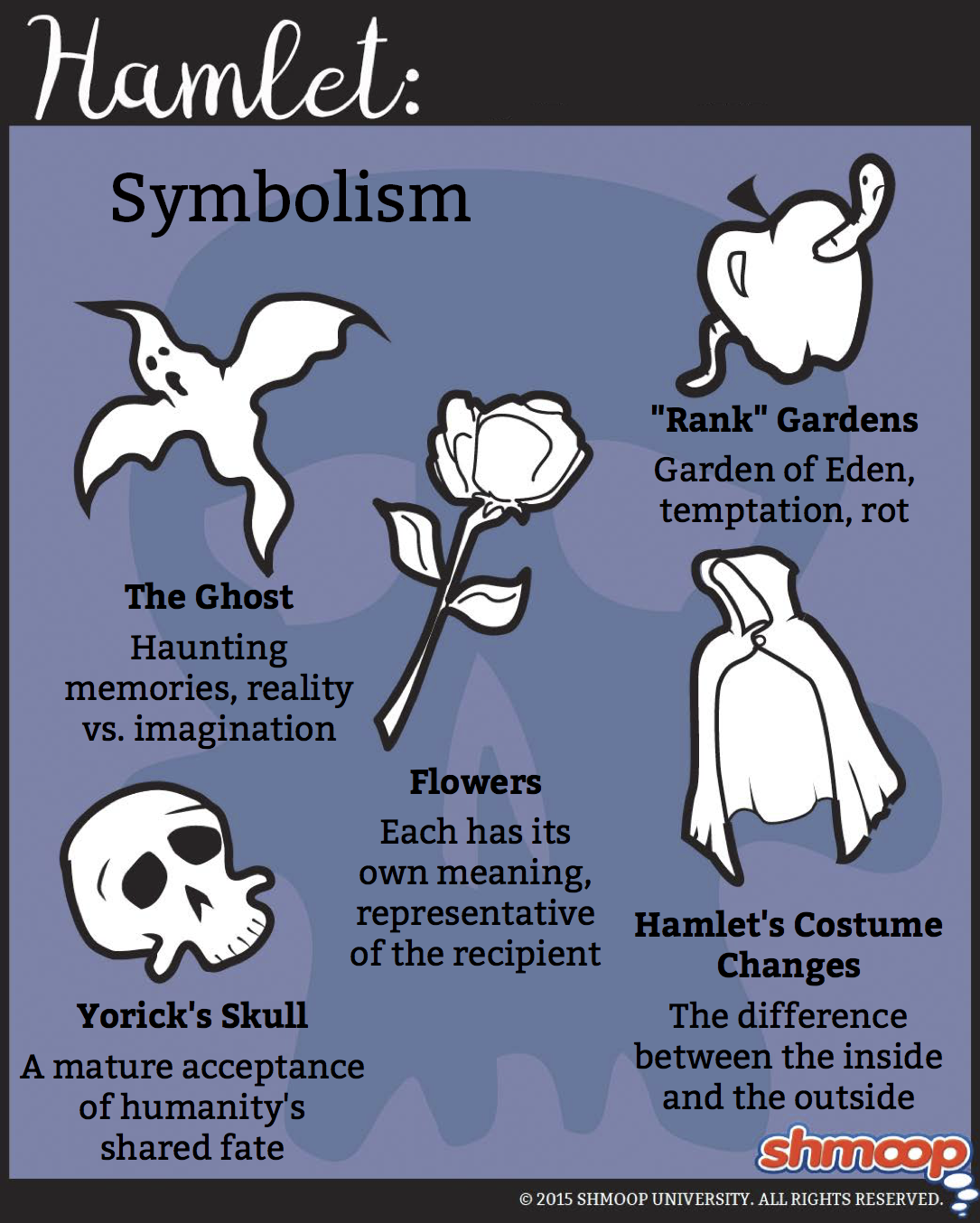
(Click the symbolism infographic to download.)
The gardens in Hamlet aren't necessarily the kind of places where you'd like to hang out and watch butterflies while you picnic. In fact, they're more like overgrown vacant lots than plots that have been tended and nurtured. According to Hamlet, the entire world "tis an unweeded garden, / That grows to seed; things rank and gross in nature / Possess it merely" (1.2.139-141).
Yuck. The word "rank" refers to the fertile overgrowth of vegetation and also implies the kind of festering and rot that often accompanies lush foliage. You know, push away that pretty vine, and underneath you see a rotting log with a bunch of icky white grubs. And the term "rank" turns up over and over again throughout the play. There's the "mixture rank, of midnight weeds collected" that the play-within-a-play's Lucianus pours in Gonzago's ear, or Hamlet's description of his mother's "rank" marriage bed:
Nay, but to live
In the rank sweat of an enseamed bed,
Stew'd in corruption, honeying and making love
Over the nasty sty, —(3.4.103-106).
Garden of Eatin'
Lit crit pro-tip: whenever you see gardens in Western literature, it's a pretty safe bet that there's at least some deep down allusion to the Garden of Eden. In this case, Hamlet's rank gardens recall Eve's temptation in the Biblical Garden of Eden, particularly when the Ghost reveals that Old King Hamlet was murdered by his brother, Claudius, while he slept in his orchard:
'Tis given out that, sleeping in my orchard,
A serpent stung me. So the whole ear of Denmark
Is by a forgèd process of my death
Rankly abused. But know, thou noble youth,
The serpent that did sting thy father's life
Now wears his crown. (1.5.42-47)
Funny thing: the Ghost sounds a lot like young Hamlet. Notice the way the Ghost insists the murder "rankly abused" the entire kingdom —as if Claudius poured poison in "the whole ear" of Denmark. What's more, the Ghost insists that Claudius' poison caused a scaly rash and "loathsome crust" to cover his once "smooth body" (1.5.79-80).
Sounds pretty rank to us.