Most good stories start with a fundamental list of ingredients: the initial situation, conflict, complication, climax, suspense, denouement, and conclusion. Great writers sometimes shake up the recipe and add some spice.
Initial Situation
Slave 4 U
Ten years after the Trojan War ended, the residents of Odysseus' great hall are being eaten out of house and home by parasitic suitors who won't take Penelope's no for an answer . Telemachos, Odysseus' son, is kind of a whiny weakling (love ya, Telly). And Odysseus himself is being held prisoner on the island of the nymph Kalypso—but nobody back in Ithaka knows that.
Conflict
Road Trip!
Finally, something changes—but not because Odysseus finally mans up and breaks free of Kalypso, and not because Telemachos finally mans up and kicks the suitors out. It's divine intervention. Zeus sends his messenger to force Kalypso into letting Odysseus leave, and Athene convinces Telemachos to go on his trip seeking news of his father. Will Odysseus make it home? Will Telemachos resolve his daddy issues?
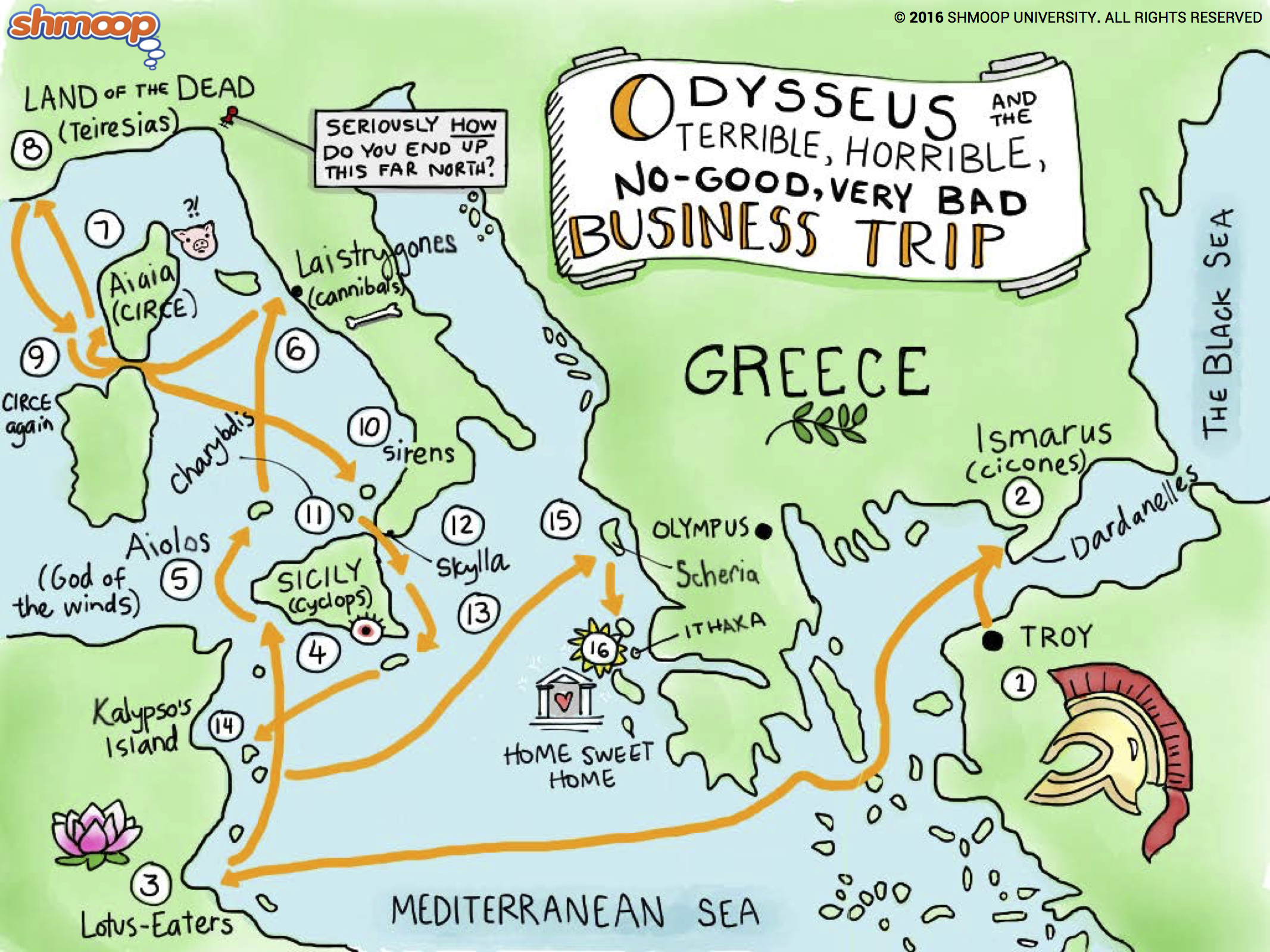 (Click the map infographic to download.)
Complication
Back to the Future
Well, he's not heading straight home, anyway. Poseidon whips up one more big storm to drive Odysseus onto the coast of the Phaiakians. In their court, he tells of all his adventures up to this point. Of course, the "complications" he tells about happened before the main epic begins—but, since they're all part of the long trip home, we'll count them. (Oh, and Telemachos is feasting with a bunch of Greek heroes.)
Climax
Home Sweet Home
When Odysseus and Telemachos reunite at the shepherd's cottage in Ithaka, their stories come together and they vow revenge. Aw! It's all downhill from here, right?
Um, have you ever tried running downhill? You think skiers have it easy? The homestretch is where you're likely to break your neck.
Suspense
Man of Mystery
First, there's the underlying danger of Odysseus entering the palace, which is full of a whole bunch of suitors who have been acting like he's dead, and would to keep things that way—permanently.
Then there are all the close calls, like when Theoklymenos prophesies that he has returned; when Argos the dog recognizes him; when Odysseus talks to Penelope face-to-face; and when Eurykleia recognizes Odysseus' scar while giving him a foot-bath.
And then there's Penelope's contest: whoever can string Odysseus' bow and shoot an arrow through twelve axe heads can have her hand in marriage. Who's it going to be—and who's going to make it out alive?
Denouement
Hello, Boys! I'm Back!
By stringing the bow, winning the arrow-shooting contest, and killing the suitors (with a little help from Telemachos, Eumaios, Philoitios, and the goddess Athene), Odysseus takes care of the major problem facing him on the home front. That night, he goes to sleep with Penelope in their bed.
Conclusion
Peace at Last
Odysseus and Telemachos go to the countryside to see Laertes, conveniently ducking out on the angry families of the slaughtered suitors. After a tearful reunion, Odysseus, Laertes, and Telemachos face down the suitors' families—until the gods intervene (of course). Everyone decides/ is divinely coerced to let bygones be bygones. This ties up the last loose end before Odysseus can…set off on his next journey (as prophesied by Teiresias in Book XI).