Clear, Poetic, Epic
Fair enough: at first, the Odyssey feels a lot more murky than clear. But if you look at learning Homeric style like learning a new dialect, it won't take you long to get the hang of it. Once you get past the initial strangeness, you'll see that Homer's work is almost never complicated for its own sake. He just says things in a very clear and direct way.
Look at the very beginning of the story: "Tell me, Muse, of the man of many ways, who was driven far journeys, after he had sacked Troy's sacred citadel" (1.1-2). In just those two lines, we're set up with a hero (Odysseus) and a quest (getting home). Like we said, pretty straightforward.
Homeric Simile
This isn't just any poem: it's a Homeric epic. And that means Homeric similes.
These aren't just your typical, "My love is like a red, red rose" type of simile. They're—how do we say it?—epic. To create one, Homer follows three steps: 1) saying what it is that whatever you're talking about is like, usually some sort of an event; 2) describing the thing you're comparing it to in extreme detail; and 3) reminding the audience of what you were originally talking about. Let's look at an example
So the famous singer sang his tale, but Odysseus melted, and from under his eyes the tears ran down, drenching his cheeks. As a woman weeps, lying over the body of her dear husband, who fell fighting for her city and people as he tried to beat off the pitiless day from city and children; she sees him dying and gasping for breath, and winding her body about him she cries high and shrill, while the men behind her, hitting her with their spear butts on the back and the shoulders, force her up and lead her away into slavery, to have hard work and sorrow, and her cheeks are wracked with pitiful weeping. Such were the pitiful tears Odysseus shed from under his brows […]. (8.521-532)
As Odysseus listens to a bard sing about Troy, he weeps—a lot. Homer starts off by saying (1) Odysseus weeps; begins the simile with (2) "As a woman weeps," and then goes on to describe that weeping in exhaustive detail; and then (3) wraps it up by bringing us back: "Such were the pitiful tears Odysseus shed." Bam. That's your Homeric simile.
So, why go to all this trouble? Well, you might have your own ideas—but we think that they add richness and depth to the poem, giving us a better understanding of what's going on and acting like little pictures in a story that otherwise is all words. They let Homer add emotions and images that might not otherwise fit into his story. They make it—yep, that word again—epic.
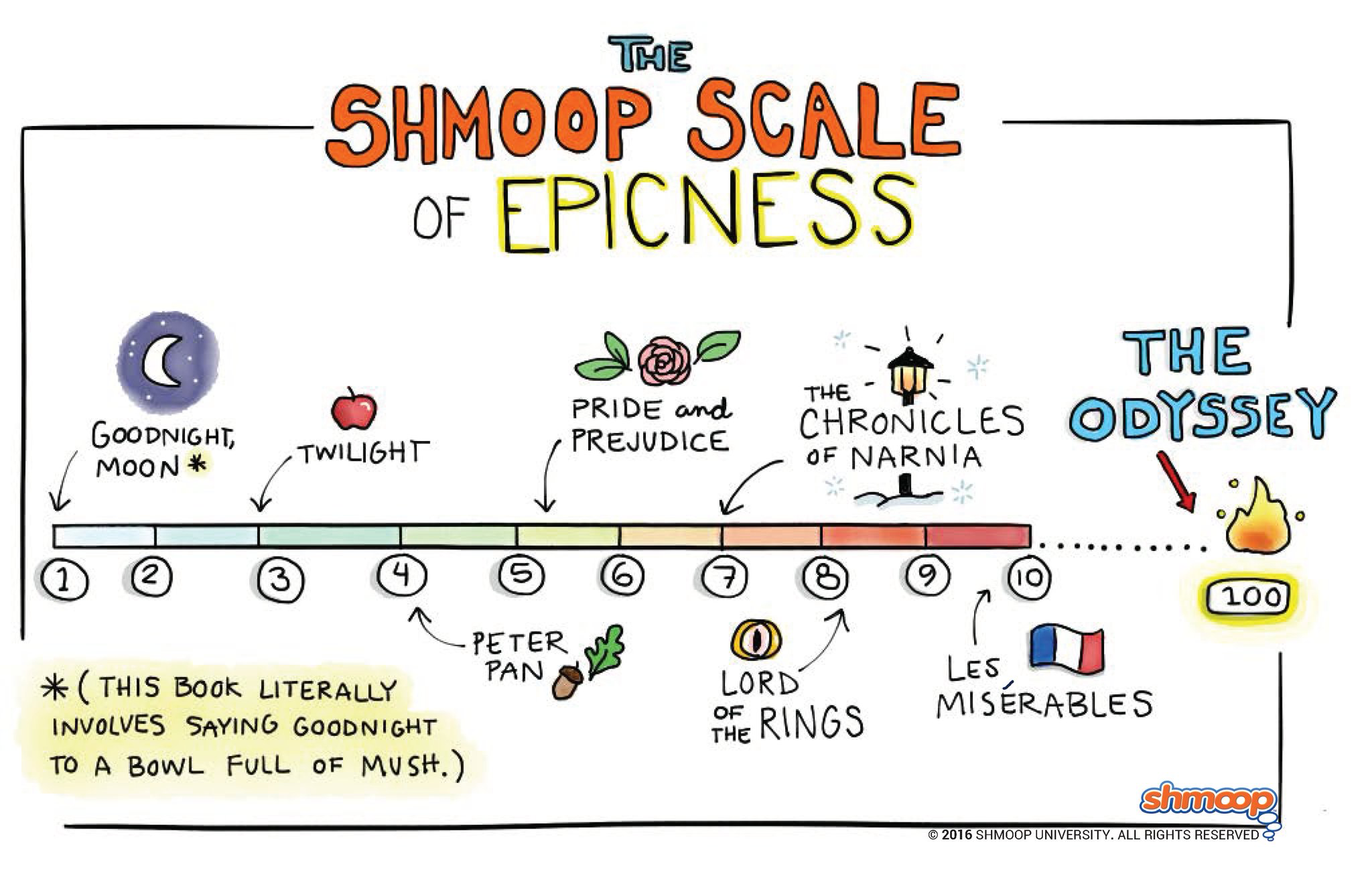 (Click the infographic to download.)
Dactylic Hexameter
Last but certainly not least, The Odyssey is written in something with the tongue-twisting of "dactylic hexameter." Try saying that five times fast. Wait—make that six times. Even though they look like syllable soup, the two words "dactylic" and "hexameter" aren't actually too complicated.
Let's start with "hexameter." The "hex" in "hexameter" is the same as in "hexagon," which you might remember is a six-sided shape. And the "meter" part is like…well, "meter," a unit of measurement. So a "hexameter" is a poetic meter with six measures. (We're using "measures" here in the musical sense, meaning the same thing as "bars.") Because measures or bars in poetry are known as feet, you might as well just translate "hexameter" as "six feet."
OK, but what about the "dactylic" part? This comes from the Greek word "daktylos," which means "finger." Why? Take a look at one of your fingers (but not your thumb). It almost certainly one long joint followed by two short joints. (Well, Shmoop's fingers—to be perfectly honest—seem to have joints of a pretty similar length, but work with us here.) A dactyl is a foot shaped like a finger: one long, or accented, syllable followed by two short, or unaccented, syllables. (We're simplifying a little, but it's close enough.)
From what we've already learned about the word "hexameter," can you guess how many of such feet are going to be in a line? If you guessed "six," give yourself a pat on the back: you are almost completely right. Why "almost"? That's because, in dactylic hexameter, only the first five feet are shaped like fingers (LONG + short + short); the last foot is never shaped this way; it will be either: (LONG + LONG) or (LONG + short).
Want some examples of dactylic words? "ELephant." "MURmuring." "MOCKingbird." "MUsical." Want to hear what dactylic hexameter sounds like in English? Check out Henry Wadsworth Longfellow's "Evangeline."
But for the most part, English isn't a great language for dactylic hexameter and translators don't usually bother with it. When translators do work with meter, they tend to switch to the English's tried-and-true iambic pentameter.