Symbolism, Imagery, Allegory
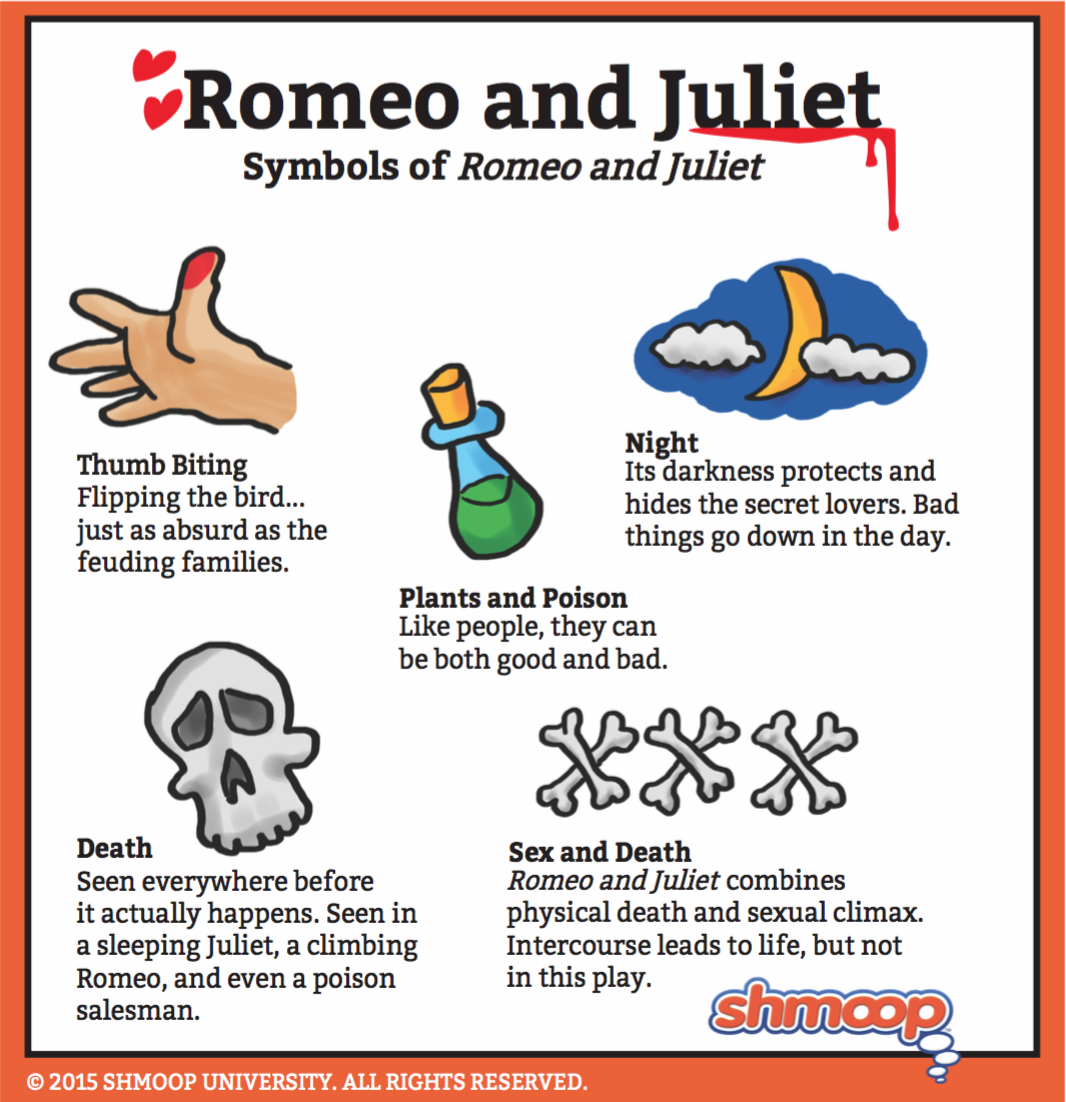
(Click the symbolism infographic to download.)
Unless you're fluent in childish Elizabethan gestures (anyone? Bueller?), you might be wondering what the what Sampson's up to when he spots the Montague's servants on the streets and announces, "I will bite my thumb at / them, which is disgrace to them if they bear it" (1.1.43-44).
Basically, thumb biting, which involves biting and then flicking one's thumb from behind the upper teeth, is a Shakespearean version of flipping someone the bird and saying "nanny nanny boo boo." It's an insulting gesture that sounds just a wee bit (okay, a lot) immature. Here's how it all goes down in the play:
ABRAHAM
Do you bite your thumb at us, sir?
SAMPSON
I do bite my thumb, sir.
ABRAHAM
Do you bite your thumb at us, sir?
SAMPSON
[aside to Gregory] Is the law of our side, if I
say 'Ay'?
GREGORY
No.
SAMPSON
No, sir, I do not bite my thumb at you, sir,
but I bite my thumb, sir. (1.1.45-52)
Sampson doesn't have a good reason to insult the Montagues' servants—he's basically looking to stir up trouble because his masters (the Capulets) are feuding with the Montagues. The funny thing is, Sampson's too much of a coward to own up to his silly gesture because the "law" won't be on his "side" if his thumb biting causes a big old brawl (he doesn't want to get busted for causing a fracas).
Pretty dumb, right? And that seems to be Shakespeare's point. The Capulet/ Montague feud, which has obviously trickled down to involve their servants, is completely absurd. Just like Sampson's thumb biting