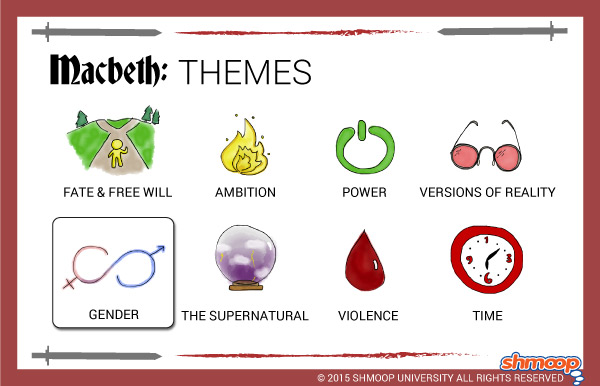
 (Click the themes infographic to download.)
Ah, 11th-century Scotland: a time when men were men, and women were … either bearded witches, unsexed nags, or dead. (Yeah, did you notice that not a single woman is left alive at the end of the play?) Shakespeare may be known for strong female heroines, but they're not hanging around this play. Not that Macbeth is full of strong male heroes, either. We get a lot of examples of how not to do it, and in the end we're left with Macduff and Malcolm as our role models. So, which one are you going to look up to: the man who left his family to the not-so-tender mercies of Macbeth's murderous crew; or the new king, whose first impulse was to run away?
Questions About Gender
- How does Lady Macbeth convince her husband to kill Duncan? Could (according to the logic of this play) a man have used a similar strategy on a woman, or a man on a man? Or does this kind of convincing only work one way?
- What is meant when Lady Macbeth says Macbeth is too "full o'th'milk of human kindness"? Why "milk"? Is this description gendered?
- How does the play define "manhood"? What is it that makes one a "man" in Macbeth?
- How are women characters portrayed in Macbeth? What kinds of roles do they play? Is "womanhood" or "femininity" defined in the way that masculinity is?
Chew on This
For Lady Macbeth and her husband, masculinity is synonymous with cruelty and violence.
In the play, women are portrayed as dangerous forces who can emasculate and ruin men.