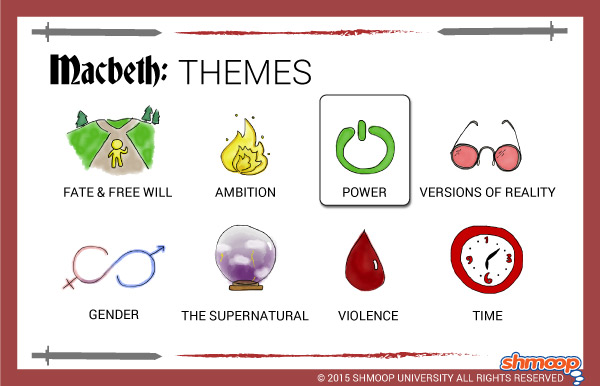
 (Click the themes infographic to download.)
Absolute power corrupts absolutely… unless, of course, your absolute power is a god-given right. In Shakespeare's time, the Divine Right of Kings was the idea that the power of kings comes directly from God. Guess who was a big fan of the Divine Right of Kings? Our man Will's very own patron, James I. In Macbeth, power is natural—until it's not. When Macbeth kills Duncan, he goes against the very law of nature and God by killing his king, and then gets killed in return. According to the play, it's okay to kill King Macbeth because King Macbeth is actually a tyrant. But who gets the power to decide what tyranny looks like?
Questions About Power
- What kind of a ruler is King Duncan? How would you compare his leadership to Macbeth's?
- What is the play's attitude toward the murder of King Duncan? Toward the death of Macbeth?
- In Act iv, Scene iii, Malcolm pretends that he thinks he'll become a tyrant once he's crowned king. Why does he do this? What's Macduff's response? What's the overall purpose of this scene?
- Does the play ever portray an ideal monarch? If yes, what does that monarch look like? If no, why do you think the play never shows us a good king?
Chew on This
In Macbeth, regicide (killing a king) is unnatural and evil but tyrannicide (killing a tyrant) is A-OK.
Although King Duncan is a good man and a virtuous king, he's too "meek" to rule effectively. Macbeth, on the other hand, rules Scotland like a tyrant. The play, then, suggests that a truly good monarch should be strike a balance somewhere between Macbeth and Duncan.