The Odyssey Introduction
Written down sometime between 800 and 600 BCE, the Odyssey is of the best known and most stupendously awesome works of ancient literature—make that any literature. Composed (maybe) by a poet named Homer (maybe), it tells the story of a man trying to make his way home from war. But not just any man, and not just any war. Its hero is Odysseus, who is basically the Jon Hamm of Ancient Greece: smart, strong, attractive, brave, beloved by the gods, and way cooler than you are.
In a way, the Odyssey is a sequel to Homer's Iliad, a poem about the decade-long Trojan War. But don't let any prejudice about sequels throw you off: the Iliad and the Odyssey may have a lot of the same characters, but they're more like fraternal than identical twins: they complement each other.
The Iliad is all about achieving glory and fame through warlike deeds, a concept the Greeks called kleos. Basically, it's full of pages and pages of heroes doing heroic things heroically. Which is awesome in its own way, and it made a fun, if not very accurate, movie. But even warriors have to go home eventually, and the Odyssey is all about the desire to go home: to see a familiar face, to kiss your wife, and to give your old dog a pat on the head.
The Greeks had a word for that, too: nostos—the root of our own word "nostalgia." The Iliad and the Odyssey together are about the competing desires for kleos and nostos, which we can boil down to the desire to die gloriously in battle and the desire to die quietly at home in bed, surrounded by your family. So, the Odyssey isn't really a sequel to the Iliad so much as it's the yin to the Iliad's yang: two equal but competing human desires.
We're not the only ones who get a little giddy when we talk about the Odyssey. Generations of readers have created their own original works inspired by Homer's epic. Just a quick sampling, from the 1st century BCE to the 21st century CE: Virgil's epic poem the Aeneid; Alfred Lord Tennyson's poem "Ulysses"; James Joyce's novel Ulysses; countless paintings (check out Henry Fuseli's "Odysseus in front of Scylla and Charybdis"); Cream's song "Tales of Brave Ulysses"; the Cohen Brothers' movie O Brother, Where Art Thou?—and the list goes on.
Maybe yours will be next.
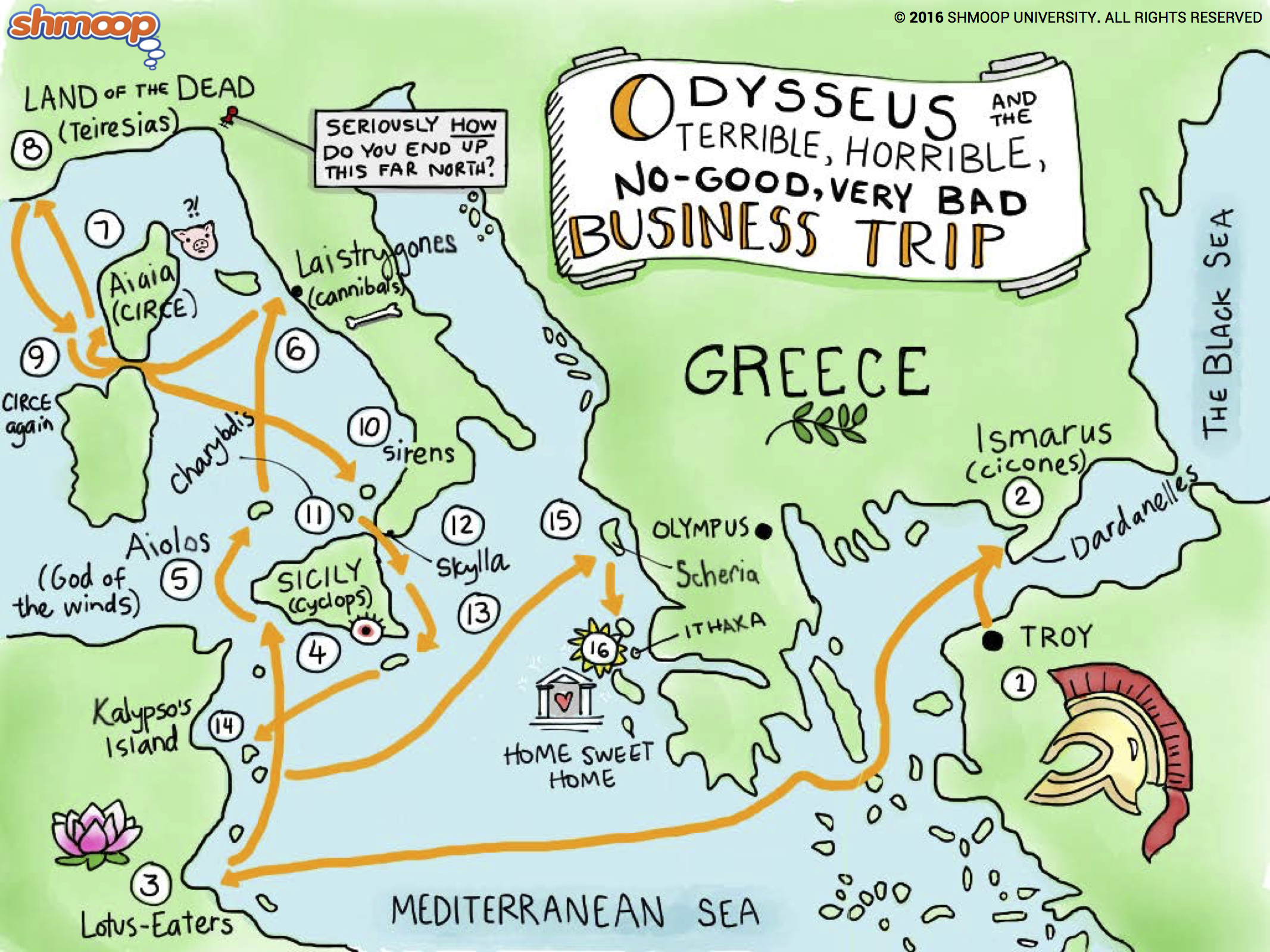 (Click the map infographic to download.)
What is The Odyssey About and Why Should I Care?
We hear you. In a word where the '90s are retro, it's not easy to see why you should care about a millennia-old epic. But bear with us. Do you like stories full of adventure, danger, and suspense? How about stories set in fantastic worlds full of strange creatures like Cyclopes, witches, sirens, and gods? You're in luck: the Odyssey is basically Western literature's first action flick/ fantasy extravaganzafirst action flick/ fantasy extravaganza.
Okay, okay, so you're not into fantasy. Or action. You're more of a rom-com kind of guy (or gal): a group of young girls stumbling on a giant naked man is more your style. Great! The Odyssey has that too.
But maybe you're more interested in the deeper side of things—intense human emotions like longing, or the desire for home, or the love of a mother for her child. Awesome! The Odyssey isn't just an exciting story about blood-drinking cannibals; it's also a poem stuffed with profound reflections on heroism, love, and human life.
Let's put it this way: there's a reason that we're still reading it 3,000 years later.
