Character Analysis
Squealer. Do you get it? He squeals. A lot.
Or, as the narrator puts it, he's "a brilliant talker, and when he was arguing some difficult point he had a way of skipping from side to side and whisking his tail which was somehow very persuasive. The others said of Squealer that he could turn black into white" (2.2). He's the one-pig PR outfit of Napoleon's regime, with a quick mind, nimble tongue, and absolutely no morals whatsoever.
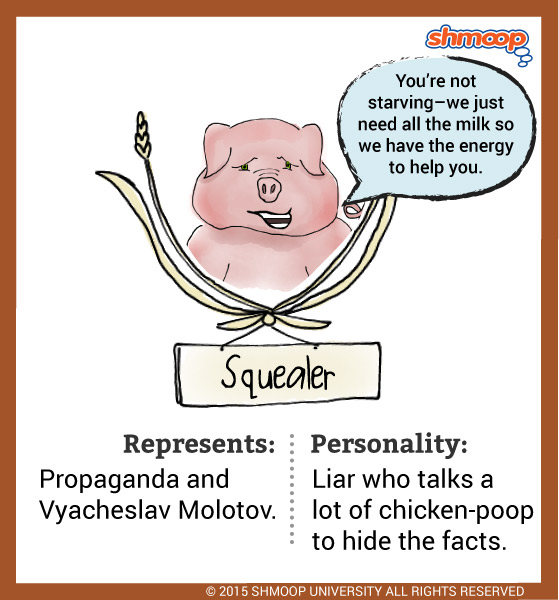
(Click the character infographic to download.)
Squealer makes his debut appearance when he justifies the fact that the pigs have hoarded milk and apples for themselves. He claims that these foods "contain substances absolutely necessary to the well-being of the pig. We pigs are brainworkers" (3.14).
Okay, sure, we'll buy that. But then later, when Napoleon eliminates the public meetings, Squealer is sent to explain the decision to the other animals. He tells them:
No one believes more firmly than Comrade Napoleon that all animals are equal. He would be only too happy to let you make your decisions for yourselves. But sometimes you might make the wrong decisions, comrades, and then where should we be? (5.19)
Hm. Maybe it's just us, but the logic seems a little backwards here. The animals can't make their own decisions, because… they might make the wrong decisions? That doesn't sound quite right. It's hard to know, though, because Squealer says it in such a roundabout way and almost forces the animals to agree. After all, it would be bad if the animals made the wrong decision. But the point of communism (or democracy, for that matter), is that people get to make the decisions they make, whether good or bad.
Squealer also knows how to play on gut instinct and prejudices, like explaining away any grumbling by saying, "Surely, comrades, you do not want Jones back?" (5.21). Meanwhile, Squealer's entire job seems to be to the hide the fact that Jones is coming back—as a pig named Napoleon. He justifies the windmill; spreads rumors about Snowball; constantly changes the Seven Commandments; squashes the revolutionary song "Beasts of England"; and even manages to explain the confusion with Mr. Frederick and Mr. Pilkington as Napoleon just being clever.
And then there's his excuse about Boxer: after Benjamin tells the animals that Boxer has been placed in a knacker's (horse slaughter's) van, Squealer tells them that the vehicle only used to be a knacker's van. It now belongs to a doctor. He even has a whole elaborate story about his experience at Boxer's deathbed: "It was the most affecting sight I have ever seen" (9.25).
Sure it was, Squealer.
Squealer and Stalin
Napoleon is obviously Stalin, and Snowball is pretty obviously Trotsky, but Squealer… is a little less obvious. Some people think he's supposed to be Vyacheslav Molotov, Stalin's Prime Minister in the 1930s, who issued a lot of the death warrants during the Great Purge and basically sucked up to Stalin wherever possible.
Squealer is also a more general allegorical figure for propaganda. Stalin's propaganda team used (and abused) language and images to keep the public calm and keep their control. Squealer's arguments even sound a little like those in Pravda, a daily paper that was the Soviet Party's official voice in the 1930s.
Either way, what is obvious is that Orwell meant Squealer to be hypocrisy embodied. He's so selfish and power-hungry that twist reality to suit his interests—or the interests of whoever he's trying to please. We think this last image does a nice job of summing him up: "Squealer was so fat that he could with difficulty see out of his eyes" (10.2).
Squealer (a pig) Timeline