Character Analysis
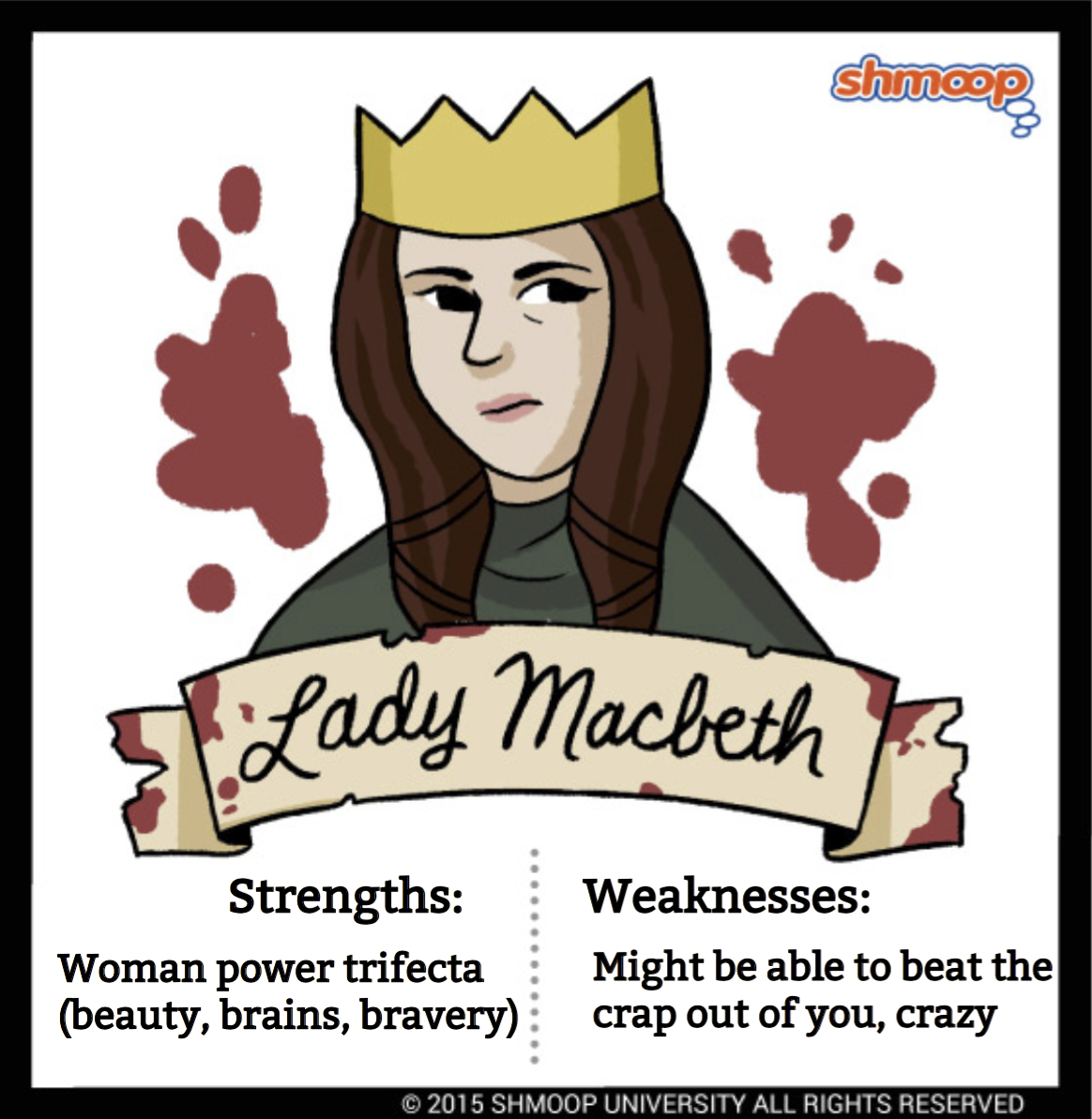
(Click the character infographic to download.)
The Macbeths are the original power couple: where her husband is a courageous, skillful warrior, she's charming, attractive, and completely devoted to her husband's career.
Murderously devoted.
Witchy Woman
Lady Macbeth is a teensy bit worried that her man isn't quite man enough to do what it takes to be king; he's "too full o' the milk of human kindness" (1.5.15). If her husband's going to be the powerful figure she wants him to be, Lady Macbeth's got to take things into her own hands. Check out this famous speech where she psyches herself up for murder (but make sure the lights are on first):
The raven himself is hoarse
That croaks the fatal entrance of Duncan
Under my battlements. Come, you spirits
That tend on mortal thoughts, unsex me here,
And fill me from the crown to the toe top-full
Of direst cruelty! make thick my blood;
Stop up the access and passage to remorse,
That no compunctious visitings of nature
Shake my fell purpose, nor keep peace between
The effect and it! Come to my woman's breasts,
And take my milk for gall, you murdering ministers,
Wherever in your sightless substances
You wait on nature's mischief! Come, thick night,
And pall thee in the dunnest smoke of hell,
That my keen knife see not the wound it makes,
Nor heaven peep through the blanket of the dark,
To cry 'Hold, hold!' (1.5.45-61)
Are you thoroughly creeped out? If not, read it again—and really dwell on the part where she asks the spirits to "fill me from the crown to the toe top-full/ Of direst cruelty" [1.5.49-50]. And note that Shakespeare's leading ladies don't usually go around saying stuff like this. Not even Katherine Minola, who's notorious for having a tongue like a "wasp" in Taming of the Shrew, summons "murderous" spirits.
Remind us who the witch(es) are, again?
Woman Up
In fact, Lady Macbeth's whole "unsex me" speech aligns her with witchcraft and the supernatural (calling on spirits and talking about "smoke of hell" and "murdering ministers" [1.5.58;55] sure sounds witchy to us). She also intends to "pour [her own] spirits in [Macbeth's] ear" when he returns home from battle (1.5.29). Literally, she means she's going to fill her husband's "ear" with harsh words that will help convince him to take action against Duncan, but there's also a sense that Lady Macbeth will "fill" her husband's body in the same way that women's bodies are "filled" or, impregnated by men.
All of this is to say that Lady Macbeth is portrayed as masculine and unnatural. It's pretty explicit: she asks the spirits to "unsex" her (1.5.48), stripping her of everything that makes her a reproductive woman. She wants her "passage to remorse" to be stopped up—i.e., her vagina. (What? Well, being a woman and a mother makes her compassionate, so she wants the "passage" [1.5.51] of childbirth to be blocked.) She wants her blood to be make thick, meaning both the blood in her veins but also her menstrual blood, the "visitings of nature" (1.5.52). Finally? She asks that her breast milk be exchanged for "gall," or poison.
In Lady Macbeth's mind, being a woman —especially a woman with the capacity to give birth and nurture children —interferes with her evil plans. Femininity means compassion and kindness, while masculinity is synonymous with "direst cruelty" (1.5.50). When Lady Macbeth says that her husband is "too full o' the milk of human kindness," she's implying that Macbeth is too much like a woman in order to wield a monarch's power (1.5.17). And she uses this notion of Macbeth's "kindness" against her waffling husband when she pushes him to murder the king: "When you durst do it, then you were a man" (1.7.56).
It sounds to us like Lady Macbeth is man enough for both of them.
Lady Who?
Okay, sounds like Lady Macbeth is a powerful figure and may evoke some fears about dominant women. You know, just maybe. But what happens to her?
Soon after Macbeth proves his "manhood" by killing Duncan and becoming king, Lady Macbeth disappears into the margins of the story and becomes the kind of weak, enfeebled figure she herself would probably despise.
When she learns that the king's dead body has been discovered, she grows faint and must be carried from the room. (Hmm. It's almost as though Lady Macbeth has literally been drained of that "spirit" she said she was going to pour into her husband's "ear.")
Later, when Macbeth decides to murder Banquo in order to secure his position of power, he excludes his wife from the decision making altogether (3.2).
And by Act V, Lady Macbeth has been reduced to a figure who sleepwalks, continuously tries to wash the imaginary blood from her hands, and talks in her sleep of murder (5.1). She's grown so ill that the doctor says there's nothing he can do to help her. "The disease," he says, "is beyond" his "practice," and what Lady Macbeth needs is "the divine" (a priest or, God), not a "physician" (5.1.62,78).
Would could easily read this as a kind of psychological breakdown. Lady Macbeth is so consumed by guilt for her evil acts that she eventually loses her mind. But we could also say that her transformation from a powerful and "unnaturally" masculine figure into an enfeebled woman reestablishes a sense of "natural" gender order in the play. In other words, Lady Macbeth is put in her place, sleepwalking through the palace while her man makes all the decisions.
However we read Lady Macbeth's transformation, one thing's certain. In the end, Lady Macbeth is all but forgotten. When Macbeth learns of her death, he says he has no "time" to think about her —"She should have died hereafter; / There would have been a time for such a word" (5.5.20-21).
Star Performance
Depending on the production, Lady Macbeth is portrayed as a virago (a brazen, war-like woman) and a manipulator, as the seed of Macbeth's evil thoughts, or as his devoted queen. In some productions she weeps incessantly, in some she sneers, and in some no one's really sure what she's doing. In some interpretations, she uses sexuality to convince Macbeth to do the murder the King.
We're partial to Judy Dench's powerful and nuanced performance in Trevor Nunn's 1979 production. What do you think?
Lady Macbeth's Timeline