Character Analysis
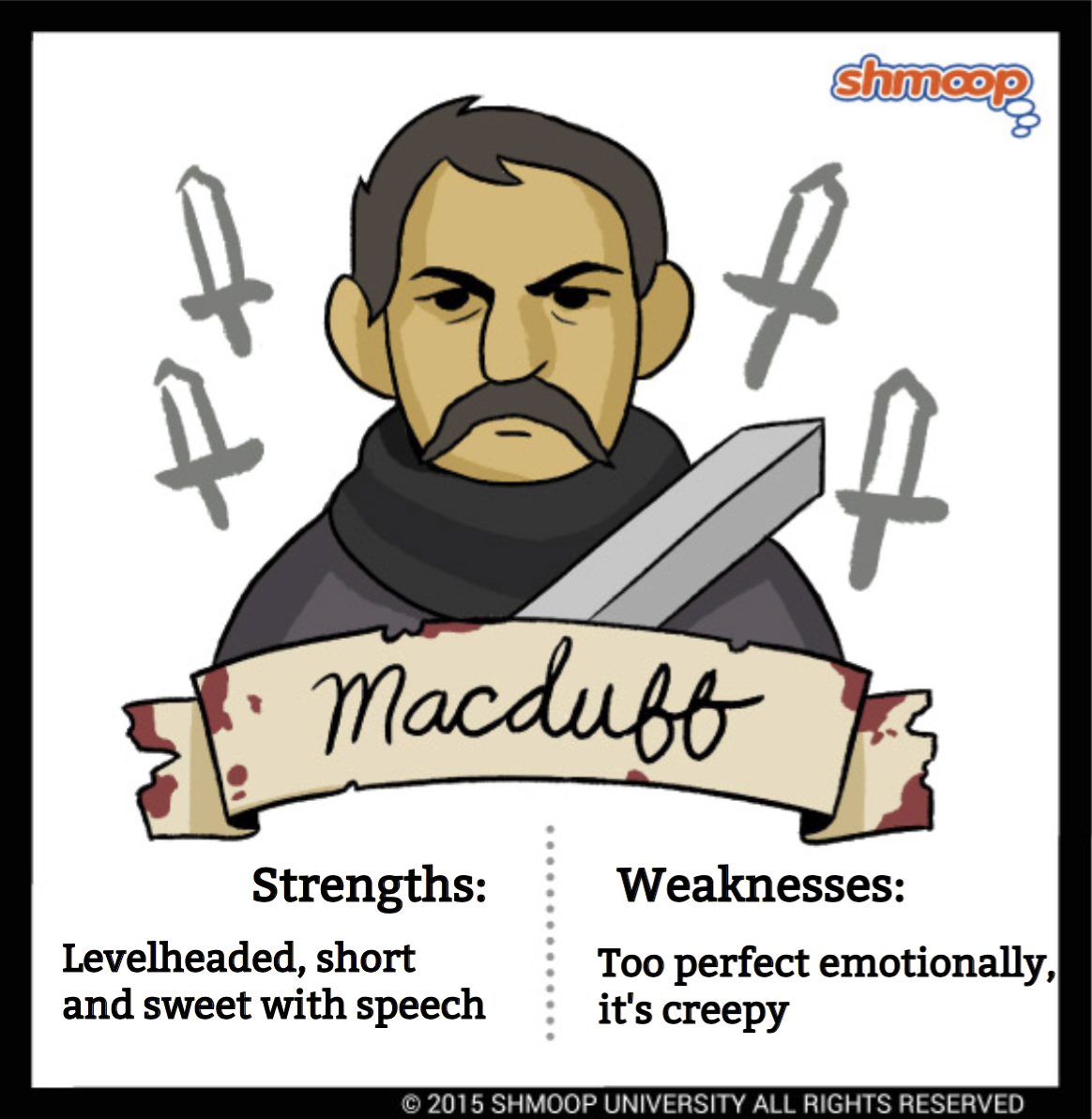
(Click the character infographic to download.)
In a game of Marry, Date, or Dump, we'd dump Macbeth (duh); date Malcolm (nice boy, but too many responsibilities) and marry Macduff. He's a loyal Scottish nobleman, a loving father and husband, and an all-around great guy. So, what makes this 17th-century #1 Dad tick?
He Has Feels
Macduff isn't a man of many words, which means… everyone listens when he talks. We first hear Macduff as he expresses raw, honest grief at the King's murder: "O horror, horror, horror! Tongue nor heart/ Cannot conceive nor name thee! … Most sacrilegious murder hath broke ope/ The Lord's anointed temple, and stole thence/ The life o' the building!" (2.3.73-79). (Apparently, even grief can't keep him from busting out elaborate metaphors to describe death.) Even more than the king's own son, Macduff appears to mourn the loss of the king, and the man.
But he's not so overwhelmed by grief that he can't pay attention to what's going on around him. He's the only one who asks why Macbeth killed the guards senselessly. He's also the first to see that Lady Macbeth is fainting. And, instead of prattling on about his suspicions, he decides to leave for England. This isn't a cowardly act, but rather a brave one intended to aid Malcolm in enlisting the English against Macbeth.
Basically, in Macduff we see a guy who can feel and act. After his wife and children are killed, Macduff is flailing around a little, saying things like "All my pretty ones? … all my pretty chickens and their dam/ At one feel swoop?" (4.3.255-258). Malcolm tells him to man up (literally), and Macduff says, sure: but he's also going to "feel it as a man" (4.3.261). In other words, men feel deeply. In fact, they just might feel more deeply than women, or unmanly men like Macbeth.
Quick brain snack: we're used to thinking of women as being the emotional ones, but that's actually a fairly recent —say, 300 years or so —invention. For hundreds of years before that, men were the emotional ones. Women were too flighty to have any deep feelings, except maybe for their kids.
So, if Duncan has feeling without action, and Macbeth has action without feeling, then Macduff seems to have both. He's a true man. Then why doesn't he become king? Because he accepts his natural place: as a friend to his country and to his true king.
Long Live the King
We see just how much Macduff loves his country in when Malcolm tests his loyalty by pretending that he'd be an even worse king that Macbeth. He finally breaks down, saying "O Scotland, Scotland," telling Malcolm that he's not fit to live, and then decides to leave Scotland forever rather than see her ruled by a man who "By his own interdiction stands accursed" (4.3.125), a.k.a. Malcolm.
And now Malcolm knows what we do: if you're trying to reclaim your kingdom, you want a guy like Macduff by your side.
Macduff's Timeline