Symbolism, Imagery, Allegory
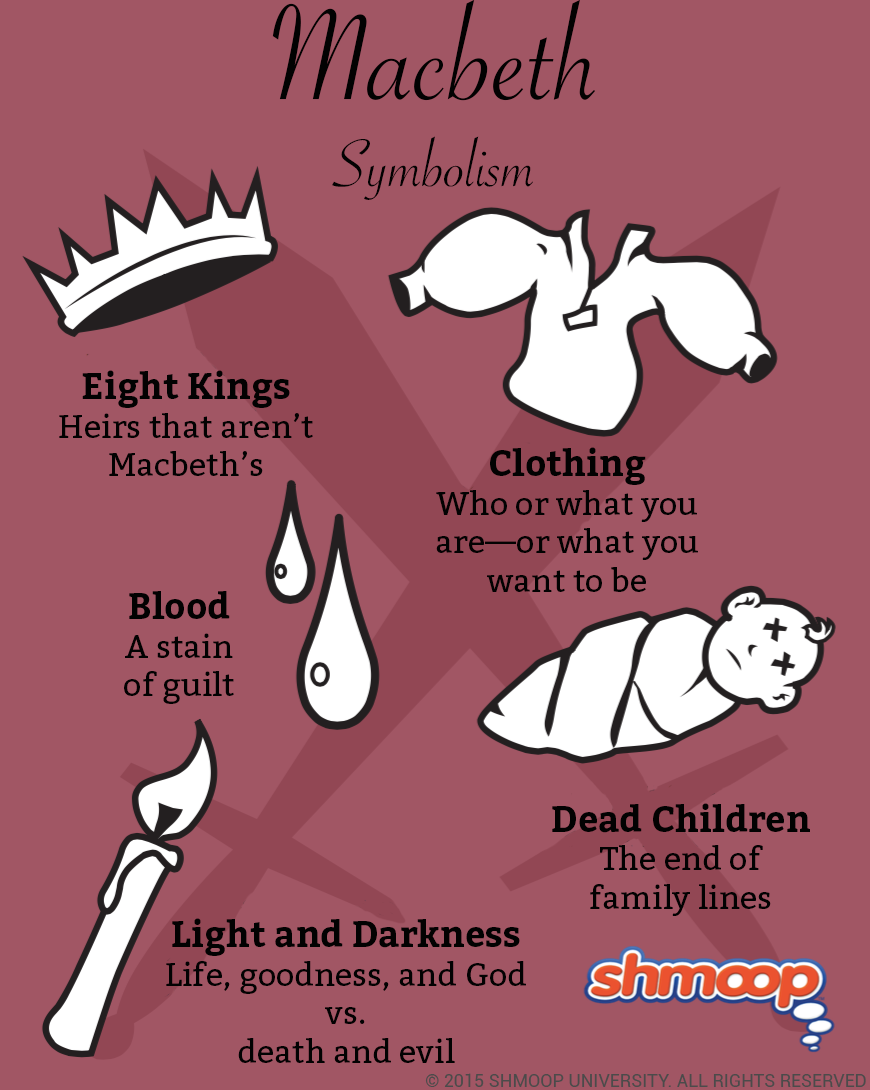
(Click the symbolism infographic to download.)
The way these characters keep talking about clothes, you'd think there was a 30% off sale at Old Navy. But clothes aren't just keeping the nobles warm in their drafty castles; they're also functioning symbolically to represent these people's stations in life—earned, or stolen.
When Macbeth first hears that he's been named the Thane of Cawdor, he asks Angus why he is being dressed in "borrowed robes" (1.3.115). Macbeth doesn't literally mean that he's going to wear the old thane's hand-me-down clothing. Here, "robes" is a metaphor for the title (Thane of Cawdor) that Macbeth doesn't think belongs to him. And later, Angus says that Macbeth's kingly "title" is ill-fitting and hangs on him rather loosely, "like a giant's robe / Upon a dwarfish thief" (5.2.24-25).
Angus isn't accusing Macbeth of stealing and wearing the old king's favorite jacket, he's accusing Macbeth of stealing the king's power (by killing him) and then parading around with the king's title, which doesn't seem to suit him at all. Famous literary critic Cleanth Brooks has something to say about that image:
The crucial point of the comparison, it seems to me, lies not in the smallness of the man and the largeness of the robes, but rather in the fact that—whether the man be large or small—these are not his garments; in Macbeth's case they are actually stolen garments. Macbeth is uncomfortable in them because he is continually conscious of the fact that they do not belong to him. There is a further point, and it is one of the utmost importance; the oldest symbol for the hypocrite is that of a man who cloaks his true nature under a disguise. (source, 48)
Keep an eye out in the play for other times when clothing shows up—or even cloth in general. Like those banners Macbeth hangs right before battle; does he actually believe they're going to help?