Symbolism, Imagery, Allegory
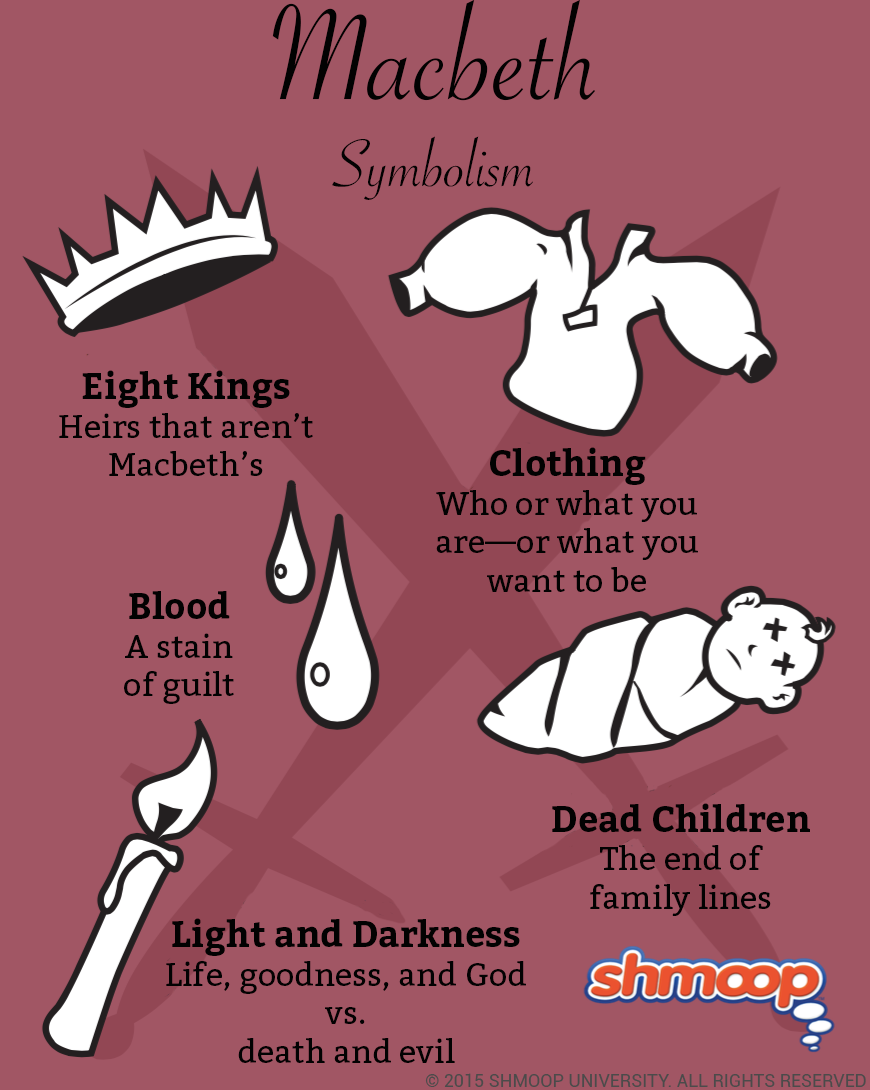
(Click the symbolism infographic to download.)
After King Duncan is murdered by Macbeth, we learn from the Old Man and Ross that some strange and "unnatural" things have been going on. Even though it's the middle of the day, the "dark night strangles the traveling lamp," which literally means that darkness fills the sky and chokes out the sun, i.e. an eclipse (2.4.9). Could this be another allusion to the way the king's life has been extinguished (kings are often associated with the sun's power) and his power usurped by "darkness" (Macbeth)?
Probably. And in this case, nature itself becomes a symbol for the political struggle. That makes sense, if you think that kingship in the play is shown to be part of the natural order, something handed down from God. (See our "Power" theme for more about the Divine Right of Kings.)
And that's not all. We also learn that an owl was seen killing a falcon and Duncan's horses went wild and began eating each other (2.4.13-24). Clearly, nature is out of whack, right? Owls are supposed to prey on mice —not go around eating larger birds of prey like falcons. And Duncan's horses? Once tame, they "broke their stalls […] contending 'gainst obedience" just before they ate each other (2.4.21).
It sounds like all of nature is in a state of rebellion, bucking their natural roles and "contending" against the natural order, just like Macbeth has upset the natural order of things by killing the king.
Dark and Stormy
And don’t forget that the play begins with a terrible storm (likely conjured by the witches) that's associated with dark forces and also the rebellion against King Duncan.
FIRST WITCH
When shall we three meet again
In thunder, lightning, or in rain?
SECOND WITCH
When the hurlyburly's done,
When the battle's lost and won. (1.1.1-4)
The word "hurlyburly" means "tumult" and can apply to either or both the literal storm and "the battle" that's being waged between the king's forces and the rebels (led by the traitorous Macdonwald and Cawdor). In Macbeth, the human world and the natural world are one and the same—and Macbeth's regicide throws both of them topsy-turvy.