Symbolism, Imagery, Allegory
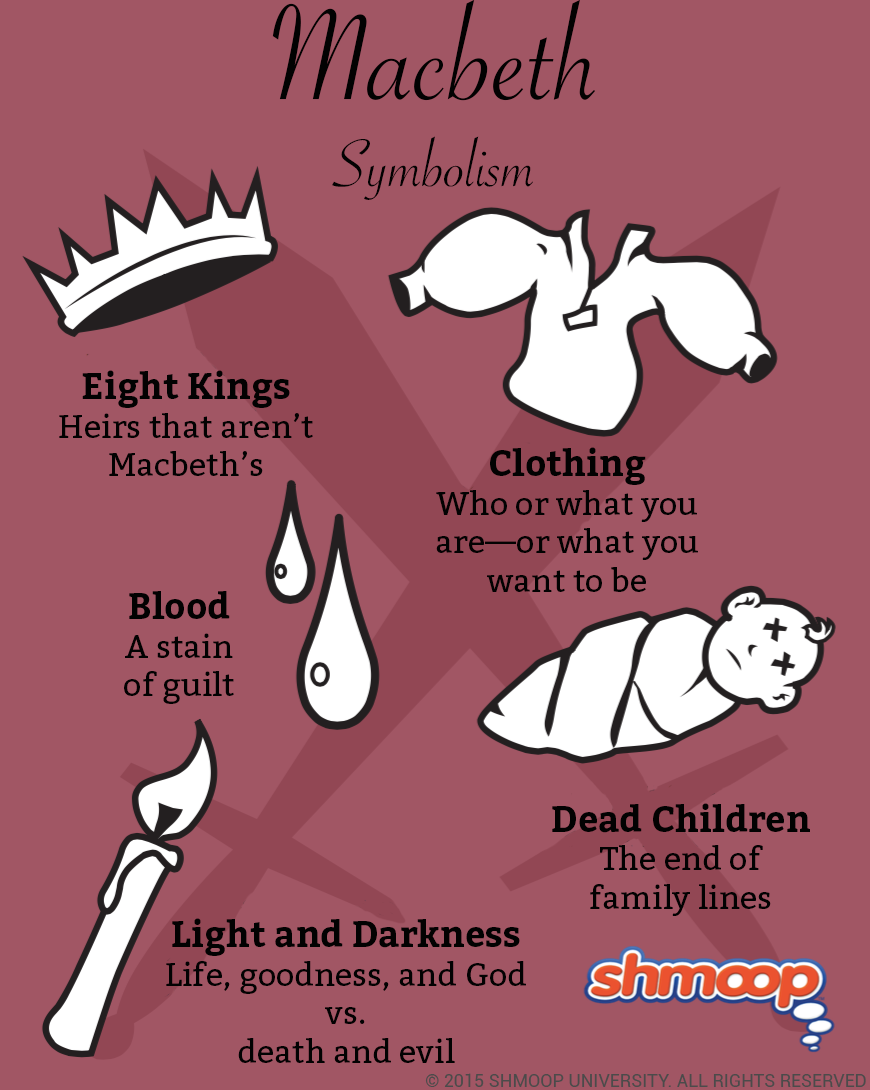
(Click the symbolism infographic to download.)
Pretty standard stuff here. Darkness indicates something bad is about to happen; light is associated with life and God. Here's a look at some specifics:
From the first act, the cover of night is invoked whenever anything terrible is going to happen. Lady Macbeth, for example, asks "thick night" to come with the "smoke of hell," so her knife won't see the wound it makes in the peacefully sleeping King (1.5.57-58). The literal darkness corresponds to the evil or "dark" act she plans to commit.
And then, when she calls for the murderous spirits to prevent "heaven" from "peep[ing] through the blanket of the dark to cry 'Hold, Hold!'" she implies that light (here associated with God, heaven, and goodness) offers protection from evil and is the only thing that could stop her from murdering Duncan (1.5.60-61). So, it's no surprise to us that, when Lady Macbeth starts going crazy, she insists on always having a candle or, "light" about her (5.1.23-24). We get the impression that she thinks the light is going to protect her against the evil forces she summoned… but no such luck.
Light/ Life
Macbeth responds to the news of Lady Macbeth's presumed suicide by proclaiming "out, out brief candle" (5.5.26), turning the candle's flame has become a metaphor for her short life and sudden death. Similarly, Banquo's torchlight (the one that illuminates him just enough so his murderers can see what they're doing) is also snuffed out the moment he's killed (3.3.27). And both of these incidents recall an event from the evening King Duncan is murdered —Lennox reports that the fire in his chimney was mysteriously "blown" out (2.3.63).
Straightforward, right? The one thing we're stuck on is that this whole play is about inversion: fair being foul, and foul being fair; men being women, women being men; and the whole regicide business. Are there any moments that make this dark/ light dichotomy more complex? Or is this one area where light is just light, and dark is just dark?