Character Analysis
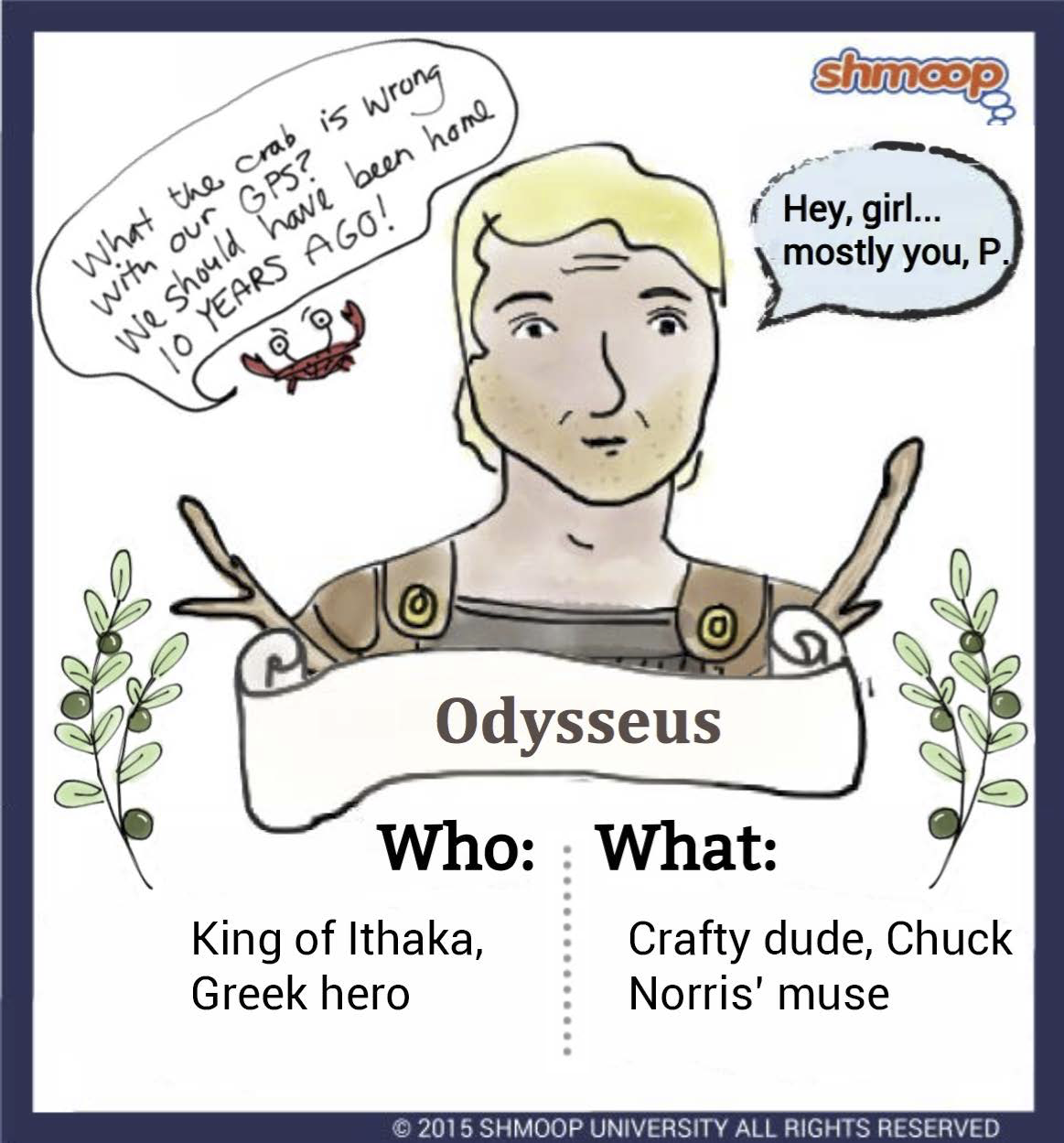
(Click the character infographic to download.)
Odysseus is brave, strong, handsome, wily, loyal, pious—and did we mention handsome? He's basically begging for a "hey girl" meme. ("Hey girl. I may have spent seven years with a goddess, but you still look divine to me.) So, what makes this paragon of perfection so darn perfect?
Strong Odysseus
First, he's a hard worker. This is man you want to invite over for pizza when you're moving, because you know he's going to be lifting that refrigerator all by himself. Menelaos tells us that "no one of the Achaians labored as much as Odysseus labored and achieved" (4.106); his friend Eurylochos says "You are a hard, man, Odysseus. Your force is greater, your limbs never wear out. You must be made all of iron" (12.279-80).
It's not just that he's strong; he works harder than anyone else. He never asks his men to do anything that he won't do, and he actually asks more of himself. This quality makes him a good leader. He's not some slacker sitting on the couch bossing people around; he's right there splitting logs and climbing the rigging (or whatever you do on a ship) with his servants and companions. Eurylochos may complain about being overworked, but you can tell that he respects the guy.
Angry Odysseus
Odysseus' massive strength is useful if you're on his good side, but you really do not want to tick this guy off. We see his temper early on, when he can't help taunting Polyphemos: "in the anger of my heart I cried to him: 'Cyclops, if any mortal man ever asks you who it was that inflicted upon your eye this shameful blinding, tell him that you were blinded by Odysseus, sacker of cities. Laertes is his father, and he makes his home on Ithaka' (9.500-505).
The sailors might head straight off to update their wills, but we have to admire him: Odysseus isn't sneaking around leaving anonymous trolling comments on some website from his basement setup. He's bold enough to lay claim to his violence. Okay, so it's maybe not the most prudent decision, but it makes him worthy of being a hero.
When he gets home, Odysseus takes his time plotting revenge. When he sees some of the servants sneak off to have sex with the suitors, the "spirit deep in [his] heart […] was stirred by this, and much he pondered in the division of mind and spirit, whether to spring on them and kill each one, or rather to let them lie this one more time with the insolent suitors, for the last and latest time; but the heart was growling within him" (20.6-13).
Yikes. That does not sound good. Odysseus may be crafty, but he's also a fighter—and an angry fighter. "Now," he tells the suitors, "upon you all the terms of destruction are fastened" (22.37). It doesn't have quite the same ring as "I'll be back"… but it sure makes us quake in our stylish yet practical shoes.
Crafty Odysseus
Even when he's seriously ticked off, Odysseus doesn't lose his cool. Trapped in Polyphemos' cave, he's quick enough to call out "Nobody is my name. My father and mother call me Nobody, as do all the others who are my companions" (9.366-367), setting Polyphemos up to look like a total idiot when he screams for help after being blinded.
During that whole Cyclops fiasco, Odysseus was "planning so that things would come out the best way … combing all my resource and treacheries" (9.421-22). He plans again later, setting up the suitors to be destroyed and really taking his sweet time about it. And then after the slaughter, he comes up with another plan, saying "I will tell you the way of it, how it seems best to me" (23.130). (Okay, so the plan doesn't exactly work, but it does buy him and Telemachos some crucial time.)
Odysseus' craftiness is so central to his character that it's almost part of his name. Ancient Greek epics helped audiences remember their massive character lists by using epithets, adjectives almost like nicknames that get attached to people or places. The "wine-dark sea"; the "gray-eyed goddess" (that would be Athene); "thoughtful Telamachos"; and, of course, "crafty (or wily) Odysseus."
To be honest, we think this is pretty interesting. Out of all the incredible feats of strength and valor, Homer is most interested in Odysseus' cleverness. Why? Were most Greek heroes all brawn and no brain? Is it just a way of emphasizing how well-rounded he is, like a high school quarterback who's also valedictorian? Did someone else already claim "strong" or "manly" or "sinewy" as epithets?
Sensitive Odysseus
As long as we're talking about how well-rounded the guy is, we should look at his other qualities. It turns out that he's not just strong and smart—he's also kind and sensitive. Look at how Homer describes it:
So the famous singer sang his tale, but Odysseus melted, and from under his eyes the tears ran down, drenching his cheeks. As a woman weeps, lying over the body of her dear husband, who fell fighting for her city and people as he tried to beat off the pitiless day from city and children; she sees him dying and gasping for breath, and winding her body about him she cries high and shrill, while the men behind her, hitting her with their spear butts on the back and the shoulders, force her up and lead her away into slavery, to have hard work and sorrow, and her cheeks are wracked with pitiful weeping. Such were the pitiful tears Odysseus shed from under his brows, but they went unnoticed by all the others […]. (8.521-532)
Odysseus is crying as he listens to the Phaiakian bard sing about the Trojan War, but he's not just letting a single tear fall: he's weeping like a widowed woman. Weird, right? This is an epic simile, another characteristic of epics in which the writer spins really elaborate comparisons. So, instead of just saying "Odysseus cried like a girl," he says "Odysseus cried like a woman whose husband died at war," etc etc.
So, add one more quality to our checklist of Ancient Greek ideals: in addition to being strong and smart, a hero has to be sensitive.
Pious Odysseus
One last thing: Odysseus may be strong, and smart, and kind—but he's also pious. He sacrifices a ram to Zeus (9.550-555); he prays to the river god at the Phaiakians (5.445-454); he explains his misfortunes by saying "so it has pleased Zeus to arrange it" (9.262). Oh, and he always washes his hands before praying.
He's also full of advice for the rest of us. Feeling good about yourself? "Leave all speech to the gods, since they are far stronger than you are" (22.289). Want to gloat over your enemies? "Keep your joy in your heart, old dame; stop, do not raise up the cry. It is not piety to glory so over slain men" (22.411-412).
Don't Hate Him Because He's Beautiful
Let's be real, though. Odysseus may be strong, smart, kind, and pious—but he can't possibly be perfect, right? Right. He has one major flaw: pride.
See, what we didn't mention before is that once the crew was able to flee Polyphemos thanks to Odysseus' trickery, he enjoyed a little ego trip and did end up revealing his real name, taunting Polyphemos.
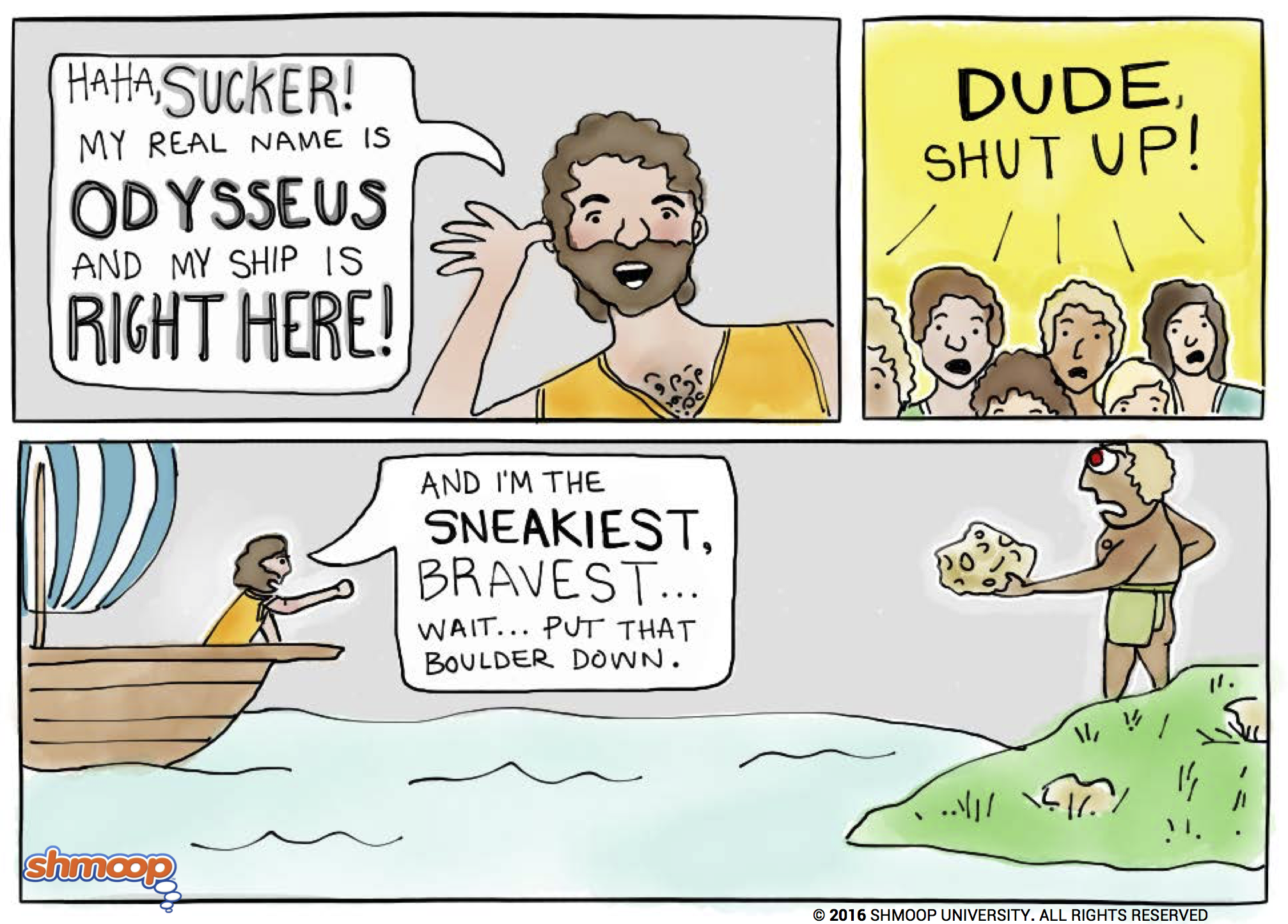 (Click the infographic to download.)
But to be fair, he's pretty awesome. Being between a rock (heh, heh) and a hard place and squeezing out in the nick of time is Odysseus' game. And, before the Internet, boasting was the only way for people to get their name out there, so he's not exactly wrong to go around talking about how he's a better archer than "all other such as are living mortals now and feed on the earth" (8.221), or how they escaped the Cyclops by his "courage and counsel and […] intelligence" (12.213).
What gets Odysseus into trouble is when his justifiable pride shades into hubris, or arrogance. At worst, this can cloud Odysseus' better judgment—as when his not-so-tactful taunting of the Cyclops sets off the whole feud between him and Poseidon. Because Odysseus just had to get the glory of besting the monster, he ended up wandering the sea for seventeen years and losing all of his companions to an untimely death.
Figuring out where the draw the line between justifiable pride and hubris might be tricky, but we do get the sense that Odysseus learns. By the end of the story, he's learned enough to keep his disguise as a poor beggar, even when he really, really, really wants to smash Antinoös' face in. And even when he's bragging about his skill as an archer to Alkinoös, he remembers to point out that he "will not set [himself] against men of the generations before" (8.222-3.
And while we're on the topic of cultural differences: if you start hating Odysseus for cheating on his wife left and right while she slept alone for two decades, just remember that we're working with a serious double standard. We're not supposed to see Odysseus as a jerk. We're supposed to think "It's not his fault these beautiful, immortal ladies can't keep their hands off him!"
Odysseus' Timeline