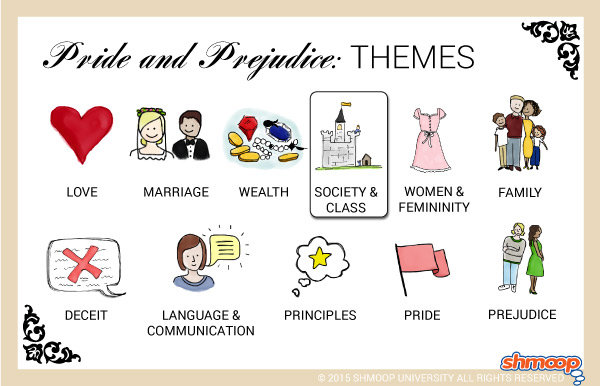
 (Click the themes infographic to download.)
We hear you: if everyone in this novel is so concerned about money, why don't any of them have jobs? Because we're talking about a specific class: the gentry. Austen never (or almost never) writes about aristocrats (people with titles), and she never writes about the middle class, people who made money from having jobs. Her main characters are landowners, meaning they get their money primarily from rents. To keep their class status, they have to hang on to their land (or marry men with land). But in Pride and Prejudice, the gentry ranges from the just-hanging-on Bennets to Mr. Darcy and his 10,000 a year. To Lizzy, she and Mr. Darcy are the same; to the Bingley sisters and to Lady Catherine, they might as well belong to different worlds. What does Austen think?
 (Click the infographic to download.)
Questions About Society and Class
- Check out the scenes where Miss Bingley is gossiping about the Bennets. Compare the way she does this with the way Mrs. Bennet trash-talks whoever is in her way (Mr. Collins, Darcy, etc.). What is the same about their remarks? What is different? How can we tell one is from a higher and the other from a lower class?
- Who in the novel is described as being a gentleman? What does that mean? Does it appear to mean different things to different people?
- Which characters take great pride in their social standing? Which don't? Why or why not?
Chew on This
In Pride and Prejudice, class determines the characters' social situation but it doesn't mean anything about their behavior.
The novel suggests that class is an arbitrary—and ultimately less meaningful—distinction between people.