Pride and Prejudice Introduction
____________________________________________________________________________________
Want more deets? We've also got a complete Online Course about Pride and Prejudice, with three weeks worth of readings and activities to make sure you know your stuff.
____________________________________________________________________________________
When Jane Austen published Pride and Prejudice in 1813, people were still getting used to the idea that women would do something so totally immodest and exhibitionist as to actually have strangers reading something she wrote for money. Oh, how shocking and taboo! Just one step away from prostitution! (We're not even joking about that.) Because of all that, the novel came out anonymously, as had her book Sense and Sensibility only a year earlier. (Imagine how those people would feel about sex bloggers.)
Not only was it a big deal for women to be authors, but it was also kind of a foregone conclusion that everyone would think that their novels were automatically kind of silly and chick-lit —you know, not like man-novels, what with their deep thoughts and serious subjects. Especially when your novel, like Austen's, was essentially about marrying off a bunch of sisters. Austen made fun of those expectations in a letter she wrote to her sister:
[Pride and Prejudice] is rather too light & bright & sparkling; —it wants shade; —it wants to be stretched out here & there with a long Chapter […] about something unconnected with the story; an Essay on Writing, a critique on Walter Scott, or the history of Bonaparte —or anything that would form a contrast & bring the reader with increased delight to the playfulness & Epigrammatism of the general stile. (Letter to Cassandra Austen, February 4, 1813)
How do we know she's kidding around? Well, just imagine: you're flipping pages frantically during Mr. Darcy's proposal, trying to find out what Elizabeth Bennet says, and all of a sudden the narrator starts in on a long essay about contemporary literature. It kind of ruins the mood, right? But that's exactly what most people expected from books—a little non-fiction mixed in with your fiction, just enough so you can say, "Yeah, I know, it's a novel—but I'm reading it for the articles."
In reality, the novel deals with plenty of its own deep thoughts and serious subjects. At the turn of the century, the old debate between rationality and emotions was heating up again. The 18th century had been the Age of Enlightenment, with Voltaire and David Hume and Adam Smith making sense of life in a super-scientific, man-centered, non-religious way. These Enlightenment ideas about the rights of men and the value of individuals got a bunch of people fired up in the American colonies, and pretty soon they were doing it up democracy-style across the Atlantic. And just across the English Channel? The French Revolution led to an overthrow of the entire monarchy. Kings all over Europe were making sure their heads were still attached to their necks.
Austen was no dummy, and it's no coincidence that characters spend a lot of time debating whether they're supposed to be making decisions based on reason and rationality or feelings and impressions. These were high-stakes questions for individuals as well as nations—particularly educated women, who suddenly looked around and said, "Hey, how come we don't get to own property? How come earning our own money is somehow disreputable? How come we have no rights or political power? How come we're supposed to be all quiet and not talk or think, even though we have brains?"
Pride and Prejudice may not be a dissertation about political independence or the relative merits of passion and reason—but it's definitely a reflection on what those ideas might mean for women's lives.
 (Click the infographic to download.)

What is Pride and Prejudice About and Why Should I Care?
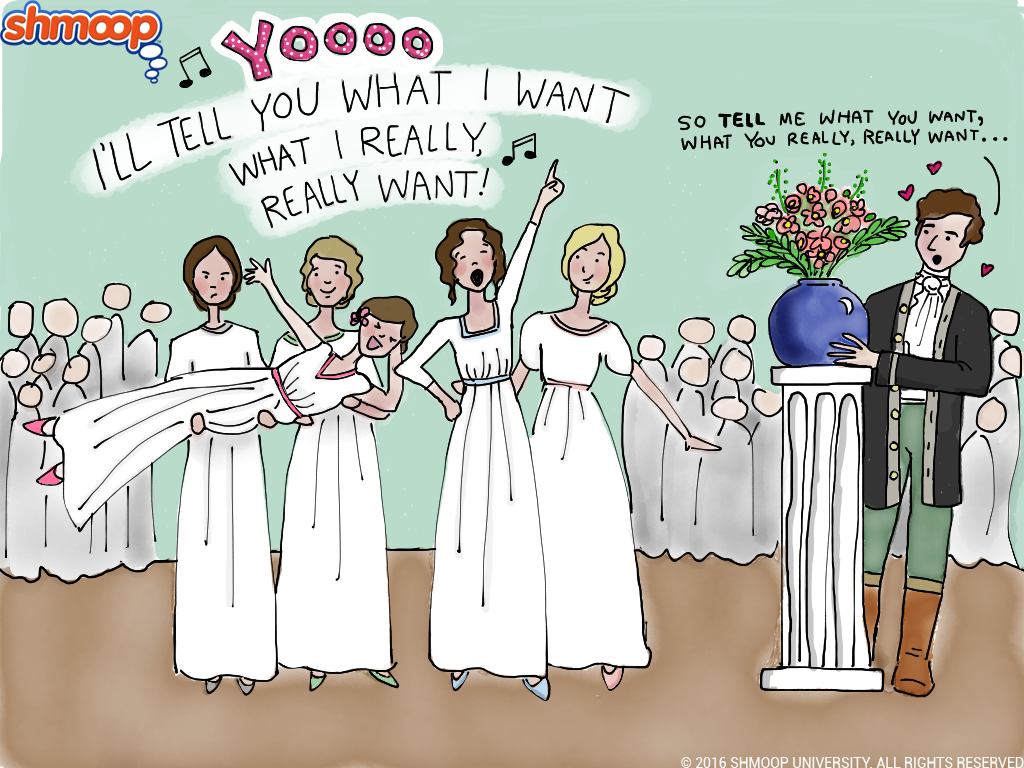
Ugh, parents are so embarrassing, right? (Not to mention your little sisters.)
Well, yeah. And they have been for at least two hundred years. Pride and Prejudice matters because, unlike a lot (okay, most) of novels published around the turn of the nineteenth century, it's about everyday people doing everyday things in everyday places. Like being humiliated by their parents, or having a hard time telling their crush how they feel, or finding themselves attracted to someone who's kind of embarrassing. Sound familiar?
Elizabeth Bennet thinks so, too.
Sure, Pride and Prejudice is full of $10 words and long sentences. But it's about real people living lives just (okay, almost) like yours—because Jane Austen just about invented English-language novels.
Sure, there was prose fiction before Austen, but it was mostly wild and crazy —people going on strange voyages, having lots of unbelievable and interminable adventures, and doing outrageous and totally impossible things (think adventures like Robinson Crusoe and Gulliver's Travels, and trashy Gothic novels, the 18th-century equivalent of Twilight).
Austen was pretty much the first writer to say, hey, you know what else is interesting? Our actual, universal, lived experiences, how people interact with one another, and how relationships happen or don't. In other words, pretty much everything that isn't about vampires or zombies or desert islands comes straight from her. And that's worth caring about.